India’s Next Decade to be defined by Aadhaar, Internet, and UPI: PhonePe CTO Rahul Chari
Chari reflects on PhonePe’s 10-year journey, framing it within India’s broader digital transformation.
Opinions expressed by Entrepreneur contributors are their own.
You're reading Entrepreneur India, an international franchise of Entrepreneur Media.
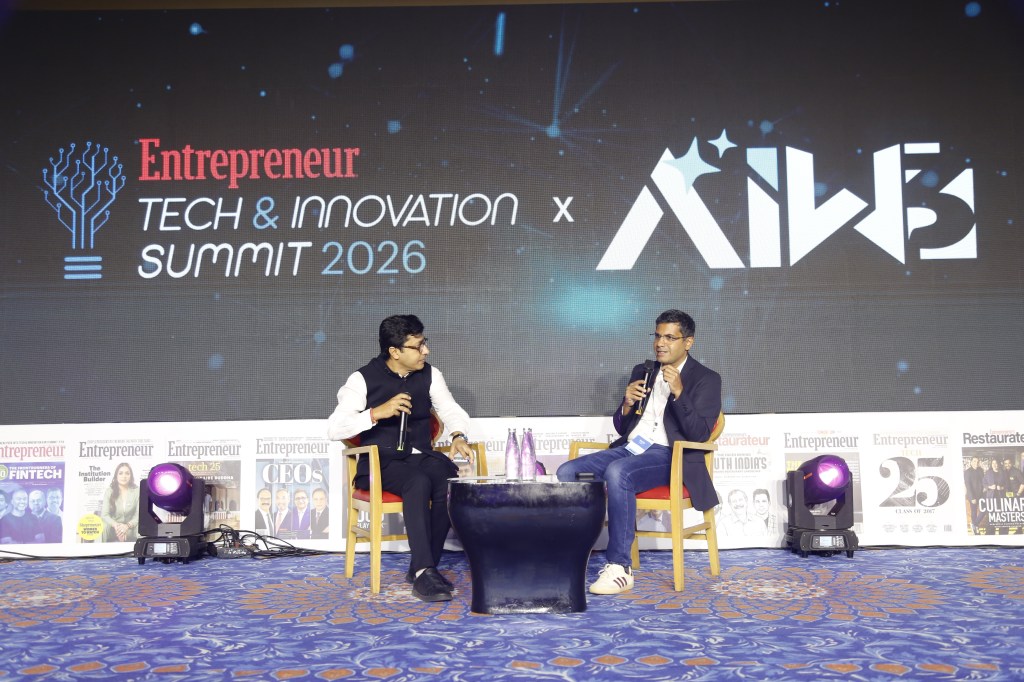
At the recently concluded Tech & Innovation Summit by Entrepreneur India, a fireside chat with Rahul Chari, co-founder and CTO of PhonePe, and Sachin Marya, Editorial Director, Entrepreneur India, a clear narrative emerged: India’s digital payments story is no longer about experimentation; it is about scale, infrastructure, and the next frontier of financial inclusion.
Chari began by reflecting on PhonePe’s 10-year journey, framing it within India’s broader digital transformation.
“We just completed 10 years as a company. I’m very proud of the first decade, and I hope that we are building an institution that outlasts us and is built for many, many decades to come,” he said. Chari noted that the company’s growth is deeply intertwined with the rise of Unified Payments Interface (UPI), which fundamentally reshaped consumer behavior and accelerated India’s transition into a digital economy.
PhonePe’s origins trace back to Chari’s time at Flipkart, where operational bottlenecks in payments revealed a deeper infrastructure gap.
“Unless we were going to solve payments at an infrastructure level, India is not going to transform into what we are talking about, a truly digitized economy of scale,” he said.
Chari cited examples like cash-on-delivery, “almost like a noose on the neck” at scale, and early failures of payment gateways during high-demand events like the Big Billion Day, where “every payment gateway in the country crashed.”
Over the past decade, PhonePe has evolved from enabling peer-to-peer transfers to embedding itself into daily financial behavior at a population scale.
“We’ve not just solved that, we’ve gone well beyond that,” Chari said, pointing to the next phase: deeper financial inclusion. With nearly half of India’s population on the platform, the challenge now lies in onboarding the next cohort, feature phone users, and non-digitally native consumers.
“This next set is still not digitally native, and it’s going to take a fair amount of innovation to actually bring them on board,” he noted. Chari highlighted the role of AI in breaking barriers of intimidation and enabling access through vernacular interfaces and simplified user experiences. Financial inclusion, he emphasized, is not just about offering products like insurance or lending, but ensuring that even basic digital payments become universally accessible.
On product design, Chari rejected simplistic binaries like metro versus rural users. “There are multiple Indias, and there are multiple Bharats,” he said, emphasizing the country’s diversity as both a challenge and an opportunity. Even within metros, language personalization remains critical. At the same time, scaling adoption in less digitally mature segments requires deeper behavioral insights.
Chari illustrated this with an early PhonePe feature that enabled users to transfer money between their own bank accounts.
“All we did was simply put a very, very basic experience, and we saw a 30 per cent jump in transaction volumes,” he said. Similarly, simplifying balance checks, now exceeding transaction volumes, helped build user trust. “These are the kind of small things that make the platform significantly more sticky.”
When it comes to monetization, Chari said, “We are an excellent user economy… but you need to focus on whether you’re solving something that somebody is ready to pay for.”
The winning model, according to him, is “extremely small ARPUs at huge amounts of scale.” By earning “a sliver of revenue on almost every transaction,” platforms can build sustainable, large-scale businesses.
Not all bets have paid off for PhonePe. Chari shared the failure of a “smart calculator” device for merchants, an innovation he remains proud of but admits was misjudged.
“We overestimated the size of that opportunity… and the business value to create from selling the device,” he said. In contrast, the now-ubiquitous smart speakers, simple, non-intrusive devices that confirm payments, have become both a utility and a revenue driver.
Looking ahead, Chari sees India’s next decade being defined by efficiency gains powered by foundational digital infrastructure, Aadhaar, mobile internet, and UPI. “What the next 10 years is going to actually help India significantly is the leverage of technology to drive hyperscale efficiency,” he said, pointing to sectors like healthcare, education, and government services.
AI, in particular, will transform high-consideration financial decisions. “The way research is done today… is going to significantly transform with AI,” he said, especially in areas like insurance, investments, and credit. These “research-oriented services,” where decision-making is complex, represent the biggest opportunity for disruption.
Chari also addressed the long-standing debate of fintech versus banks, firmly positioning PhonePe within a collaborative ecosystem. “We’ve proved that there is a genuine partnership model,” he said.
On the issue of fraud, a key concern in digital payments, Chari emphasized close collaboration with regulators like the Reserve Bank of India. Efforts span user education campaigns to technology integrations such as Mule account detection and telecom-based fraud signal tracking.
“Connected networks of technology… are a very good example of how we actually do that,” he said.
Closing the conversation, Chari shifted focus to a broader societal imperative: entrepreneurship. “We have to do everything to actually grassroots build more and more entrepreneurial spirit across the country,” he said.
At the recently concluded Tech & Innovation Summit by Entrepreneur India, a fireside chat with Rahul Chari, co-founder and CTO of PhonePe, and Sachin Marya, Editorial Director, Entrepreneur India, a clear narrative emerged: India’s digital payments story is no longer about experimentation; it is about scale, infrastructure, and the next frontier of financial inclusion.
Chari began by reflecting on PhonePe’s 10-year journey, framing it within India’s broader digital transformation.
“We just completed 10 years as a company. I’m very proud of the first decade, and I hope that we are building an institution that outlasts us and is built for many, many decades to come,” he said. Chari noted that the company’s growth is deeply intertwined with the rise of Unified Payments Interface (UPI), which fundamentally reshaped consumer behavior and accelerated India’s transition into a digital economy.

Prince Kariappa • Features Content Writer
Entrepreneur Staff