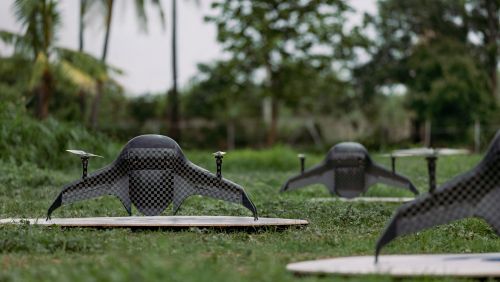
TIS 2026: Airborne & Autonomous, Intelligent Systems, Algorithmic Command and the Future
With global supply chains actively seeking alternatives to China, Indian startups have a strategic opening to dominate critical subsystems, from sensors to autopilots.
Opinions expressed by Entrepreneur contributors are their own.
You're reading Entrepreneur India, an international franchise of Entrepreneur Media.
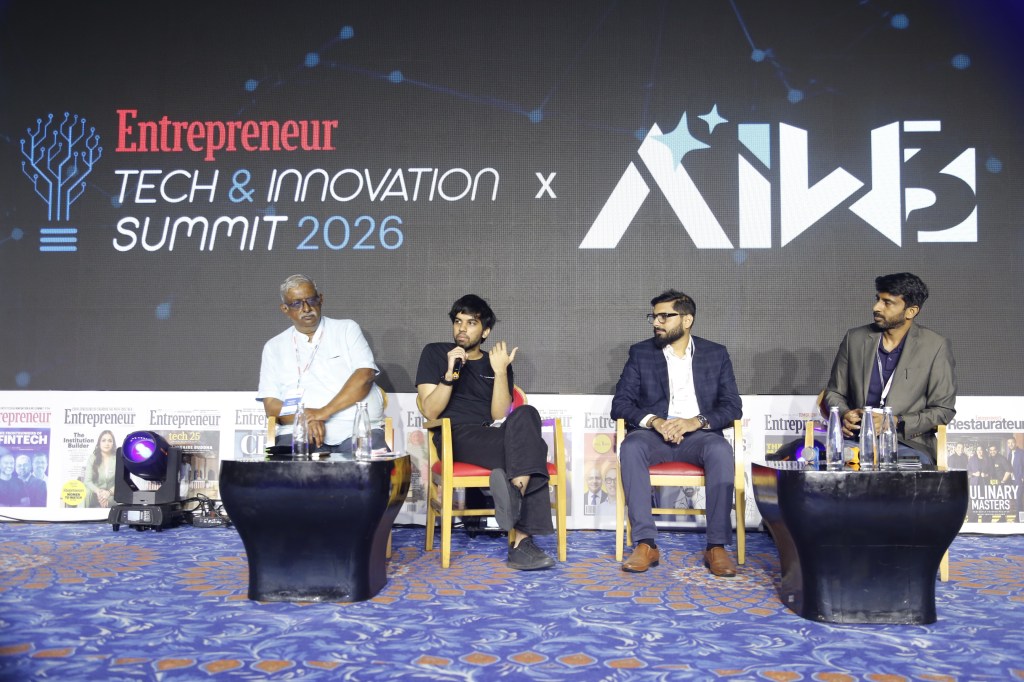
At a time when geopolitics is increasingly being shaped by asymmetric warfare, drones have moved from niche military assets to strategic tools. That shift was at the center of a panel discussion at Entrepreneur India’s Tech & Innovation Summit 2026, where industry leaders unpacked how economics, cybersecurity, and policy are redefining the drone ecosystem across both defense and civilian applications.
Ezhilan Nanmaran, Head of Product and Strategic Partnership at ideaForge, pointed out that public awareness of drones has surged. “The mainstream media has covered the Ukraine-Russia and Middle East conflicts so much that people now talk about drone specs like Android phone specs,” Nanmaran said.
But beneath that visibility lies a fundamental shift in the economics of warfare. “If you look at the ratio, a USD 20,000 drone versus a USD 2 million missile, it’s nearly 200:1. The whole war game is boiling down to economics.”
That cost asymmetry introduces new vulnerabilities. Sai Pattabiram of ZUPPA Geo Navigation Technologies said that weaponized drones are only as effective as their resilience to cyber threats.
“A drone is essentially a flying computer; unless you ensure it cannot be hacked, spoofed, or redirected, you yourself become the target,” he said, highlighting the growing importance of electronic warfare.
“Hacking, spoofing, jamming, these are now central to modern conflicts. We’ve built a completely indigenous, patented autopilot system… and supplied over 500 cybersecure drones to the Indian Army in the last three months,” said Pattabiram.
The conversation also highlighted how quickly battlefield needs evolve, with Nanmaran noting that capabilities once overlooked are now essential.
“Two years back, we realized electronic warfare would be critical… but there were no takers. Two months later, after operational realities changed, every requirement began demanding EW-resilient systems,” said Nanmaran.
Santosh Mishra of IG Defence brought in a frontline perspective on India’s preparedness. “When operations escalated, the Indian Army did not have short-range offensive drones… we were challenged to deliver, and we did,” he said, adding that his firm has since supplied over 5,000 kamikaze drones in just six months.
Stressing the urgency of self-reliance, he said, “India does not have an option; it needs to be self-reliant. Even an INR 10 lakh crore defense budget won’t suffice without indigenous capability.”
Yet, scale remains the defining challenge. Pattabiram contrasted legacy defense manufacturing with emerging realities: “We used to talk about hundreds or thousands of units a year. Today, the requirement is in millions.” Pattabiram said that India must rethink production models and regulations to enable rapid scaling, particularly for startups operating without heavy capital infrastructure.
While defense dominated much of the discussion, the civilian opportunity is equally transformative. Naman Pushp, Founder and CEO, Airbound, reframed logistics itself:
“Logistics today is built around the movement of people… but it doesn’t need to be. We’ve already moved from sending letters to sending data. Similarly, logistics can move from moving humans to moving energy.” Autonomous drone logistics, he said, could dramatically reduce costs and delivery times. “When you treat it as a physics problem, moving mass from point A to point B, you unlock entirely new efficiencies.”
However, regulation remains a bottleneck. “All current frameworks are built from an aviation perspective, not a drone perspective,” Pushp noted, pointing to restrictions like limited beyond-visual-line-of-sight operations and large no-fly zones around urban infrastructure.
The panel concluded with a clear consensus: the real opportunity may lie beyond building drones themselves. As Nanmaran put it, “There may be room for only a handful of OEMs, but the real opportunity is in components.” With global supply chains actively seeking alternatives to China, Indian startups have a strategic opening to dominate critical subsystems, from sensors to autopilots.
At a time when geopolitics is increasingly being shaped by asymmetric warfare, drones have moved from niche military assets to strategic tools. That shift was at the center of a panel discussion at Entrepreneur India’s Tech & Innovation Summit 2026, where industry leaders unpacked how economics, cybersecurity, and policy are redefining the drone ecosystem across both defense and civilian applications.
Ezhilan Nanmaran, Head of Product and Strategic Partnership at ideaForge, pointed out that public awareness of drones has surged. “The mainstream media has covered the Ukraine-Russia and Middle East conflicts so much that people now talk about drone specs like Android phone specs,” Nanmaran said.
But beneath that visibility lies a fundamental shift in the economics of warfare. “If you look at the ratio, a USD 20,000 drone versus a USD 2 million missile, it’s nearly 200:1. The whole war game is boiling down to economics.”

Prince Kariappa • Features Content Writer
Entrepreneur Staff