TIS 2026: AI 2030: Future Skills, Public Good & the Next Leap in Human Development
Experts also shed light on enterprise AI adoption maturity and highlighted the shift in required future workforce skills from data-centric to decision-centric problem-solving and governance.
Entrepreneur India
You're reading Entrepreneur India, an international franchise of Entrepreneur Media.
The 2026 edition of Entrepreneur India’s Tech & Innovation Summit, held last month in Bengaluru, dove deeper into the need for leveraging new-age technology, specifically AI, to help empower mankind. The panel also discussed the need for upskilling the workforce.
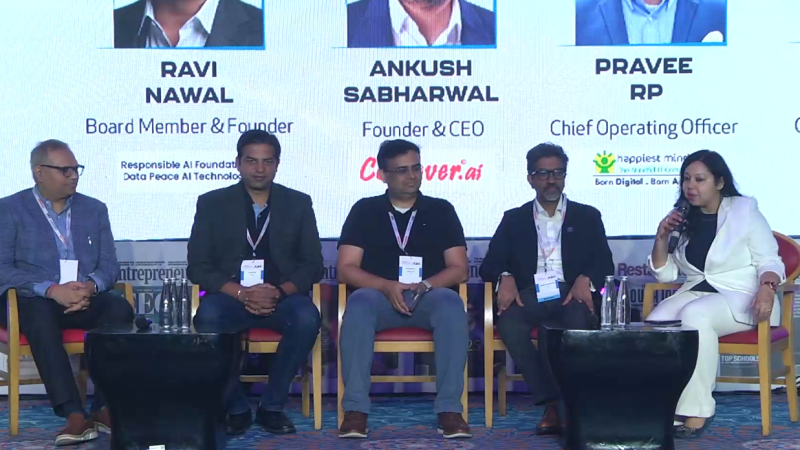
The panel discussion was joined by Ravi Nawal (Board Member & Founder, Responsible AI Foundation & Data Peace AI Technologies), Shashank Shekhar Thakur (VP – Business, CoRover), Praveen RP (Chief Operating Officer – Generative Business services, Happiest Minds Technologies), and Vikram Balakrishna (Chief Technology Officer- India, Atos).
Leading the conversation, Nawal called for inclusive and responsible AI, but also stressed the need to understand the nuances of what is “inclusive.”
“When we talk about responsible AI, we typically dimension it around things like: is this AI or AI solution inclusive? Right. And when we say inclusive, this is the “how” of the AI. Is it available in a format or a form factor where even the last person standing can use it? Is it available—so for example Edge, , [Shashank] was talking about Edge solutions that they are kind of building for the larger Indian population, the masses. So that is one way of looking at inclusivity,” Nawal said.
“The other way of looking at inclusivity is: can the person converse with AI in their own vernacular languages? Right. So is that access also available? The way we interface with devices, the technology in India, primarily if you look at it, the majority of the people are more comfortable using voice as a conduit. Right. So that interface, does it enable [that]? Which we find that a lot of the Western-led models do not have. So inclusivity is one prong,” he added.
He further said “transparency”, “governance”, and “accountability” as the key drivers to make the things more relevant and democratized. Nawal also said that India could also lead the Global South in AI with its unique approaches.
“..when a lot of the work is happening in the Global North, we are a market for them. But can we become a model for the Global South, when we establish these systems around AI? So that is the other prong that we need to think of as a nation,” he said.
Shekhar shed light on the need for building a sovereign AI. He added that the company’s BharatGPT is completely built in India, and such platforms allow Indians to have more control over their data as compared to platforms like OpenAI’s ChatGPT and Google’s Gemini.
“So we have—when we say it is a sovereign AI, sovereign LLM BharatGPT—we reach out to clients, the clients adopt us. The reason is that we are doing on-premises with them and we are making their data safe and private under their control, under their governance,” he said.
Shekhar further said that the company’s palm-sized device, a supercomputer-like, can be used by enterprises and rather than using GPUs, the device which has the Nvidia chip into it—the Blackwell, Grace Blackwell chip installed into it—that helps cater to a lot of use cases, ranging from governance to healthcare.
“So we are expanding that gradually in the market. But yes, the theme, the agenda behind all these innovations is that we remain sovereign. And as most of our clients are government enterprises, so yes, sovereignty is one of the models. And yes, as Ravi pointed out correctly, I think he covered most of the points: responsible AI, ethical AI, it has to be trusted. So all those things must be taken care of while implementing any AI solutions,” Shekhar noted.
Industry veteran Praveen chimed in with his perspective on the adoption of AI among the enterprises, and future in the Indian market known for its unique complexities, challenges, and opportunities.
“…this is a question that we deal with every single day. The context that I want to give is the inflection point in usage of Generative AI started with ChatGPT, right? So if I have to respond to this in two different variations: the first is how the adoption has changed over the last two years. So Year 1, it was mostly POCs (Proof of Concepts), it was mostly with skepticism about how the model providers will use my data and I will lose my competitive edge to my competition. Right, so that was the skepticism and then we’ve seen adoption gradually increasing,” he explained.
“The second part of my answer is, , even today I would want to classify the usage by five different layers of maturity. The first ones are still “fence-sitters” trying to see what others are doing. These are enterprises, these are not small companies. They don’t want to adopt, they want to go slow, they want to see successes that other companies demonstrate. The second one are “open to experiment.” They have allowed employees to bring in their own AI, right? So you can use AI to improve productivity, build POCs, but these POCs don’t go to production. The third level of maturity are those companies who are moving some of these POCs to production. See, there is a lot of difference in terms of building a POC—it’s very, very quick, it’s very rapid to build a POC—but it’s not so easy to take something to production,” he further said.
Praveen noted that the third level of maturity are companies that are taking these POCs to production whereas the fourth one is the companies which have certain things in production and making sure that one function or one business unit is seeing the benefit of deploying AI and want to scale it to multiple departments.
“And finally, the most mature ones are the ones which are ahead of the market. They are the leaders. Just like the digital transformation age where we saw digital leaders experimenting and demonstrating value, these are also the companies or the AI leaders who are at the forefront of adopting AI. So that’s my perspective on the adoption,” he said.
As mentioned above, Balakrishna explained what future skills the workforce will need now to stay relevant in the short-term or long-term future.
“…It’s no longer about implementing AI and all that. It’s happening in pockets and also there is a lot of capability we’re seeing in people understanding and I mean coming up with new use cases and stuff. So there are two sets of people clearly emerging. One, who have a theoretical awareness and are to a certain degree AI literate of sorts. And then there is the other set of people who are deep into it, who can understand what’s under the hoods and are looking at deeper aspects of, , how do you orchestrate? How do you manage and govern this whole deployment across managing ethics, responsibility and everything else also, and security as key guardrails,” Balakrishna said.
“So I would say I mean, if you saw the trend in terms of skill evolution also, there was a lot of focus on, I mean, understanding how to work with data, interpreting data. So a sort of data-centric approach was prevailing. And then now you see, I mean as Praveen mentioned, the last two years have been so rapid. Initially it was getting into that AI literacy or like usage mode and all of those things, there’s a lot of focus on that—gaining skills on tools, models. And then now it’s moved to workflows, right, where it’s getting more decision-centric. I think that is a very important nuance we all have to bear in mind and that is what is like the core of the skill which has to be developed, he added.
Balakrishna also pointed out that it’s not about what can be really accomplished from AI but how to tell what are the real challenges and when AI is not true.
“How do you add that contextual knowledge? How do you validate outcomes? How do you like, deal with edge cases? Those are the kind of skills which are going to be even more important and it’s no more about systemic thinking and all that—you have to gear up for the probabilistic world. And I would like to say that we ought to cultivate a mindset where you are able to shape better problems—I mean, define them very clearly—because the solutions can emerge and there are various means today. So that is going to be very vital, I mean for the next 5-10 years and of course, I mean keeping up with the trends and not getting bogged down by tools and like, the evolution—how do you manage in this messy ecosystem?” he explained.
Check out other deep dives from other panel discussions at the Tech and Innovation Summit 2026 below:
TIS 2026: AI Vision 2026
TIS 2026: The Future of Gaming, Powering Technology, Innovation & Digital Culture
The 2026 edition of Entrepreneur India’s Tech & Innovation Summit, held last month in Bengaluru, dove deeper into the need for leveraging new-age technology, specifically AI, to help empower mankind. The panel also discussed the need for upskilling the workforce.
The panel discussion was joined by Ravi Nawal (Board Member & Founder, Responsible AI Foundation & Data Peace AI Technologies), Shashank Shekhar Thakur (VP – Business, CoRover), Praveen RP (Chief Operating Officer – Generative Business services, Happiest Minds Technologies), and Vikram Balakrishna (Chief Technology Officer- India, Atos).
Leading the conversation, Nawal called for inclusive and responsible AI, but also stressed the need to understand the nuances of what is “inclusive.”

Entrepreneur Staff • Editor
Entrepreneur Staff
For more than 30 years, Entrepreneur has set the course for success for millions of... Read more