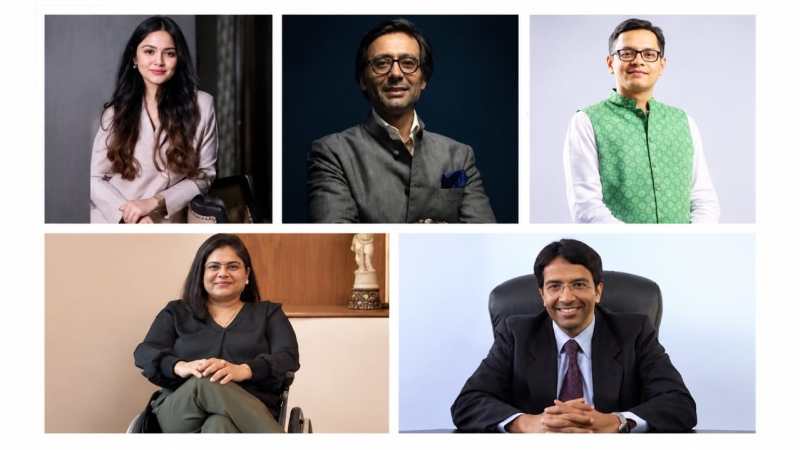
The New Custodians: How 5 Next-Gen Leaders Are Reshaping Legacy Businesses
Meet five next-generation leaders transforming legacy businesses while preserving their heritage, from jewellery and pharma to spirits, steel and manufacturing.
Founders
You're reading Entrepreneur India, an international franchise of Entrepreneur Media.
- The New Jewel
Tarang Arora, CEO & CREATIVE DIRECTOR, Amrapali Jewels
For Tarang Arora, jewellery was never simply a business. It was the backdrop to his childhood. Growing up in Jaipur, he was surrounded by gemstones, craftsmen, antique pieces and conversations about design and history. Some of his earliest memories are of watching his father work with jewellery and artisans and gradually understanding that every object carried a story. “Jewellery and the business were part of my everyday environment from a very young age,” says Arora, CEO and Creative Director, Amrapali Jewels. “What stayed with me was never just the commercial side of the business, but my father’s curiosity about history, craft and the cultural significance of jewellery.”
That early exposure eventually became a vocation. Family vacations often included art and jewellery exhibitions, reinforcing a fascination that would later become a career. Arora went on to study at GIA London, graduating as a gemologist, while also training in jewellery design and manufacturing. But formal education was only one part of his preparation. The deeper learning came from entering a family business that had spent decades building a distinctive identity around Indian craftsmanship.
Today, Arora is tasked with something perhaps more difficult than building a brand from scratch: making a legacy relevant to the next generation without diluting what made it special in the first place. “A heritage brand cannot exist only in the past. You have to constantly ask how that heritage can be made relevant to contemporary lives,” states Arora.
Founded in 1978 by Rajiv Arora and Rajesh Ajmera, Amrapali’s journey began with handmade wooden boxes, beads and silver jewellery sourced from different parts of Rajasthan. “The things I have been most careful to preserve are our relationship with Indian craftsmanship, our fascination with history, and our belief that jewellery can be a form of cultural storytelling,” he says.
What has changed is how that philosophy is expressed. The business is becoming more digital-first, while its retail footprint has expanded across airports, multi-designer stores and curated international retail environments. Contemporary design thinking is being brought into traditional forms, while the brand looks beyond its established customer base to engage a younger, more global audience. The challenge, Arora says, is to “modernise the expression without modernising away the soul.” That distinction perhaps best captures his approach to GenNext leadership.
Arora’s leadership style is different from that of his father, but he sees the contrast as complementary rather than confrontational. His father, he says, built the business through instinct, curiosity and an almost obsessive passion for discovering jewellery and craftsmanship. He was willing to take risks, move quickly and follow his instincts.
- The Next- Generation Prescription
Shivani Wagh, Joint Managing Director, Supriya Lifescience Ltd.
For Shivani Wagh, the family business was never an abstract concept reserved for boardrooms. It was something she watched being built. Growing up, Wagh saw her father put in the commitment, discipline and resilience required to build Supriya Lifesciences from the ground up. When she joined the company in 2014, she knew she was entering a business that had already been shaped by decades of work. Today, as Director at Supriya Lifesciences, Wagh represents a GenNext leadership approach that is less about replacing the past and more about extending it-into new markets, partnerships, capabilities and opportunities. Her ambition is clear: take the strengths that built Supriya Lifesciences and create a pharmaceutical company that is more diversified, globally relevant and ready for the next phase of the industry.
Unlike many second-generation leaders who grow up in the technical core of their family businesses, Wagh entered pharmaceuticals without a chemistry background. That could have been a disadvantage. Instead, she turned it into her first major test. Her education in management, commerce and international business gave her a foundation in marketing, business development and global markets. But pharmaceuticals demanded a different depth of understanding. She had to learn about manufacturing processes, quality systems, GMP, regulatory requirements, supply chains and the complexities of international healthcare markets.
“For me, the boldest move was perhaps deciding to step into an industry where I did not have a technical or chemistry background and committing myself to learning it from the ground up,” she says.
Wagh spent years learning from people across functions, understanding the business beyond her immediate responsibilities and gradually taking on larger roles in business development, market expansion and strategic decision-making. “I have learnt that a bold decision does not necessarily mean taking an unnecessary risk,” she says. “It means being adequately prepared, understanding the consequences and having the conviction to act when the opportunity is right.”
If her father’s leadership was shaped by entrepreneurial instinct and deep technical understanding, Wagh’s style is more collaborative and structured. She places considerable emphasis on communication, market intelligence, team building and global relationships. That doesn’t mean avoiding difficult decisions. “I believe in listening to different perspectives before making a decision, but once a decision is made, I believe in taking ownership of it.”
The pharmaceutical industry is undergoing its own transformation, and Wagh sees the opportunity in moving Supriya Lifesciences further up the value chain. “The objective is not growth for its own sake, but sustainable growth supported by the right capabilities, regulatory strength and product portfolio.” The company has publicly outlined a Rs. 1,000-crore revenue ambition for FY27, alongside investments in new facilities, product launches, R&D and automation.
- The Turnaround Man
Amit Dahanukar Chairman & Managing Director
Tilaknagar Industries Ltd.
For Amit Dahanukar, succession did not come with the luxury of time. He did not have the years of shadowing his father that many second-generation business leaders experience. He entered Tilaknagar Industries after his father’s death, stepping into a leadership role at a moment when personal grief and business responsibility collided. “There was no opportunity for a gradual transition or a period of learning alongside him,” Dahanukar recalls. “I was, in many ways, thrown into the deep end and had to find my own way.” What followed was not simply a generational transition. It was a corporate turnaround.
Tilaknagar Industries had been through an extended period of severe financial distress. Debt had climbed to around Rs. 1,200 crore by March 2019, while annual finance costs had crossed Rs.180 crore. Volumes had fallen, lender confidence had weakened and internal morale was at its lowest. For a next-generation leader, it could hardly have been a more difficult inheritance. But it was also the making of his leadership philosophy. “I had to develop conviction through experience rather than simply following an established playbook,” he says.
The first challenge was survival. The second was figuring out what kind of company Tilaknagar Industries wanted to become. Instead of attempting to compete across the entire Indian Made Foreign Liquor (IMFL) spectrum, Dahanukar and his team made a difficult choice: focus on the company’s heritage in brandy while moving up the value chain into the Prestige & Above (P&A) segment.
The logic was simple but difficult to execute: better margins, stronger brands and sustainable cash flows were more valuable than chasing volume for its own sake. “It meant consciously walking away from lower-margin volumes and staying focused on rebuilding margins, brand equity, and sustainable cash flows,” he says. The balance sheet needed an equally radical intervention.
Tilaknagar undertook debt restructuring, negotiated one-time settlements with lenders and raised fresh equity through preferential issuances from institutional investors during a period when market confidence remained fragile. The turnaround was neither quick nor linear. But it worked.
In January 2024, Tilaknagar Industries became net debt free. For a company that had once been classified as an NPA, the milestone represented more than financial engineering. It marked the restoration of credibility-and gave Dahanukar the freedom to think beyond recovery.
The next bold move was almost the opposite of the first. Having spent years repairing the balance sheet, Tilaknagar was ready to make a transformational acquisition. In late 2025, the company acquired Imperial Blue, a move that dramatically expanded its national footprint and changed its position in the Indian spirit’s market.
The acquisition took the company from a stable, growing business to one of India’s largest IMFL companies, giving it a pan-India distribution platform and the opportunity to scale its existing portfolio while building new brands and categories. “Imperial Blue gives us a much stronger pan-India platform and creates significant opportunities to scale our existing portfolio and build new categories and brands over time,” Dahanukar says.
The objective isn’t to abandon what Tilaknagar knows. It is to anticipate where consumers are going next.
- The Indian Whisky Globalist
Rakshit Jagdale MD. Amrut Distilleries
For many second-generation entrepreneurs, joining the family business begins with a familiar trajectory: shadow the founder, learn the ropes and gradually assume responsibility. For Rakshit Jagdale, the education was considerably more hands-on. After completing his BBA, he joined the business as an apprentice under his father’s watchful eye. The apprenticeship took him across the entire organisation-from production and distillation to sales, marketing, accounting, factory operations and supply chain. Then came an unusual classroom: the pubs of the UK. In 2002, he spent considerable time working the pub circuit across Newcastle, Glasgow, Edinburgh, Birmingham and London, gaining a first-hand understanding of consumers, drinking habits and the international spirit’s market. “That experience gave me a very different perspective on the business and helped me understand the consumer and the market from the ground up,” he says. It would prove particularly valuable because the business was about to embark on a journey that few Indian spirits companies had attempted at scale: building an Indian single malt with ambitions far beyond the domestic market.
“What really drew me to it was the opportunity to build something that was distinctly taking the Indian market to a global platform,” he says. The ambition wasn’t merely to produce another whisky. It was to establish the credibility of Indian single malt itself. That meant creating a product rooted in the Indian context, developing the category, and then convincing international consumers that whisky from India could stand confidently alongside established global names.
During his MBA at the University of Newcastle upon Tyne, he took that question into academia. He conducted sampling and tastings in Scotland and presented a thesis arguing that there was a market for Indian single malt. What began as an academic exercise eventually became a business conviction. “I presented a thesis around the opportunity for Indian single malt after conducting sampling and tastings in Scotland,” he says.
Nearly two decades later, the scale of the business reflects how far that original thesis has travelled. The company now has a presence across 58 countries globally and 24 states in India, with a growing portfolio of single malt expressions, most of which have received awards.
- The Woman Who Stayed the course
Sminu Jindal MD. Jindal Saw Ltd.
For Sminu Jindal, the business world was not something she discovered when she entered the boardroom. She encountered it as a child, watching her father at work and absorbing the atmosphere around him. She remembers being fascinated by the way he conducted himself, by the people, the operations and the energy of the workplace. There was no single moment when she decided she wanted to become a businesswoman. The ambition grew organically from years of exposure. “I simply loved the whole environment around it, the way he conducted himself fascinated me, and I think that’s where the seed was planted for me to want to become a businesswoman myself,” she recalls. But the path from that early fascination to leadership was anything but conventional. At just 21, Jindal was given independent charge of a business unit. Soon after, 11 of the company’s most senior employees walked out because they refused to report to a woman. For a young leader, it could have been a defining setback. Instead, it became a defining test. “Choosing to stay the course and continue leading despite that was, I think, one of the boldest things I’ve done,” she says. “And looking back, if that happened today, it would still make most people deeply uncomfortable.”
Jindal’s early leadership wasn’t built around a carefully designed succession plan. It was built on the factory floor. One of her earliest challenges was turning around the unit she had been given responsibility for. She knew that before people accepted her as a leader, she had to demonstrate that she could deliver. “I earned it by turning around my first unit,” she says. The challenge was amplified by the fact that she was a woman in a traditionally male-oriented industrial business-and used a wheelchair. “I needed people to believe I could actually do it, especially as a woman on a wheelchair stepping into a very male-oriented business,” she says. Once people saw the results, perceptions began to change. “That turnaround was a defining period for me; it was what made people believe in my ability as a leader.”
Her willingness to take calculated risks emerged early as well. One of the decisions she remembers most vividly was attempting 0.1mm rolling of steel in the company’s existing mills. The risk was significant. If the mill broke down, the company could have been left with nothing to roll. “I am unsure if at the time I fully registered how bold it was,” she says. But she took the chance.
Her other defining decision was less technological and more human. During the 1990s, when industrial relations could be volatile and strikes and labour unrest were common, she began speaking directly with workers-one-on-one and without intermediaries. It was unconventional, and not without risk. But it gave her something that organisational hierarchies often conceal: an unfiltered understanding of what was happening on the ground. “I made it a point to speak with our workers directly, one-on-one, without any filters,” she says. The experience changed the way she led.
- The New Jewel
Tarang Arora, CEO & CREATIVE DIRECTOR, Amrapali Jewels
For Tarang Arora, jewellery was never simply a business. It was the backdrop to his childhood. Growing up in Jaipur, he was surrounded by gemstones, craftsmen, antique pieces and conversations about design and history. Some of his earliest memories are of watching his father work with jewellery and artisans and gradually understanding that every object carried a story. “Jewellery and the business were part of my everyday environment from a very young age,” says Arora, CEO and Creative Director, Amrapali Jewels. “What stayed with me was never just the commercial side of the business, but my father’s curiosity about history, craft and the cultural significance of jewellery.”
That early exposure eventually became a vocation. Family vacations often included art and jewellery exhibitions, reinforcing a fascination that would later become a career. Arora went on to study at GIA London, graduating as a gemologist, while also training in jewellery design and manufacturing. But formal education was only one part of his preparation. The deeper learning came from entering a family business that had spent decades building a distinctive identity around Indian craftsmanship.
Today, Arora is tasked with something perhaps more difficult than building a brand from scratch: making a legacy relevant to the next generation without diluting what made it special in the first place. “A heritage brand cannot exist only in the past. You have to constantly ask how that heritage can be made relevant to contemporary lives,” states Arora.

Punita Sabharwal • Managing Editor, Entrepreneur India
Entrepreneur Staff
Punita Sabharwal is the Managing Editor of Entrepreneur India.