India Data Center Tryst: Powering AI, Efficiency, and Scale
Entrepreneur India’s Tech and Innovation Summit 2026, in its data center panel discussion, explored the current discourse around sustainability, policies and infrastructure shaping India’s journey
Entrepreneur India
Opinions expressed by Entrepreneur contributors are their own.
You're reading Entrepreneur India, an international franchise of Entrepreneur Media.
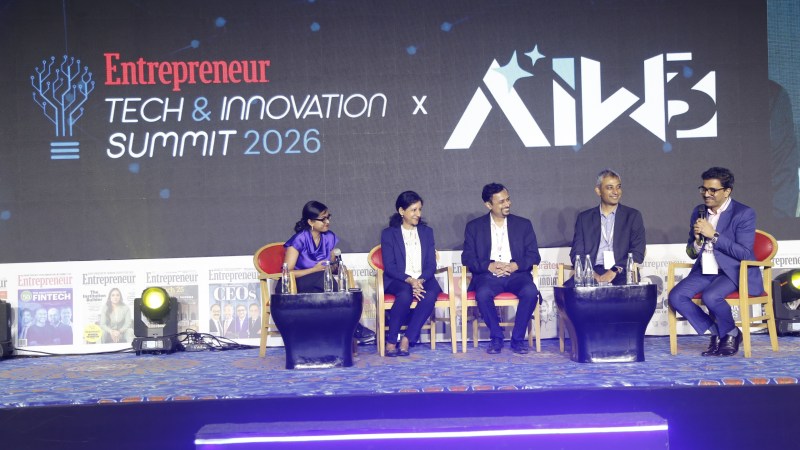
As India accelerates toward a $1 trillion digital economy, data centers have emerged as the foundational pillars of technology. Yet, their rise is accompanied by a paradox: they are indispensable for powering AI and digital services, but also criticized for being energy guzzlers. Entrepreneur India’s Tech and Innovation Summit in its data center panel discussion explored the current discourse around sustainability, policies and infrastructure shaping India’s journey.
As AI workloads intensify, concerns about power consumption have grown. Globally, data centers consume three to four per cent of electricity in the US, and nearly nine per cent in Singapore. In India, however, the industry’s footprint is still modest at 0.3 per cent.
“We are converting electricity to intelligence…concerns of the West sometimes get imposed on India. The West already had their share of growth and they tried to push us away from development. What’s happening with data centers in the West shouldn’t be a concern to India. We are creating green energy, our concern of data center power consumption is far lesser than what developed countries are doing,” said Sunil Gupta, co-founder, MD & CEO, Yotta Data Services.
The panel discussion emphasized that India’s data center industry has grown from 200 MW to 1.5 GW in under a decade, with projections of 7–9 GW by 2035. “Yet even at that scale, it will remain under one per cent of national capacity, thanks to India’s ambitious renewable energy expansion,” Gupta added.
Operators are adopting liquid cooling, advanced interconnects, and wafer-scale AI hardware to reduce energy intensity. Companies like Cerebras are pioneering architectures where memory and compute reside on the same wafer, cutting data movement and boosting efficiency.
Lakshmi Ramachandran, India country head & VP, Cerebras Systems, said, “Technology is a part of evolution for mankind. The problem isn’t about tech, it’s about how we use it. For larger workloads we need massive compute and designing efficient systems is the key to sustainability in data centers.”
“We do wafer-scale AI hardware, we don’t cut the wafer into chips to create GPUs or ASICs in the traditional sense. The entire wafer is productized as is. For large AI workloads, you need massive compute: a million cores, petabytes per second of network bandwidth, with both the network and memory on the chip. That’s why our inference can be up to 20 times faster than a traditional GPU,” she explained.
Metrics are evolving too; from teraflops per watt to tokens per second per watt, reflecting AI’s unique demands. Cooling innovations even extend to reusing hot water for heating buildings, turning carbon negatives into positives.
Navin Bishnoi, associate VP and India country manager, Marvell India, said, “The critical point is to move data faster. For sustainability of data centers, the infrastructure layer needs to be put in. It’s not just about software, it starts with the hardware and power is a design constraint rather than optimization problem.”
“Sustainability isn’t a choice anymore and new technologies are a must. With innovations coming up, how we design data centers have completely changed. Over time, chips have become much more powerful, performance per watt has overshadowed concern on the power side. In the future, we will see the benefits,” said Ananda Bhattacharjee, head, AI Enterprise, Lenovo Asia Pacific.
Scaling data centers requires supportive regulation. State governments have stepped up with dedicated policies, offering incentives from land approvals to cheaper power. The central government’s India AI Mission, with a $1.2 billion GPU fund, is designed to bridge demand gaps by subsidizing infrastructure. Currently, Mumbai, Chennai, Hyderabad, and Delhi dominate, with Mumbai alone hosting half the market. Tier-II and Tier-III cities may eventually see edge data centers, driven by 5G, IoT, and satellite internet. But until real-time use cases mature, financial viability remains limited outside metros.
India’s data center journey is not about choosing between growth and sustainability, but about embedding green practices into expansion. With AI adoption poised to scale, millions of GPUs and innovative architectures will be required. The challenge is to ensure that this infrastructure is efficient, ethical, and inclusive.
As India accelerates toward a $1 trillion digital economy, data centers have emerged as the foundational pillars of technology. Yet, their rise is accompanied by a paradox: they are indispensable for powering AI and digital services, but also criticized for being energy guzzlers. Entrepreneur India’s Tech and Innovation Summit in its data center panel discussion explored the current discourse around sustainability, policies and infrastructure shaping India’s journey.
As AI workloads intensify, concerns about power consumption have grown. Globally, data centers consume three to four per cent of electricity in the US, and nearly nine per cent in Singapore. In India, however, the industry’s footprint is still modest at 0.3 per cent.
“We are converting electricity to intelligence…concerns of the West sometimes get imposed on India. The West already had their share of growth and they tried to push us away from development. What’s happening with data centers in the West shouldn’t be a concern to India. We are creating green energy, our concern of data center power consumption is far lesser than what developed countries are doing,” said Sunil Gupta, co-founder, MD & CEO, Yotta Data Services.
Shrabona Ghosh • Former Senior Correspondent
Entrepreneur Staff
I write on corporates and lead a project called 'Corporate Innovations', wherein I cover large... Read more