AI is Not Just a Tool For Efficiency; It a Catalyst For Reimagining Industries: Kunal Purohit of TechM
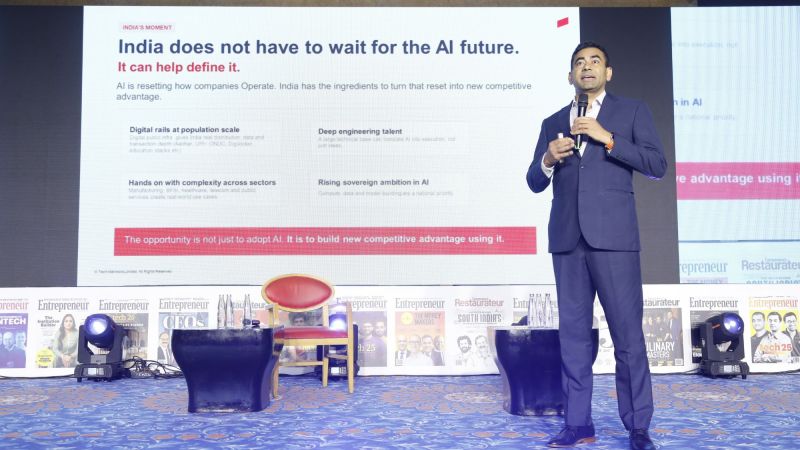
At TIS 2026, Kunal Purohit, chief digital services officer at Tech Mahindra. says, technology alone cannot drive transformation; it must be anchored in values, talent, and domain expertise.
Entrepreneur India
Opinions expressed by Entrepreneur contributors are their own.
You're reading Entrepreneur India, an international franchise of Entrepreneur Media.
India’s artificial intelligence (AI) journey is a once-in-a-generation opportunity; one that must be scaled responsibly.
At the Entrepreneur Tech & Innovation Summit, Kunal Purohit, chief digital services officer at Tech Mahindra, said, “We need to balance innovation with trust, transparency, and human leadership.”
His address underscored technology alone cannot drive transformation; it must be anchored in values, talent, and domain expertise.
He emphasized that AI is not just a tool for efficiency but a catalyst for reimagining industries, from manufacturing and healthcare to retail and financial services.
Trust & Transparency in AI
Purohit argued that scaling AI requires leaders to embed transparency into decision-making processes. Teams must feel empowered, not threatened, by automation. “Trust and transparency are not buzzwords,” he noted, “they are operational necessities in the AI era.” This positions ethical governance as a competitive advantage for Indian enterprises.
Talent & Strategies
Purohit highlighted that core engineering skills and domain expertise remain indispensable. He urged companies to invest in reskilling and upskilling, ensuring that talent strategies evolve to integrate AI seamlessly into workflows.
“In the age of AI, how you work, how you build, and how you scale are equally critical. It’s not a short-term program; it must be run sustainably for generations. Every action carries a duality: trust AI to deliver, yet remain mindful of the problem you’re solving and the impact you’re creating,” he said.
India’s AI journey is a leapfrog moment. With initiatives in digital infrastructure, cloud adoption, and data-driven innovation, India can set global benchmarks for responsible AI.
Enterprises seeking unparalleled benefits from AI must embrace the duality of doing both: building platforms with guardrails of security, trust, and responsible AI, while simultaneously solving real industry use cases. “The future lies in domain language models where business problems, domain expertise, converge to enable scalable solutions. Too many companies, in their excitement, choose either. The right approach is to balance both, because only in that duality can AI scale sustainably across the enterprise.”
The true power of AI is not just in boosting productivity. The duality lies in trusting AI for efficiency while deploying the freed-up hours to think creatively, to design new customer journeys, and to see industries as outsiders.
India’s AI journey is poised to redefine enterprise transformation, but its success hinges on balancing innovation with responsibility. Reports by McKinsey estimate that AI could add $500 billion to India’s GDP by 2030, provided enterprises integrate domain expertise with scalable platforms. Gartner similarly warns that by 2027, 80 per cent of enterprises will fail to scale AI if they neglect governance and talent reskilling.
Purohit’s emphasis on dualities efficiency and creativity, trust and transparency, platforms and use cases mirrors these findings. The industry consensus is clear: AI is not a short-term productivity tool but a generational opportunity. Companies that embed ethical guardrails, invest in reskilling, and harness AI to reimagine customer journeys will set global benchmarks. As Purohit concluded, “Productivity must fuel imagination.”
India’s artificial intelligence (AI) journey is a once-in-a-generation opportunity; one that must be scaled responsibly.
At the Entrepreneur Tech & Innovation Summit, Kunal Purohit, chief digital services officer at Tech Mahindra, said, “We need to balance innovation with trust, transparency, and human leadership.”
His address underscored technology alone cannot drive transformation; it must be anchored in values, talent, and domain expertise.
Shrabona Ghosh • Former Senior Correspondent
Entrepreneur Staff
I write on corporates and lead a project called 'Corporate Innovations', wherein I cover large... Read more