Economic Survey 2025-26 Outlines India’s Approach to AI and the Way Forward
The extensive mention of AI in the survey signals the government focus on the socio-economic impact of the technology.
pixabay
Opinions expressed by Entrepreneur contributors are their own.
You're reading Entrepreneur India, an international franchise of Entrepreneur Media.
Ahead of the Union Budget, the Ministry of Finance has released the Economic Survey 2025-26 which talks at length about the state of Artificial Intelligence in India, preparedness and also suggests the way ahead.
According to the survey, India has its own strengths as it enters the AI era. For instance, it’s among the top global contributors to AI research output and possesses a deep pool of technical talent in the field of artificial intelligence.
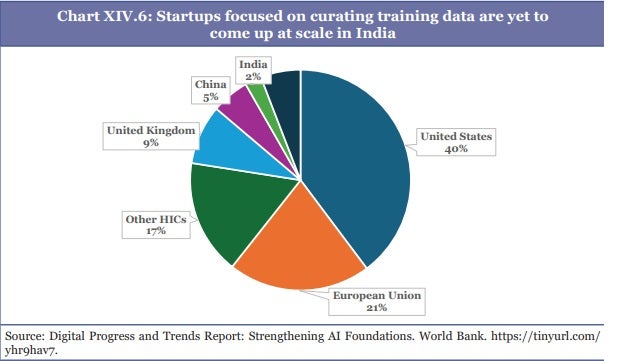
“The country also has a highly AI-literate labour force, outranked only by the United States as of 2024.27 India also holds a considerable potential comparative advantage in terms of its own domestic data sources. The heterogeneity and the scale of our country suggests the possibility of curating diverse domestic datasets across various sectors, including health, agriculture, finance, education, and public administration.” This asset remains underutilised, the survey noted.
Given the limited availability of cutting-edge compute infrastructure in India, the scarcity of financial resources for training large-scale models, and the relatively subdued private sector involvement in foundational AI research compared to global counterparts, a strategy cantered on developing foundational models is challenging. Therefore, a bottom-up approach to AI development is more appropriate and aligned with these existing constraints.
On human capital for AI, it says that “building models and applications, either fine-tuned or ground-up, capable of catering to local-level requirements needs two distinct skills, namely: algorithms and software engineering. India needs talent that understands the algorithmic issues involved in building models, along with an understanding of software engineering, to scale up and optimise models. This kind of knowledge is ‘underground knowledge’ that is not usually written down, and only those with hands-on experience of building models will understand these nuances. Accordingly, India must endeavour to attract people who have worked on large models and, in turn, have those with experience train others.”
You can read more about the AI in the survey here. Just to summarise some key pointers from above and survey overall, the survey calls for an OS-isation of the AI, making the technology more accessible in the form of a public good with shared cloud compute and structure and anonymised datasets. For instance, it says, there could be a platform like Github for mass accessibility.
For building human capital, it calls for models like earn and learn making upskilling more lucrative for youngsters. It also talks about the importance of governance in the form of accountability and overall regulatory oversight as data continues to flow from and to the country. It also suggests setting up a body that can track automation and ensure human workforce is not prematurely replaced.
To put things into perspective, let’s understand the survey on three fronts: preparedness, autonomy, and democratisation.
Starting with preparedness, Jaspreet Bindra, cofounder of AI&Beyond tells Entrepreneur India that India’s AI journey is focused on inclusion, jobs, and open-source innovation, with a strong emphasis on leveraging AI for societal benefit, especially in sectors like healthcare, agriculture, and education. The country’s approach is application-led, aiming to solve real-world problems rather than just chasing frontier models.
As far as job loss fears go, he adds that the AI adoption is expected to create more meaningful and dignified employment, rather than just replacing jobs. The focus is on upskilling and reskilling the workforce to augment human efforts.
“Initiatives like AI training programs, skill-based hiring, and collaborations with industry partners are underway to prepare the workforce for AI-driven jobs. India aims to develop its own AI solutions, reducing dependence on foreign technologies. The IndiaAI Mission is promoting open-source AI models, data sharing, and collaboration,” he said.
Democratisation, as mentioned above, will happen when the technology is equally available to everyone.
“AI autonomy can come when solutions are designed keeping in mind India-specific situations. AI-enabled precision farming & predictive analytics and tech can hugely benefit agriculture. AI tools for diagnosis, integrating AI with national health initiatives for telemedicine to provide access and solutions can give a boost to the system. India can achieve AI autonomy in agriculture, healthcare, and other sectors by building sovereign AI infrastructure, creating large-scale, open-access, domain-specific datasets, and fostering public-private collaborations. We need to build an AI ecosystem that is secure, inclusive, and tailored to its specific developmental needs,” Shrijay Sheth, founder at legalwiz.in told Entrepreneur India.
Democratisation as mentioned above can happen when the technology is available to everyone.
According to Bindra, a centralized code repository can be achieved by leveraging existing platforms that is building on existing open-source platforms like GitHub, community engagement by encouraging contributions from developers, researchers, and industry experts. And also it needs the government support in the form of funding, resources, and policy support for the initiative.
“A centralized code repository under IndiaAI can be achieved quickly by leveraging the existing vibrant open-source community in India, utilizing existing platforms like Open Forge/GitHub, and consolidating resources under the new “AI-OS” initiative. Leveraging India’s (one of the world’s largest) open-source developer communities + existing platforms, with clear governance & standards and ensuring data & compute access can give a robust boost. Initiatives like the IndiaAI Innovation Challenge and public-private partnerships can also help,” Sheth added.
Vikas Singh, Chief Growth Officer at Turinton Consulting, further explains: Make it mandatory for government funded projects to contribute usable code, not just documentation. Create incentives for private sector participation through procurement preferences. And appoint people who’ve actually shipped enterprise systems at scale, not formed committees to discuss feasibility studies.”
Ahead of the Union Budget, the Ministry of Finance has released the Economic Survey 2025-26 which talks at length about the state of Artificial Intelligence in India, preparedness and also suggests the way ahead.
According to the survey, India has its own strengths as it enters the AI era. For instance, it’s among the top global contributors to AI research output and possesses a deep pool of technical talent in the field of artificial intelligence.
“The country also has a highly AI-literate labour force, outranked only by the United States as of 2024.27 India also holds a considerable potential comparative advantage in terms of its own domestic data sources. The heterogeneity and the scale of our country suggests the possibility of curating diverse domestic datasets across various sectors, including health, agriculture, finance, education, and public administration.” This asset remains underutilised, the survey noted.