TTBS in Focus: Indian SMEs’ Need For Robust Cyber Resilience
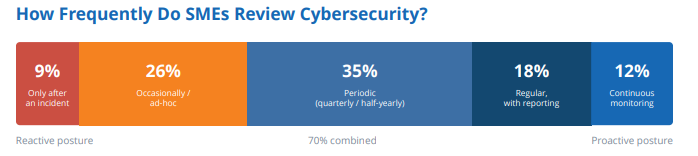
Research shows that 35% of Indian SMEs conduct cybersecurity reviews only quarterly or half-yearly, making it the single largest operating model.

pixabay
You're reading Entrepreneur India, an international franchise of Entrepreneur Media.
Tata Tele Business Services (TTBS) is taking an ‘integrated’ approach to provide cybersecurity to SMBs in India. The method – inclusive of connectivity, cloud, and security suite – is essentially making cybersecurity part of the wider technology environment rather than treat it as a standalone function.
TTBS’ push comes in the wake of increasing cybersecurity risks to smaller businesses as the overall ecosystem becomes more digital and larger.
In a newer world order wherein AI-driven cybersecurity risks are increasing, smaller businesses are said to be at more risk.
A June 2025 report from Prime Infoserv states that nearly 74% of Indian SMEs have suffered at least one cyberattack in the last year. Interestingly, nearly 60% of affected SMEs were unable to recover fully, which even led to the shutting down of the business altogether. Just 13% of Indian SMEs have a formal cybersecurity policy.
ALSO READ: The Dawn of the Autonomous Cybersecurity Era & Risks To SMEs
A newer study conducted by Tata Tele Business Services & CyberMedia Research (CMR) puts things into perspective.
According to SME Digital Insights 2026 – a study spanning 800 IT decision-makers across Indian cities – many SMEs have established foundational security practices and are now progressing toward more continuous and proactive security models.
But there’s a massive gap.
Research shows that 35% of Indian SMEs conduct cybersecurity reviews only quarterly or half-yearly, making it the single largest operating model. Another 26% approach cybersecurity on an ad-hoc basis, responding only when an incident or visible disruption occurs.
ALSO READ: Why Are Standalone AI Security Platforms Under The Spotlight?
The report reveals that more than six in ten SMEs in India continue to operate with extended periods of limited or no continuous security oversight.
The operational consequences are already becoming visible. Among SMEs that experienced cybersecurity incidents, 19% reported business disruption or operational downtime, while 17% experienced data leakage or loss and 15% reported unauthorized access to systems or information.
The report notes that these outcomes reinforce that delayed detection is no longer confined to technology functions; it increasingly translates into business disruption, operational risk, and weaker organizational resilience.
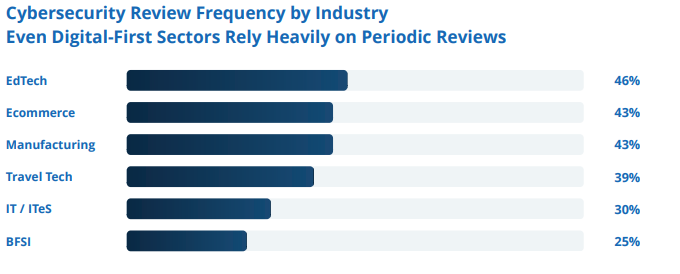
India’s digital infrastructure growth has not translated into cybersecurity governance maturity. This is seen across sectors, including IT, ecommerce and BFSI.
For instance, the report notes, nearly 30% of IT firms surveyed still deploy quarterly or half-yearly security reviews. In e-commerce, this improves to 43%, while in BFSI, despite stringent regulatory oversight, 25% of organizations continue to operate on the same periodic review cadence.
“These findings challenge the assumption that digital maturity automatically translates to cybersecurity maturity. Organizations that have invested substantially in cloud infrastructure, digital commerce platforms, and data-intensive operations are simultaneously running security review cycles that cannot detect threats operating on a timeline of hours or days,” the report says.
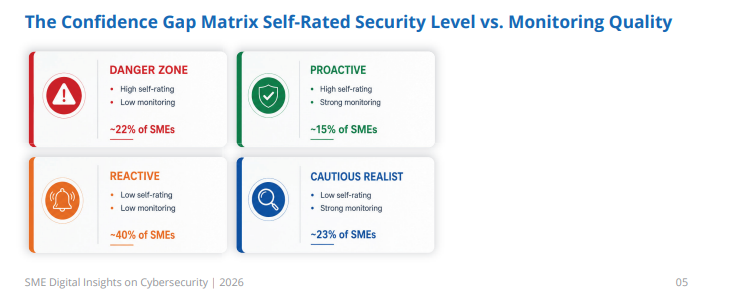
“The mismatch between perceived cybersecurity readiness and operational maturity becomes even more apparent when organizations assess their own security posture against the quality of their monitoring capabilities. While a relatively small group has successfully aligned confidence with continuous monitoring, many SMEs either underestimate or overestimate their operational preparedness, reinforcing the need for greater visibility-led cybersecurity models,” it continues.
Ecosystem Nudge
For SMEs, to have a resilient cybersecurity model, they require access to expertise rather than simply access to technology. An SME may have a capable IT team managing its applications, cloud infrastructure and user support, but building 24/7 monitoring, threat intelligence and incident response internally is neither practical nor economically viable.
The study reinforces this. Expertise and operational capability are cited as the biggest barriers to effective cybersecurity by 45% of SMEs, ahead of integration complexity at 43% and budget constraints at 23%. At the same time, only 33% of SMEs report having incident response capabilities in-house, while just 53% have internal cloud security expertise.
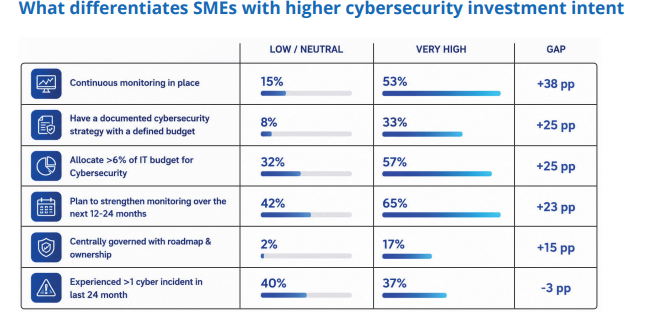
The encouraging trend was 84% of SMEs planning to increase cybersecurity investment over the next 12–24 months. The opportunity now is to help them channel that investment towards capabilities that improve detection, response and resilience rather than simply adding more technology layers.
TTBS in Focus
As mentioned above, TTBS’ objective through its comprehensive suite is to reduce the complexity of having to coordinate multiple technologies and providers.
“So, ecosystem-wise, managed security partnerships with technology partners become critical where specialized capabilities can be shared and accessed as a service. At TTBS, we are approaching this through a service-led model that brings connectivity, cloud and security capabilities together, backed by specialist expertise and continuous monitoring. This allows SMEs to access capabilities that would otherwise require significant investment in people, infrastructure and technology. Our aim is to make cybersecurity simpler to adopt and operate, while giving businesses clear visibility and accountability and helping them scale with confidence,” Rajesh Gupta, VP and Head – Cloud Business, Tata Teleservices, tells Entrepreneur India.
Gupta says that the company is bringing together managed security services, continuous monitoring, real-time visibility, rapid response and compliance support to give SMEs stronger protection without adding unnecessary complexity,” Gupta says.
“We have taken a platform led approach partnering with top quadrant security companies who are building their solutions on our platform and further we integrate this with our security operation centre(soc) focused on delivering reliable security solutions to businesses; backed with utmost trust and accountability. By combining technology with expertise and ongoing support, we aim to give businesses the confidence and resilience to grow in an increasingly digital environment,” he continued.
Conclusion
To sum it up, Indian SMEs face increasing cybersecurity risks given the exponential digital transformation. Though, it appears that there is a critical governance gap as many still rely on periodic reviews or ad-hoc response, despite knowing the threats and risks. There could be multiple reasons behind the slow uptake. It could be, as the study says, lack of ecosystem-level maturity, or lack of products/software suits that not only have cybersecurity tools by default, but also in budget.
As the study points out, a delayed detection and redressal are counterproductive if it has already caused major operational disruption and data loss. That said, a long-term organisation needs a fundamental shift towards continuous monitoring, high quality support and all-in-one platforms like what TTBS is trying to offer.
Tata Tele Business Services (TTBS) is taking an ‘integrated’ approach to provide cybersecurity to SMBs in India. The method – inclusive of connectivity, cloud, and security suite – is essentially making cybersecurity part of the wider technology environment rather than treat it as a standalone function.
TTBS’ push comes in the wake of increasing cybersecurity risks to smaller businesses as the overall ecosystem becomes more digital and larger.
In a newer world order wherein AI-driven cybersecurity risks are increasing, smaller businesses are said to be at more risk.

Entrepreneur Staff • Editor
Entrepreneur Staff
For more than 30 years, Entrepreneur has set the course for success for millions of... Read more