Why Indian Content Platforms are Betting Big on Gen AI
With GenAI now driving the Indian content platforms with dedicated platforms for creators and production houses, the next battleground could be for distribution and attention.

pixabay
Opinions expressed by Entrepreneur contributors are their own.
You're reading Entrepreneur India, an international franchise of Entrepreneur Media.
Artificial intelligence is fast turning into the foundation for Indian digital platforms as several of them have entered the microdrama race. And they’re investing in building on AI platforms to drive the next phase of growth.
VerSe Innovation, the parent company of Dailyhunt and Josh, recently launched SparkStation, which the company described as an AI Content Operating System that
carries an entire production from first idea to final cut inside a single system.
At the core of SparkStation is a model-agnostic AI layer that intelligently routes each creative task to the optimal AI model, ensuring consistency throughout at unprecedented economics: SparkStation can reduce, according to the company, the
production cost of a 60-second brand film by 90% from INR 10–25 lakh to INR 50,000– INR 75,000, while compressing production timelines from weeks to nearly 24 hours.
Just recently, Eloelo Group launched Dolphin AI, an agentic AI studio designed for giving creators end-to-end video production capabilities. Akin to some of VerSe’s capabilities, Eloelo aims to provide coherent production across multiple shots, allowing creators to work on a production as a whole rather than generate each shot independently. The objective is also quite similar which is reducing content production costs and time.
Another notable partnership has been Pocket FM’s with OpenAI. Pocket FM said it will integrate OpenAI’s APIs into various workstreams to accelerate its content creation and production infrastructure powering over 300,000 creators globally. PocketFM said it currently hosts over 100,000 AI-native audio series, with AI-led titles emerging as the fastest-growing segment, expanding at an average of approximately 30% month-on-month.
ALSO READ: Inside ShareChat’s Financial Turnaround & the Next Big Bet on Microdrama
Even the likes of JioStar are betting big on AI.
Vijay Seshadri, Chief Architect at JioStar, representing JioStar AI, had told Entrepreneur India about the company’s AI foray: “AI presents an opportunity to rethink both sides of that equation, as a foundational capability that could improve how stories are created, discovered and experienced. That’s why our approach has been much broader than deploying individual AI tools. We see AI as a layer that can sit across the entire entertainment ecosystem, from content creation and localisation to discovery, personalisation and audience engagement.”
Source: Redseer
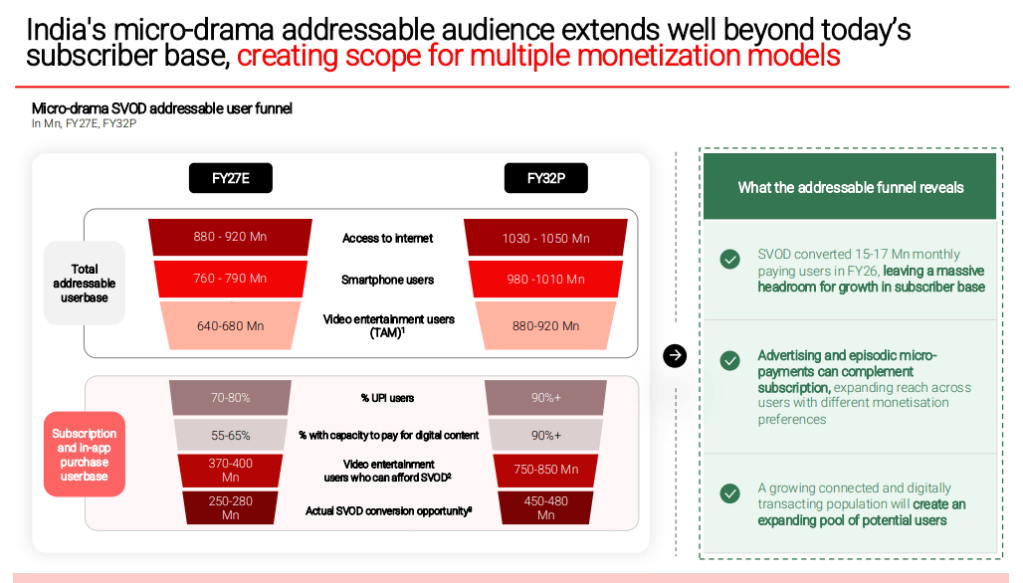
Microdrama + AI Growth
To understand the pivot, it’s important to note that microdrama is becoming increasingly popular in India.
According to a Lumikai report, published in April 2026, India’s microdrama sector is worth USD 300 million. This jump is phenomenal given the category barely existed one year ago.
“That single data point reflects a broader shift playing out across the ecosystem, as a new generation of users moves beyond passive consumption toward formats designed for how they actually use their phones,” the report said.
In the last one year or so, the space has seen nearly 450 million downloads, 100 million monthly active users, and is projected to be worth USD 4.5 billion by 2030, the report added.
And at the same time, demand for AI-driven content has also grown in the country.
According to a PWC report, PwC India’s findings of its Global Entertainment & Media Outlook 2026-2030 projects India’s entertainment and media (E&M) market is set to grow from USD 25.7 billion in 2025 to USD 36.7 billion by 2030. The report also highlights that AI is increasingly being applied across content creation, production, discovery, advertising, and audience engagement.
“Applications include pre-visualisation, de-ageing, multilingual voice modelling, virtual production, generative engine optimisation (GEO), personalisation, and recommendation systems. AI is also helping create opportunities to improve both efficiency and monetisation,” it says.
Clearly, there’s some convergence between the two sectors.
Speaking to Entrepreneur India, Umang Bedi, Co-founder, VerSe Innovation helps us understand the economics of it:
“The economics vary depending on the quality and complexity of each production, so the 90% reduction should not be viewed as a fixed number across every project. For certain workflows, we can bring a 60-second brand film that traditionally costs INR 10–25 lakh down to INR 50,000–75,000,” he told Entrepreneur India.
“To give creators greater visibility into these economics upfront, SparkStation has a budget estimator module that provides an estimate of the expected credit usage, and therefore the cost, of a particular project with approximately 70% confidence. This can be demonstrated directly through the platform. On the compute side, our orchestration layer helps optimise costs by routing each task to the model best suited for it, rather than relying on the most expensive model for every workload. Over time, we expect the economics to improve further as we increasingly use our own models alongside frontier and open-source models,” he continues.
Moreover, the company has set aside a fairly large sum ~ USD 30 million over the 24 months towards building GPU infrastructure and AI talent.
AI As Cost-Cutting Tool
One of the primary reasons microdrama platforms are adopting GenAI is that the economics of the category are fundamentally built around volume, experimentation and speed.
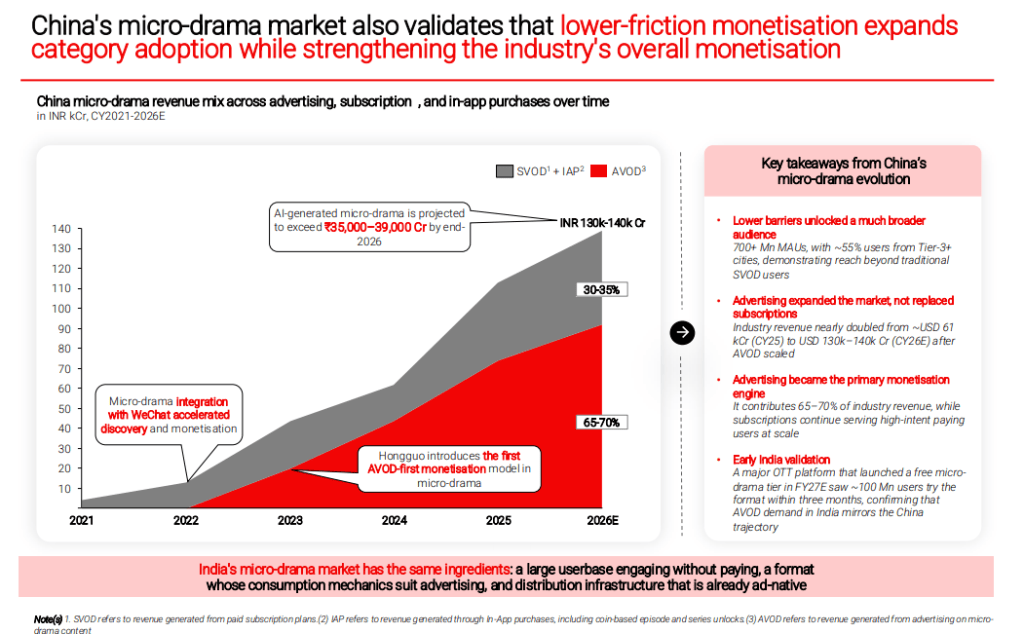
It’s quite similar to the Chinese model where the focus is on bulk-content model, which is essentially to produce a large number of titles, test what works, identify winning hooks and characters, and then scale the formats that show strong retention and monetization.
Experts believe that philosophy is now becoming even more powerful with AI.
Chinese regulators said that roughly 430,000 microdramas were released in the first eight months of 2026, around 13 times the total for the previous year, with more than 90% using AI technologies.
Source: Redseer
Speaking to Entrepreneur India, Abhinav Singla, Cofounder at Canvas said: “AI changes the economics because the expensive part of traditional production isn’t just the camera. It’s the entire production infrastructure, actors, locations, crew, sets, wardrobe, scheduling, reshoots, post-production and coordination.”
“There are now reports of mature Chinese AI pipelines getting production costs down to roughly $30 per finished minute at the generation/production layer, although that’s an optimized benchmark and shouldn’t be confused with an all-in studio cost. Other 2026 estimates put structured AI-native production much higher, roughly 50–350 per finished minute, depending on quality, workflow maturity and human involvement.”
There is also evidence of major production efficiencies before you even get to fully AI-generated shows. For example, Vigloo has said that allocating about 30% of its production budget to AI workflows allowed it to reduce production time from around three months to one month and production cost to roughly one-fifth.
But there’s a more important economic change: GenAI doesn’t simply make one show cheaper. It changes the economics of experimentation. If it costs USD 200,000 to produce a traditional 60–80 episode season, you have to make a major bet before you know whether the concept works. Current estimates for traditional vertical seasons are in roughly the 100,000–300,000 range, although actual budgets vary considerably by market and production quality.
With AI, you can potentially make multiple concepts, multiple visual treatments, different character approaches and even alternative scenes for a fraction of that cost.
Experts believe the Chinese approach becomes particularly interesting.
Content starts behaving like data. You don’t necessarily make one perfect show and release it with a huge launch. You can produce, measure, learn, iterate and scale.
Pocket FM has publicly discussed using AI for retention optimization, identifying potential blockbuster stories and A/B testing content, which is a good example of this broader data-driven content philosophy.
“And that’s where I have a personal concern. Netflix, HBO or a traditional studio generally makes a creative decision, produces the work and releases the work. The audience experiences a relatively fixed piece of IP. The microdrama model increasingly risks becoming: Create → release → measure → modify → release again → optimize for payment. That’s extremely powerful from a monetization perspective,” Singla added.
That said, generative AI is clearly lowering the barrier to enter the microdrama category. For production houses and creators, producing sophisticated short-form content will be much more accessible in the near future.
In such a scenario – when creation/production is easy, the challenge will be how it’s distributed without diluting the value of the content. At some point, according to experts, most Indian platforms will be battling it out for customers’ attention – akin to a brief social networking rush we saw a few years ago. The value for investors too will be on platforms that deliver a balance of discovery, audience trust, curation, distribution networks, brand identity, IP, and creator reputation.
“So I think the winning ecosystem will combine three things: Creator IP + AI production infrastructure + consumer distribution. AI will make production increasingly abundant. Distribution will remain scarce. And the real long-term moat will be the combination of audience relationship and differentiated IP. That’s ultimately why I believe the future isn’t simply “AI-generated content.” It’s creator-owned media IP, produced with AI and distributed through powerful consumer networks. And that’s a much bigger opportunity than simply making microdramas cheaper,” Singla concludes.
Artificial intelligence is fast turning into the foundation for Indian digital platforms as several of them have entered the microdrama race. And they’re investing in building on AI platforms to drive the next phase of growth.
VerSe Innovation, the parent company of Dailyhunt and Josh, recently launched SparkStation, which the company described as an AI Content Operating System that
carries an entire production from first idea to final cut inside a single system.