What’s Driving India’s Drone Space: Tech Breakthroughs, Enterprise Push, and More
According to a KPMG report, Drone-as-a-Service (DaaS) is helping enterprises manage expenses. Given the cost effectiveness of the commercial drones, a lot of companies are now subscribing to DaaS.
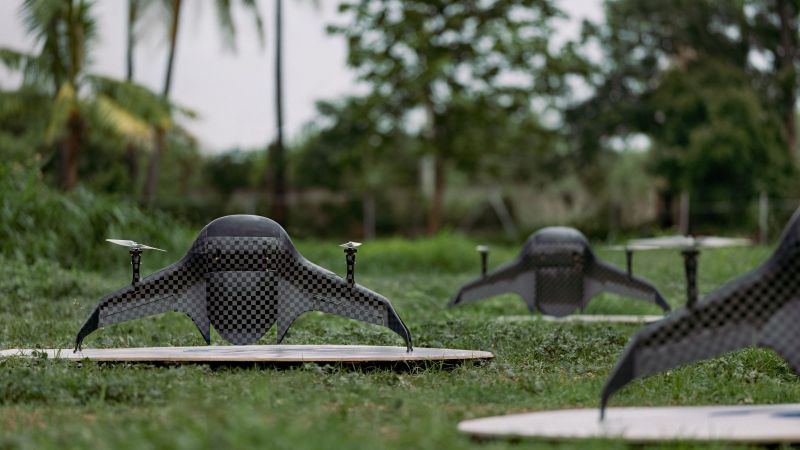
Airbound
Opinions expressed by Entrepreneur contributors are their own.
You're reading Entrepreneur India, an international franchise of Entrepreneur Media.
With more than 900 startups and a market projected to be worth USD 1.39 billion by 2030, India’s drone space is picking up momentum like never before.
To put things into perspective, India’s drone market was worth USD 0.47 Billion in 2025 and is set to record a massive 24% growth in another five years, according to a Markets and Markets report.
It’s well known that the defence sector is one of the major growth drivers. And with the prowess shown during last year’s Operation Sindoor, the segment is likely to grow manifold in the coming future.
In addition to defence, there are multiple factors that have put India’s drone sector on a hyperdrive.
The above-mentioned report cites growing application in agriculture, logistics, infrastructure along with initiatives such as Drone Shakti and PLI among others. From a technology point of view, improvements in capabilities like batteries and autonomy have also played a big role.
Before we hold forth, let’s take a look at the key regulatory reforms that have helped fast track the drone segment.
Regulatory reforms
Last year, the government slashed the GST on unmanned aircrafts (drones) reduced from 18 percent – 28 percent to a uniform. The objective is to push wider adoption of drones across sectors while also boosting domestic manufacturing under the Make in India and Atmanirbhar Bharat initiatives.
The GST rate is applicable on all kinds of drones whether they come with cameras or not, eliminating the ambiguity in classifications.
The GST restructuring is supposed to complement the government’s PLI schemes. It’s worth noting that the country’s first PLI scheme for drones and drone components has concluded the first cycle, and that the government is now working on the second iteration of the Mission Drone Shakti. In the first round, the government had allocated an INR 120 crore financial outlay.
Some of the companies that got benefited from the PLI scheme are: IdeaForge Technology (Mumbai), Dhaksha Unmanned Systems (Chennai), IoTechWorld Aviation (Gurugram), Omnipresent Robot Technologies (Gurugram), and Raphe Mphibr (Noida), among others.
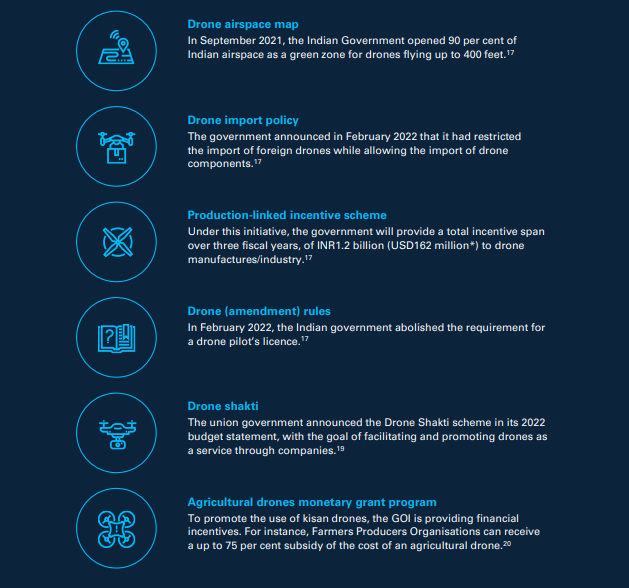
Source: KPMG
“The drone sector has experienced rapid growth, with turnover increasing seven-fold under the PLI scheme for Drones Drone Components. Driven by MSMEs and startups, this success has attracted significant investments and job creation, positioning India as a global leader in drone manufacturing,” according to a Ministry of Commerce & Industry statement last year.
Rise of Commerce Drone Sector
Not that drones did not exist a while back. For years, we saw their sporadic implementation in the above-mentioned industries while the majority was being driven by the defence sector.
According to a PwC report, drones are finding applications in several categories including infrastructure, agriculture, transportation, and security.
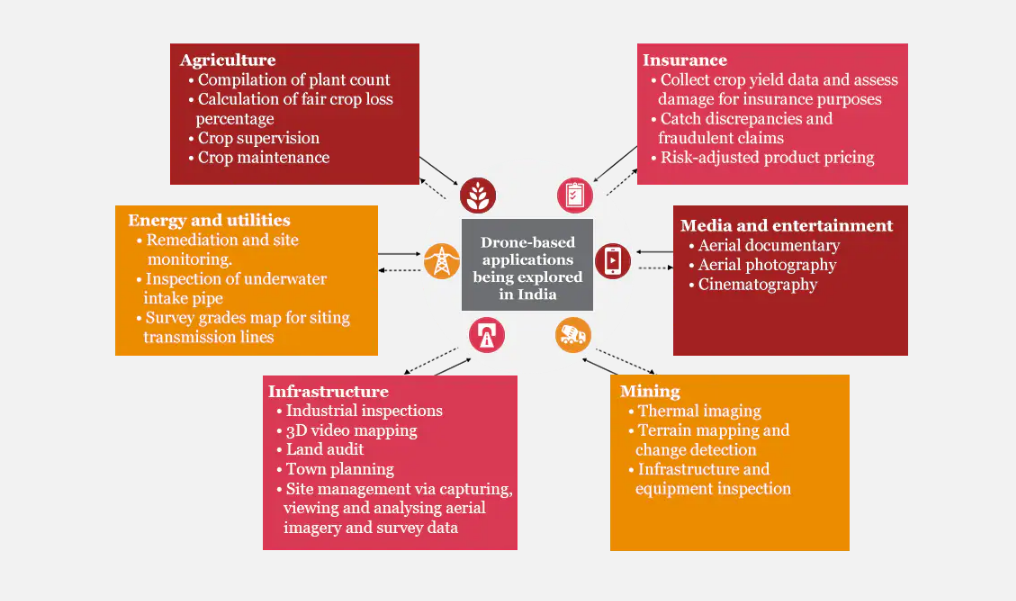
Source: PwC
Technology Breakthroughs
But what exactly boosted the commercial space? One of the drivers is the technology breakthrough.
Airbound founder and CEO Naman Pushp tells Entrepreneur India that factors like autonomy, electric propulsion and aircraft weight have made this possible.
“For most of aviation’s history, you needed a pilot, so an aircraft had to be large enough to spread that cost across a lot of payload. Autonomy removes that constraint. Electric propulsion makes smaller aircraft more efficient, and advances in materials and computing let us build aircraft that are radically lighter,” he said.
“That changes the economics. Our aircraft weighs 1.5 kg and carries 1 kg of payload, compared with roughly 4 kg of aircraft for every 1 kg of payload for the typical delivery drone. Our next aircraft is designed to weigh less than the cargo it carries. Once you solve for weight, flight starts becoming a practical logistics option rather than a premium service,” he continued.
It is worth understanding that modern commercial UAVs favor Vertical Takeoff and Landing (VTOL) and with better wing designs, it’s become possible to use lesser energy as compared to the older generation UAVs. In addition to payload capabilities, newer UAVs are backed by edge AI hardware and computer vision, enabling better management.
SkyeAir CEO Ankit Kumar dives deeper into this as he shares four critical technology and operational breakthroughs:
“First, high-precision sensor suites—including RTK GPS, optical flow cameras, and miniaturized solid-state LiDAR—became lightweight, power-efficient, and cost-effective, allowing smaller aircraft to navigate complex spatial environments without wasting crucial payload capacity.
Second, onboard edge computing and physical AI enabled real-time computer vision and local path re-routing directly on the aircraft, eliminating the latency risks associated with off-board remote control.
Third, advancements in battery chemistry now yield higher energy densities (~250–300 Wh/kg), paired with multi-redundant battery management systems and emergency ballistics (parachutes) that meet stringent airworthiness criteria over populated zones.
Finally, the industry shifted from manual, single-pilot operations toward automated ground infrastructure (such as Skye Pods) and digital Unmanned Traffic Management (Skye UTM) platforms. This transition solved the human labour bottleneck, making commercial aerial logistics cost-competitive for the first time.”
High Scale
To scale commercial drone operations globally, operator-to-aircraft ratios must evolve from 1:1 (one pilot per drone) to 1:N, where a single operator monitors a fleet swarm.
Software stacks and Unmanned Traffic Management (UTM) platforms are already close to making this the commercial standard.
Modern UTM solutions integrate algorithmic collision avoidance, dynamic geo-fencing, and automated contingency routing. If an aircraft encounters unexpected headwinds, bad weather, or an unannounced restriction, the software automatically recalculates an alternate route or directs the unit to a safe landing zone without human intervention.
“While software platforms like Skye UTM natively support 1:N fleet oversight today, widespread implementation is bottlenecked primarily by regulatory frameworks rather than technology. Full, multi-drone autonomous fleet control over urban centres is roughly 12 to 24 months away from becoming an everyday regulatory standard as certification protocols mature,” Kumar tells Entrepreneur India.
Pushp further explains: “We’re already moving in that direction. RUDRA allows a single operator to manage more than 100 aircraft at once, with real-time fleet visibility and deconfliction. But I don’t think the end state is about removing humans completely. It’s about changing what humans do.
Today, an operator manages individual flights. At scale, the operator manages the system, flight planning, weather, traffic, exceptions and safety, while the aircraft handles the routine parts autonomously.
That shift is critical because you cannot build a network of 10,000 flights a day with one person attached to every aircraft.”
Healthcare Meets Drones
Interestingly, healthcare space has become one of the top adopters of drones.
Earlier this year, Airbound had entered into a partnership with the Andhra government to set up a scalable aerial logistics network across the Amaravati capital region.
According to a joint statement, the initiative is expected to begin with operations in Guntur, with both parties working towards enabling 10,000 daily drone flights across Andhra Pradesh over the coming year.
“Supporting this effort is Airbound’s blended-wing-body tailsitter aircraft, built from lightweight carbon fiber. Weighing just 1.5 kg, the TRT offers a payload ratio of 1.5:1, compared to the industry standard of 4:1, making it one of the most efficient logistics platforms in use today. Designed for large-scale aerial logistics, it can deliver goods at costs as much as 20 times lower than conventional methods, enabling fast, reliable and affordable access across a wide range of geographies,” the statement added.
Pushp adds, “Healthcare is the clearest ROI today, and it’s the easiest case to make: the value of time is high, the payload is light, and a delay has real consequences.”
“With Narayana Health, we’ve completed more than 1,000 diagnostic-sample flights with zero mission failures. A route that took three to five hours by road now takes about seven minutes. The clearest sign it works: Narayana’s new Banashankari hospital was designed without its own diagnostic lab, because samples fly to a central one instead. When a customer restructures a building around your service, the ROI question is already answered,” he said.
“None of this demand has surprised us. Our goal is to move all movement to the air, across every sector and every segment, healthcare is a great starting point. The stakes are high, the value is obvious, and it’s a natural proving ground for new technology. Commerce, both e-commerce & quick commerce, where distribution and logistics are the backbone of the sectors, is why in Andhra Pradesh we’re already building the network across healthcare, logistics and e-commerce, connecting Amaravati, Vijayawada and Guntur, with the ambition to reach 10,000 flights a day,” he continued.
In a similar vein, the ePlane Company teamed up with Apollo Hospitals Enterprise Limited to introduce electric air ambulances and medical delivery drones. The partnership aims to connect emergency patients across urban corridors and remote locations to trauma care.
For SkyeAir too, healthcare is currently showing some of the most immediate ROI, especially for time-sensitive medical logistics such as diagnostics, blood components and vaccines, where faster transportation can make a significant operational difference.
“We are also seeing strong demand from e-commerce, quick commerce and postal services. In e-commerce and Q-commerce, drones can move packages between warehouses, fulfilment centres, dark stores and distribution hubs, helping bypass road congestion and improve delivery predictability. Postal services are another promising area, particularly for remote and difficult-to-reach locations, where drones can connect distribution points more efficiently. The larger opportunity is to integrate drones into existing logistics networks rather than treating them as standalone delivery systems,” he added.
While the adoption by the segment is welcome, the sector needs more attention as Push mentions that any delay has real consequences. For drone firms, the biggest challenges are speed, temperature control, payload safety, and reliability. Blood products, organs, and diagnostic samples often require strict cold-chain conditions, careful handling, and minimal transit time. The payload also needs secure, impact-resistant packaging with continuous monitoring of temperature, location, and container status.
Kumar says drones can address these challenges by enabling fast, point-to-point delivery, particularly in remote or congested areas. Beyond healthcare logistics, they can also act as a critical first responder on highways and national roads, reaching accident sites quickly to assess the situation, deliver emergency medical supplies, and support response teams before conventional emergency services arrive. The focus, therefore, is not just on faster delivery, but on building a safe, reliable, and digitally monitored healthcare and emergency-response network.
Enterprise Moat
The successful deployment in the healthcare industry indicates the massive potential the drone space has.
According to a KPMG report, Drone-as-a-Service (DaaS) is helping enterprises manage expenses. Given the cost effectiveness of the commercial drones, a lot of companies are now subscribing to DaaS.
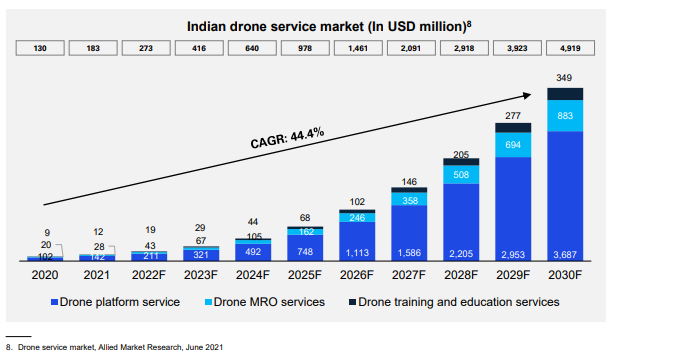
The report maps the DaaS space primarily into three categories: drone maintenance, repair and overhaul (MRO), drone platform services and drone training and education services.
“The drone service market in India was valued at USD130.4 million in 2020 and is expected to reach USD 4,918.9 million by 2030, at a CAGR of 44.4 percent. Drone service market segment, drone MRO services and drone training and education services are predicted to grow at a CAGR of 46.8 per cent and 45.2 per cent, respectively, from 2020 to 2030. By 2030, the combined share of these two segments is expected to be 25 per cent,” the report said.
As far as efficiency and cost-effectiveness go, according to the report, a typical planning survey and mapping would require ground-based manual data collection, manual analysis, and single-point decision-making. With drones, however, one gets automated analysis and collaborative decision-making, 10x faster and 10000x more data points on a digitised base for better plans, and resulting in overall cost per square kilometer going down by 45 percent.
Similarly, it estimates up to 90 percent saving for projects relating earthworks
management, and up to 40 percent for construction monitoring.
IdeaForge CEO Ankit Mehta had earlier told Entrepreneur India that the company was seeing a strong opportunity to build more stable and recurring revenue streams beyond defence sectors.
“This includes software-led platforms like FLYGHT CLOUD, where customers are increasingly looking for integrated solutions rather than just hardware, as well as drone-as-a-service models that can scale across enterprise and civil use cases. Its portfolio includes mapping and enterprise logistics.
It may be recalled that IdeaForge had made a stellar stock market debut in July 2023 – listing at a nearly 94% premium over its IPO price.
Capital & Economics
Another push has come from the increasing VC bet in the ecosystem.
According to Tracxn, Indian drone startups have collectively raised USD 791 million in venture capital money and private equity. Out of these, 42 are series A+ funded.
Some of the most funded startups in the space are NewSpace Research & Technologies (USD 73 million), Airbound (USD 50 million), and Garuda Aerospace (USD 49.5 million), among others. Ideaforge, for instance, has already listed in the public market. Some of the active investors in the space are General Catalyst, Blume Ventures, and Lightspeed.
IdeaForge, DroneAcharya (SME IPO), and Drone Destination are already listed.
“India’s commercial drone segment has shown an immense potential. VCs are now increasingly shifting their focus on deeptech segments like spacetech and drones. We already have space unicorns, and likely to see similar interest in other parallel sectors. Enterprise is one of the areas where drone companies are doing better given massive applications beyond defence and typical surveillances. For VCs, backing these companies makes sense as the market is massive. Moreover, in a longer-term we see larger ticket rounds for the segment along with support for smaller players. Like any segment, this also has potential for bigger returns at some point,” a Mumbai-based investor told Entrepreneur India.
Kumar adds that transitioning from pilot projects to sustainable, positive unit economics requires moving away from the “single package delivered directly to a back garden” consumer model. The scalable path relies on a structured Hub-Pod-Walker architecture.
“Under this architecture, autonomous drones handle high-density mid-mile transit between primary distribution centres (Hubs) and strategically placed automated landing pods (Skye Pods). Drones consolidate multiple packages per trip, bypassing road gridlock, while human couriers or ground robotics execute the final hyper-local leg,” he said.
Kumar also added that financial viability hinges on high asset utilization: an aircraft must execute 15 to 20 flights per day to amortize capital costs efficiently. Achieving this requires minimizing turnaround times down to under 3–5 minutes through automated docking pods and rapid battery-swapping systems.
Combined with software stacks that allow a single ground supervisor to oversee dozens of airborne units simultaneously, this operational model drives the cost per parcel lower than traditional two-wheeler road freight, according to the CEO.
Infrastructural challenges
Even as the ecosystem is thriving and shows great potential, there are some bottlenecks that need to be addressed to make the industry even more promising.
Experts believe that scaling Beyond Visual Line of Sight (BVLOS) operations requires a robust ecosystem of physical and digital infrastructure that extends far beyond the aircraft itself.
According to Kumar, currently, three major infrastructure bottlenecks slow down expansion.
First, there is a shortage of standardized, weather-proof physical ground infrastructure—such as automated landing pods (Skye Pods) equipped with precision landing beacons, automated payload release, and charging capabilities.
Second, digital infrastructure in low-altitude airspace (<400 ft) lacks dedicated radar coverage. Drones must rely on cellular (4G/5G) and satellite communications for telemetry and command-and-control (C2) links. Signal dead zones along urban canyons or rural valleys represent a significant operational hurdle.
Third, macro-level weather forecasts are insufficient for light aerial vehicles operating at low altitudes. Safe urban BVLOS operations demand hyper-local, real-time micro-weather sensing networks to detect wind shears, thermal updrafts, and micro-bursts around tall structures.
“The biggest bottleneck is still BVLOS approval at scale. Building the aircraft is only one part of the problem. A real delivery network needs to operate beyond visual line of sight, across multiple routes, safely and predictably. That requires regulators to have confidence in the aircraft, the operating system and the infrastructure around it,” Pushp explains.
“On the ground, turnaround infrastructure also matters. Battery swaps, payload loading and routine checks need to happen quickly so aircraft spend their time flying rather than waiting. That’s why our Andhra Pradesh rollout is being designed as a network, not a collection of individual drone routes, with route mapping, ecosystem partnerships, regulatory coordination and eventually interconnected drone corridors.”
The Sky Ahead
The sector is likely to undergo a natural evolution with no dramatic tipping point. Even as it’s at a nascent stage with good momentum, an ideal situation will be when the industry sees drones as commodity instead of novelty.
Pushp of Airbound says: “I don’t think it will happen as one dramatic moment. It will happen route by route, until people stop noticing the aircraft and start noticing what they enable. A hospital gets a diagnostic sample in minutes. A store can replenish several times a day. A business can serve customers farther away without needing a warehouse next door. Someone outside a city can access the same goods and services without distance being such a constraint.”
Kumar gives even a broader picture of what it may look like in the next three to five years: low-altitude aerial transport will transition from an innovative novelty into a routine layer of urban and rural infrastructure.”
“Skylines will gradually evolve to feature designated low-altitude aerial transit lanes, typically structured between 200 and 400 feet. Modern architectural standards will increasingly integrate automated landing pods, smart drop zones, and charging infrastructure onto the rooftops of commercial towers, residential complexes, and hospital facilities. For the general public, this shift will make same-hour transport routine. Urgent medical diagnostics, life-saving medicines, and critical e-commerce goods will move rapidly across cities, decoupled from ground traffic congestion. By shifting mid-mile freight into the sky, urban environments will benefit from quieter, less congested streets and cleaner air.”
With more than 900 startups and a market projected to be worth USD 1.39 billion by 2030, India’s drone space is picking up momentum like never before.
To put things into perspective, India’s drone market was worth USD 0.47 Billion in 2025 and is set to record a massive 24% growth in another five years, according to a Markets and Markets report.
It’s well known that the defence sector is one of the major growth drivers. And with the prowess shown during last year’s Operation Sindoor, the segment is likely to grow manifold in the coming future.