TIS 2026: What VCs Look for in Deep Tech & Emerging Startups
Deep tech investing is as much about patience and pattern recognition as it is about scientific rigor. And as venture capital leans back into its origins, the rules are being rewritten, once again.
You're reading Entrepreneur India, an international franchise of Entrepreneur Media.
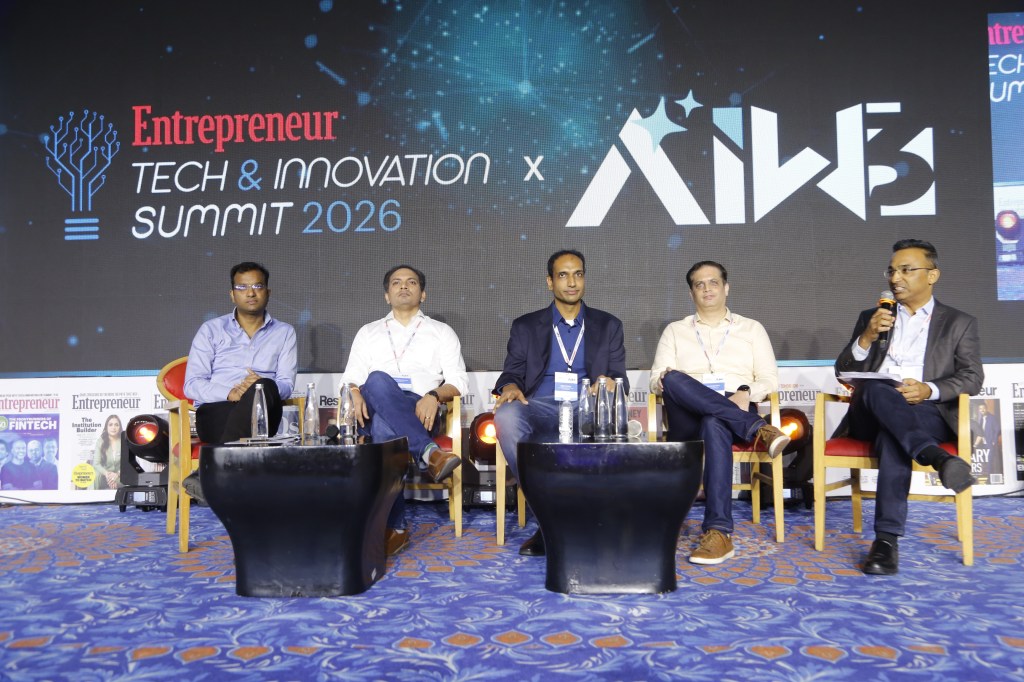
At a time when venture capital is rediscovering its original roots in deep technology, investors are once again grappling with questions that defined the earliest days of Silicon Valley: how to evaluate science-led startups, what constitutes a defensible moat, and whether timing can make or break a company.
Opening the discussion, Krishna Jha, Partner, Equirus InnovateX Fund, said, “Most of us here have cut our teeth in software, internet in the last 25 years… I guess Deep Tech was where VC started… and we’ve come a full circle.”
That ‘full circle’ is evident in how investors are thinking about deep tech today. For Manish Gupta, General Partner, growX ventures, the breadth of sectors itself signals the scale of opportunity. “We have done some Deep Tech in the last decade or so across AI, defense, robotics, semiconductors, genomics, space tech, biotech across the board,” he said, citing investments ranging from space-tech players like Pixxel and Bellatrix to defense and RF satellite companies.
Murali Krishna Gunturu, Partner, Inflexor Ventures, emphasized that the investment thesis has evolved beyond just IP-led businesses. “We want to invest in companies which are leveraging science, engineering and technology to build a product or a platform,” he said, pointing to investments into companies like Bellatrix, Nopo Nanotechnology, and Yakruta Life Sciences.
Yet, evaluating such startups, often pre-revenue and sometimes pre-product, requires a fundamentally different lens. Mandar Dandekar, Partner, Sorin Investments, framed it through the constraints of venture capital itself: “Funds have a finite time life… we have to return the capital back in say 10 to 12 years. For deep tech… semiconductor or space tech, robotics, they require that extra amount of time and hence planning for that early in your fund life… is important.”
Interestingly, not all investors are willing to take pure technology risk. “We don’t come in at an idea stage… we don’t take product risk,” Dandekar noted, highlighting a preference for early commercialization signals.
The conversation then moved to one of the most debated aspects of deep tech, intellectual property. While patents are often seen as the cornerstone of defensibility, Murali pushed back against that notion. “Are we too hung up on patents? No, not really,” he said. “More important than IP is what the value prop is that you are driving by using the IP.”
He illustrated this with Atomberg, where deep tech innovation translated into a 65 per cent reduction in power consumption for ceiling fans, “That is what I define as value prop.”
Gupta echoed the skepticism around early-stage patenting. “It just takes too many resources and time… there is nothing called a global patent,” he said, adding that enforcement is equally challenging. “Even if you find out it’s just too expensive to go after them.”
For corporate investors like Adarsh Sekhar of Lam Research, however, technical diligence can be the difference between conviction and caution. Recalling a quantum computing deal, he said, “On the surface, very promising… but once we did the deeper dive, we realized that the IP would not hold water beyond a point. So we ended up not investing.”
Beyond technology, one recurring theme was the importance of commercialization, a common blind spot for deep tech founders. “The tech part… is sorted,” Dandekar said. “What also is ideal… is a strong sense of commercialization, knowing how to price, whom to talk to.”
Murali said, “You can have the world’s best technology, but if you don’t know how to sell it, it’s like you having gold, but you don’t know that it is gold.”
This gap often shows up in founding teams dominated by technical talent. Gupta said: “A deep tech founder starts a company for the love of tech… it doesn’t come naturally to them” to engage in sales or customer conversations. Yet, in deep tech, early market feedback is critical because “it’s harder to pivot or iterate.”
Timing, too, remains an imperfect science. Reflecting on early bets in space tech and genomics, Gupta said, “We always thought this is the right time… and it’s always maybe a bit early.”
Finally, the panel touched on an often overlooked dynamic in India’s deep tech ecosystem, the role of the government as a customer. While traditionally seen as a bottleneck, that perception is shifting. “Decision making is faster… payments… are faster,” said Dandekar, pointing to structural improvements.
Murali added: “It’s not always a bad thing to have government as a customer… they can act as a beachhead for a fledgling startup.”
There was one clear takeaway from the discussion: deep tech investing is as much about patience and pattern recognition as it is about scientific rigor. And as venture capital leans back into its origins, the rules are being rewritten, once again.
At a time when venture capital is rediscovering its original roots in deep technology, investors are once again grappling with questions that defined the earliest days of Silicon Valley: how to evaluate science-led startups, what constitutes a defensible moat, and whether timing can make or break a company.
Opening the discussion, Krishna Jha, Partner, Equirus InnovateX Fund, said, “Most of us here have cut our teeth in software, internet in the last 25 years… I guess Deep Tech was where VC started… and we’ve come a full circle.”
That ‘full circle’ is evident in how investors are thinking about deep tech today. For Manish Gupta, General Partner, growX ventures, the breadth of sectors itself signals the scale of opportunity. “We have done some Deep Tech in the last decade or so across AI, defense, robotics, semiconductors, genomics, space tech, biotech across the board,” he said, citing investments ranging from space-tech players like Pixxel and Bellatrix to defense and RF satellite companies.

Entrepreneur Staff • Editor
Entrepreneur Staff
For more than 30 years, Entrepreneur has set the course for success for millions of... Read more