Semiconductor Innovation: India’s Strategic Chip Opportunity
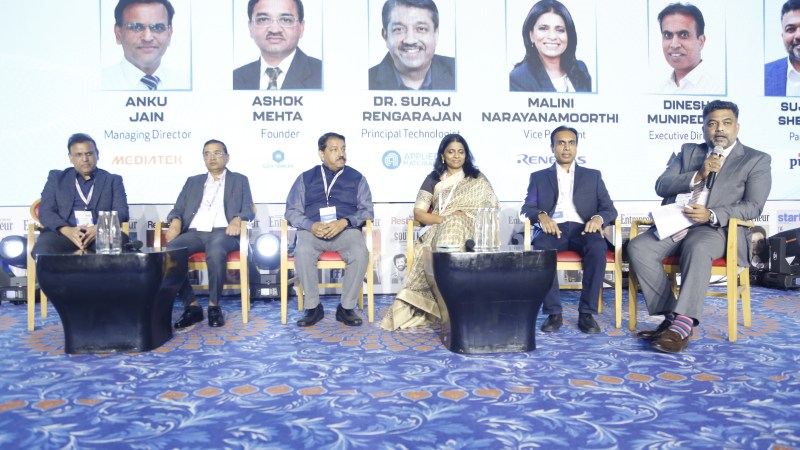
At Entrepreneur India’s Tech and Innovation show, the semiconductor panel discussion laid out a blueprint for how India can transform from a design hub into a chip powerhouse.
Entrepreneur India
Opinions expressed by Entrepreneur contributors are their own.
You're reading Entrepreneur India, an international franchise of Entrepreneur Media.
India’s semiconductor story is a rising chorus. At Entrepreneur India’s Tech and Innovation show, the panel titled “Semiconductor Innovation: India’s Strategic Chip Opportunity”, laid out a blueprint for how India can transform from a design hub into a chip powerhouse.
India already commands 20 per cent of global chip design talent, yet its manufacturing footprint remains modest. There is a need for homegrown fabless startups to move beyond services into intellectual property creation. MediaTek’s India journey has moved from 32 engineers in 2004 to over 1,000 today, contributing to global R&D across smartphones, TVs, automotive, and AI.
Anku Jain, MD, MediaTek India, said, “We need homegrown startups to support indigenous chip ambitions; we have to move from services to IP generations.”
Dr. Suraj Rengarajan, Principal Technologist, Applied Materials, said that India has raw talent, “We need to refine those talents in areas of inflection, and one such spot is advanced packaging in semiconductors.”
Rengarajan added that India must leapfrog rather than imitate, investing in pilot lines for advanced packaging and specialty chips like gallium nitride and silicon carbide critical for EVs and renewable energy integration.
Localization emerged as a critical theme. India still imports most raw materials from Japan and Malaysia. The panelists argued that developing domestic supply chains is essential. Ashok Mehta, founder, Suchi Semicon said that entrepreneurial risk is important. He revealed that he set aside INR 25 crore purely for R&D, knowing it could either dissolve or multiply into thousands of crores. His advice to the government is to encourage MSMEs and startups and recognize that semiconductors demand long-term capital burn. “To survive in the semiconductor industry, one needs good capital to burn. We need to take calculative risks,” said Mehta.
Dinesh Munireddy, executive director, Lam Research, said,
“Whenever we are entering a new industry there will be maturity curves. We have seen countries such as Taiwan achieve scale, India too in its own way will be there.”
Lam Research Corporation is a leading global supplier of innovative wafer fabrication equipment and services to the semiconductor industry. Munireddy outlined four non-negotiables for fabs: uninterrupted electricity, continuous water supply, specialized process gases, and disciplined cleanroom governance. Talent, he noted, is not India’s challenge but policies must ease imports and enforce rigorous standards.
Malini Narayanamoorthi, president, Renesas Electronics India and vice president, Renesas Electronics, said, “The market needs products built for India. Currently, the market is fragmented and the industry is expecting consolidation.”
Government support is already visible through ISM 2.0 and the India AI Mission. Building pilot lines with industry involvement, academia’s role in aligning talent with industry needs and prioritizing indigenous development or joint ventures are the key factors to move ahead.
The panel’s message was clear: India’s semiconductor journey is at an inflection point. With abundant design talent, rising packaging facilities, and government support, the country is poised to become a chip powerhouse. But success will hinge on risk-taking entrepreneurs, localized supply chains, advanced R&D, and a balance between global partnerships and indigenous innovation.
India’s semiconductor story is a rising chorus. At Entrepreneur India’s Tech and Innovation show, the panel titled “Semiconductor Innovation: India’s Strategic Chip Opportunity”, laid out a blueprint for how India can transform from a design hub into a chip powerhouse.
India already commands 20 per cent of global chip design talent, yet its manufacturing footprint remains modest. There is a need for homegrown fabless startups to move beyond services into intellectual property creation. MediaTek’s India journey has moved from 32 engineers in 2004 to over 1,000 today, contributing to global R&D across smartphones, TVs, automotive, and AI.
Anku Jain, MD, MediaTek India, said, “We need homegrown startups to support indigenous chip ambitions; we have to move from services to IP generations.”