Beyond the Hype: Decoding VC Bet on Indian AI Startups
Smaller ticket sizes for the rest of the ecosystem do not signify a lack of investor appetite; rather, they signal a demand for capital efficiency.

pixabay
Opinions expressed by Entrepreneur contributors are their own.
You're reading Entrepreneur India, an international franchise of Entrepreneur Media.
India’s approach to boost AI is a combination of private investors and strategic initiatives like IndiaAI mission. Much of this appears to have begun paying off as well with India having unicorns – Krutrim (Ola), Sarvam AI, and Emergent, and hundreds of early to mid-stage companies.
As many as 304 new AI startups in 2026 so far while 495 were founded in 2025, according to Tracxn.
To put things into perspective, India saw 71 companies being founded in 2017. The year 2023, appears to be the AI pivot year where the number of such startups grew to 412 from 195 in the previous year.
A likely reason for the growth spurt is mass availability of generative AI and agentic AI models, and several companies looking to build new products on top of the available foundational models.
Among these Tracxn identified as many as 34 startups building Indic AI, essentially AI products built around Indiaʼs own languages, rather than treating language support as an add-on to an English-first product.
Among the IndicAI firms, Sarvam, Krutrim, skit.ai, Nuplay, and gnani are the five startups in terms of total funding. Overall, large-funded startups include Wispr Flow (USD 361.6 million), Kore.ai (USD 220 million), Qure.ai (USD 139 million), and Pixis AI (USD 124 million). Fractal Analytics stands out for its public debut earlier this year.
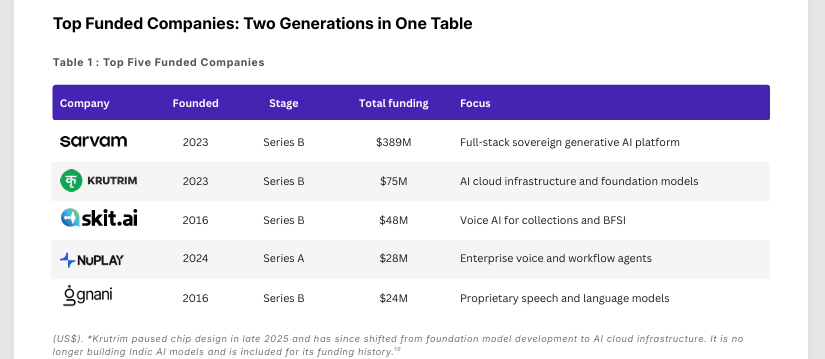
Top funded IndicAI companies (Source: Tracxn)
Clearly, there are just a handful of large-funded new-age AI startups. But there’s a theory to it – building foundational and sovereign models demand massive infrastructure (compute and GPU among others), forcing companies to seek larger checks. Therefore, we’d see the likes of Sarvam, also a government partner, see larger fundraises. For the rest of the ecosystem, typical business metrics come into the picture.
Rathnakar Samavedam, Managing Partner at haf.vc (Hyderabad Angels Fund) tells Entrepreneur India that smaller ticket sizes for the rest of the ecosystem do not signify a lack of investor appetite; rather, they signal a demand for capital efficiency.
“Investors are actively writing seed to Series A checks for verticalized AI startups (e.g., enterprise voice, vernacular NLP, healthcare diagnostics) that do not require massive compute capex. Here, the winning metric is rapid commercial traction and high Net Revenue Retention (NRR), not sheer parameter count,” he explained.
Fibonacci X founder Kulmani Rana makes an important point about the possible concentration of the funding – the real test is whether smaller businesses can grow around them.
“A platform supplying models may also sell applications that compete with its own customers. That creates a difficult position for independent startups. Government-supported infrastructure should therefore offer transparent pricing, fair access and workable alternatives. I would measure ecosystem strength by the number of independent Indian businesses these platforms enable, rather than the valuations of model developers,” he said.
Long-haul
For typical VCs, the traditional venture capital runs on somewhere between 7 and 10 year exit horizons. The Indian AI ecosystem, however, requires massive capital expenditure and longer gestation periods. This is for other related ecosystems like deeptech.
Samavedam notes that traditional 8-to-10-year Indian VC fund cycles were designed around asset-light consumer internet and SaaS business models.
When applied to foundational AI and deep tech, these structures face friction: compute capex burns capital before commercialization begins, and exit timelines easily stretch past 10-12 years.
This is why the government raised the limit from 10 to 20 years.
“In recognition of the long gestation periods, high research and development intensity, and capital-intensive nature of deep technology enterprises, the eligibility criteria for this category have been expanded, with the age limit extended from 10 years to 20 years from the date of incorporation or registration, and the turnover limit enhanced to INR 300 crore,” the government had announced earlier this year.
Samavedam stresses the need for an evolution of Indian VC fund structures as well as alternative capital pools. This includes building dedicated deeptech and sovereign vehicles wherein vehicles similar to the India AI Mission’s computational subsidies, blended finance structures, and domestic institutional LP participation (pension funds, insurance pools) that offer 12-to-15-year patient capital.
Moreover, there have to be specialised VC formats. “Early-stage funds like Hyderabad Angels Fund will continue identifying and de-risking high-potential teams at early stages, but later stages require sovereign-backed co-investment facilities and corporate strategic balance sheets to bridge the deep tech ‘valley of death’,” he continued.
Consolidation
Not very dissimilar to the AI ecosystem, several categories start with multiple names and over the period of time.
With time, we see consolidation of the sector with a few large names. Look no further than the duopoly of Zomato and Swiggy in the food delivery sector. For the longest time, Ola Cabs and Uber dominated the sector until Rapido came into the picture. Even in the hot spacetech, there are a handful of large firms.
Will we see something similar to the AI ecosystem in the long-run? Samavedam does not rule out the possibility.
He said that high regulatory moats, hardware lead times, and launch cadence naturally concentrate capital into 4–5 full-stack players (e.g., launch vehicles and satellite constellations), while smaller niche players would support subsystem manufacturing.
“While foundational model development will remain confined to a handful of heavily backed players, the downstream application layer is far broader than Spacetech. We will likely see a barbell distribution: 2–3 massive sovereign/foundational champions at one end, and dozens of lean, highly profitable, verticalized application companies at the other,” he added.
With the hype of AI gradually slowing down eventually, consolidation and acqui-hires among mid-tier AI startups is likely on the cards.
“Some consolidation is plausible, but predicting distress sales requires evidence on cash reserves, customer renewals, technology commitments and existing investors’ willingness to provide further funding. China’s financing pressures warrant caution without establishing what happens next in India. Strong teams with useful technology may attract strategic buyers even if venture funding slows. Buyers will examine intellectual property, customer contracts and integration costs. An earlier funding valuation offers little protection if the business cannot demonstrate what an acquirer would gain from ownership,” Rana explains.
It’s worth noting that many startups funded during the peak hype cycle raised early rounds on “wrapper” architectures thin layers built on third-party APIs without proprietary data moats or workflow integration.
Last year, Paul Ravindranath, senior program manager for Google for Startups Accelerator India, told Entrepreneur India that the company was interested in working startups that use the latest technologies, including AI, to solve social problems.
READ: Breaking Down Google’s Decade of Supporting Indian Entrepreneurs
Samavedam adds that as Series B investors scrutinize gross margins (especially inference costs relative to ARR), companies lacking clear pricing power will struggle to raise growth capital.
“Consequently, we will see mature IT services firms, legacy enterprises, and well-capitalized domestic tech leaders absorb these engineering teams for their specialized AI talent and domain-specific assets,” he added.
Takeaway,
The AI funding landscape in India is likely to become more selective, with investors looking beyond the technology itself to assess whether a company is solving a real business problem and can build a sustainable commercial model around it.
“While foundational models are important to the ecosystem, there is also a significant opportunity for companies applying AI to specific enterprise use cases. Much of the Voice AI market has focused on outbound use cases, but complex inbound customer operations present a different challenge, requiring AI to understand multiple intents, draw on enterprise context and take action across systems,” VijayPal Singh, Co-Founder and CEO, Karta AI said.
From a commercial point of view, especially in the wake of the US’ control over its AI companies, private venture capital and institutional LPs will remain clear-eyed: training frontier models from scratch is financially prohibitive for typical fund returns.
Therefore, the dominant investment strategy remains backing vertically tuned models built on open-weight architectures, fine-tuned with proprietary, localized enterprise data, and deployed on domestic infrastructure. This approach delivers the security and resilience enterprises now demand without the unsustainable capex of training frontier LLMs.
India’s approach to boost AI is a combination of private investors and strategic initiatives like IndiaAI mission. Much of this appears to have begun paying off as well with India having unicorns – Krutrim (Ola), Sarvam AI, and Emergent, and hundreds of early to mid-stage companies.
As many as 304 new AI startups in 2026 so far while 495 were founded in 2025, according to Tracxn.
To put things into perspective, India saw 71 companies being founded in 2017. The year 2023, appears to be the AI pivot year where the number of such startups grew to 412 from 195 in the previous year.