AI-First Businesses Must Rethink How Work Gets Done
As AI moves beyond answering questions to executing tasks, businesses face a bigger challenge than adopting new technology.
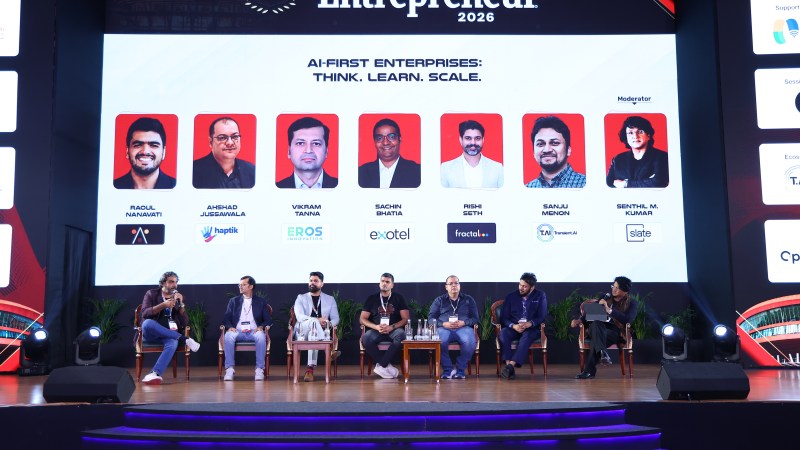
from (L-R) Sachin Bhatia, Founder & CGO, Exotel,Vikram Tanna, CEO, Eros Universe and Eros Now,Rishi Seth, India Business Head, Fractal,Raoul Nanavati, Co-Founder & CEO, Navana.ai ,Ahshad Jussawala, CEO, Jio Haptik,Sanju Menon, APAC CTO, Transient AI,Senthil M. Kumar, C.T.O, Slate Technologies
Opinions expressed by Entrepreneur contributors are their own.
You're reading Entrepreneur India, an international franchise of Entrepreneur Media.
As artificial intelligence moves beyond answering questions to executing tasks, businesses face a bigger challenge than adopting new technology: rethinking how they operate. At the Entrepreneur 2026 panel discussion, AI-First Enterprises: Think. Learn. Scale., business leaders explored how AI is transforming creativity, enterprise workflows, customer experience and decision-making, while raising questions about human judgement, trust and accountability.
From AI agents that can manage business operations to voice technology that makes digital services accessible in Indian languages, the discussion highlighted how AI can reshape the way businesses work and scale.
The panel brought together Vikram Tanna, CEO, Eros Universe and Eros Now, Ahshad Jussawala, CEO, Jio Haptik, Sanju Menon, APAC CTO, Transient AI, Sachin Bhatia, Founder & CGO, Exotel, and Raoul Nanavati, Co-Founder & CEO, Navana.ai , Rishi Seth, India Business Head, Fractal. The discussion was moderated by Senthil M. Kumar, C.T.O, Slate Technologies.
Creativity in the AI era
As AI makes it easier to create videos, music, scripts, and other forms of content, the role of human creativity is evolving. Vikram Tanna argued that while AI can execute tasks and scale production, humans will continue to determine what should be created and why.
Vikram said “creators could move from being editors to becoming “story architects”, using AI tools to turn their imagination into finished work. Individuals or smaller creative teams can increasingly handle tasks that once required specialist skills and large teams.”
Tanna also highlighted the potential for artists to expand their reach through AI, provided they give consent for their work to be used. Their voices and creative output could be adapted into regional languages and new formats, opening additional revenue opportunities. In this model, humans retain ownership of the story and intellectual property, while AI helps scale production.
Why Adaptability will matter
When AI takes on more knowledge-based and execution-heavy tasks, businesses will increasingly need employees who can learn quickly and adapt to changing roles.
Rishi Seth said, “Enterprises should look for people who are smart, humble and hungry to learn. Employees must be willing to upgrade their skills continuously, recognise that their existing expertise may need updating and remain open to learning from others”.
Strong domain knowledge will remain important, he added, because AI is most effective when people understand how to apply it to real business problems. As roles evolve faster, the ability to learn and adapt could become as important as the knowledge employees already possess.
AI agents from advice to action
The next stage of AI adoption is moving from systems that respond to questions to agents that can take action across business platforms. Ahshad Jussawala said, “enterprises are beginning to move from conversations with AI to interactions that produce tangible outcomes”.
AI agents can access systems and execute tasks, potentially managing activities such as creating marketing content, publishing social media posts, running advertisements, and following up with sales leads. For small and medium-sized businesses, this could provide access to an AI-powered team without requiring the same level of manpower.
However, greater autonomy also raises questions about how much decision-making businesses should delegate to machines and where human oversight remains necessary.
More than automation
For businesses operating in regulated markets, AI adoption requires more than automation. Sanju Menon, APAC CTO at Transient, emphasised the importance of consistency, auditability and governance, particularly when AI agents handle business-critical workflows.
As these systems scale, manually checking every output can become difficult. Menon highlighted “the need for safeguards that identify unreliable information, detect hallucinations and flag when an AI agent operates beyond its intended limits. Deterministic evaluations and clearly defined guardrails can help make oversight more reliable”.
The challenge is to build systems that allow AI to operate efficiently without compromising accountability. In regulated environments, errors can have significant consequences, making trust and verification essential parts of the design.
Why human support still matters
When AI tools become more widely available, the technology itself may become less of a differentiator. Sachin Bhatia drawing on his experience in customer experience, he said, “how businesses respond when something goes wrong can leave a lasting impression on customers, routine interactions can increasingly be automated, but customers dealing with stressful or emotional situations may need immediate human support.” Bhatia cautioned against placing bots at the front of every interaction and bringing in a person only after automation fails.
Businesses should use context to recognise the problem and connect customers with the right person when human intervention is needed. The opportunity lies in combining automation with empathy, rather than treating human support as a last resort.
Bringing digital services closer
Raoul Nanavati, highlighted the potential of voice AI in India, where people communicate across languages, dialects and mixed-language conversations.
Many users find speaking more natural than navigating an app or typing a message. Voice AI designed for Indian speech patterns, background noise and multilingual conversations can allow people to interact with businesses in the languages they are comfortable using.
By reducing dependence on English-based interfaces, voice AI could help make digital services more accessible to a wider range of users. Raoul Nanavati said, “The technology can bridge the gap between people and digital systems by allowing them to communicate more naturally.”
Conclusion
The discussion underscored that successful AI adoption is not about deploying the largest number of tools, but about redesigning businesses around clear outcomes. AI can expand creative possibilities, automate repetitive work, and execute increasingly complex tasks, but its impact depends on how organisations integrate the technology into their workflows. Enterprises that combine AI’s ability to scale with human insight and accountability will be better positioned to turn experimentation into lasting business value.
As artificial intelligence moves beyond answering questions to executing tasks, businesses face a bigger challenge than adopting new technology: rethinking how they operate. At the Entrepreneur 2026 panel discussion, AI-First Enterprises: Think. Learn. Scale., business leaders explored how AI is transforming creativity, enterprise workflows, customer experience and decision-making, while raising questions about human judgement, trust and accountability.
From AI agents that can manage business operations to voice technology that makes digital services accessible in Indian languages, the discussion highlighted how AI can reshape the way businesses work and scale.
The panel brought together Vikram Tanna, CEO, Eros Universe and Eros Now, Ahshad Jussawala, CEO, Jio Haptik, Sanju Menon, APAC CTO, Transient AI, Sachin Bhatia, Founder & CGO, Exotel, and Raoul Nanavati, Co-Founder & CEO, Navana.ai , Rishi Seth, India Business Head, Fractal. The discussion was moderated by Senthil M. Kumar, C.T.O, Slate Technologies.