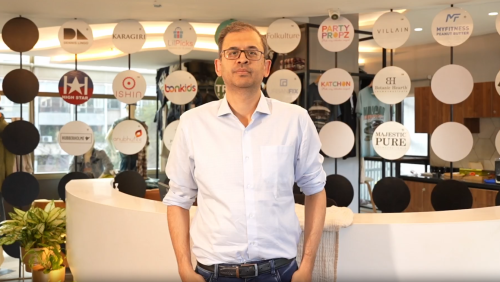
From Survival to Simplifying Savings
For Misbah Ashraf, co-founder of fintech platform Jar, becoming an entrepreneur was never about a fashionable career choice. It was a necessity born out of survival.
Opinions expressed by Entrepreneur contributors are their own.
You're reading Entrepreneur India, an international franchise of Entrepreneur Media.

For Misbah Ashraf, co-founder of fintech platform Jar, becoming an entrepreneur was never about a fashionable career choice. It was a necessity born out of survival. Growing up in Bihar, Misbah witnessed financial strain at close quarters, long before balance sheets and unit economics became part of his vocabulary.
“I was born and brought up in Bihar in a family where my dad was the only earning member,” Misbah recalls.
He was supporting not just us, but his parents and siblings as well. When I was around 16 or 17, I saw him taking loans from local moneylenders. To pay one loan, he would take another loan. It became a never-ending spiral.
These experiences shaped Misbah’s earliest instincts around money, risk, and responsibility. As a teenager, he began tutoring, selling software, and even game CDs, anything that could bring in cash to support his family. “My journey of entrepreneurship has always been more about survival than ambition. It was about making sure I survive every day and continue supporting my family.”
Misbah went on to study Computer Science at Amity University, Noida, but his education extended far beyond the classroom. During his first two years of college, he sold printed T-shirts with corporate logos, including Infosys, TCS, and other IT brands. By his third year, he had dropped out to start a fintech venture called Cibola with friends from IIT Delhi.
“The idea was to build a wallet at a time when India was just opening up to digital payments. But after six to eight months, we realised we needed a wallet licence from the RBI. This was around 2014, when only about 11 companies had those licences. Even Paytm and others were in the queue. We were 20-year-old kids with almost no money in the bank. It was clear we wouldn’t get it,” says Misbah.
The company was eventually shut down, but Misbah stayed close to technology and product-building, working remotely on product and growth consulting roles. In 2017, he co-founded Marsplay, a social commerce platform focused on fashion and beauty content. The startup scaled to a million monthly active users and raised USD 1 million before COVID disrupted funding plans, leading to the sale of its IP and team to social commerce firm Foxy.
Jar, the company Misbah is now best known for, was born in March 2021 and launched two months later. At its core, Jar reimagines how Indians save money by tapping into deeply ingrained financial and cultural behaviours around savings.
Misbah explains, “To understand Jar, you need to understand Indian savings behaviour. When I went to Kota for coaching, my mother mortgaged whatever jewellery she had to pay my fees. Years later, when I started earning, she went back to the same jewellery store and deposited money every month. After 12 or 13 months, she converted that into gold.”
Misbah noticed that jewellery stores in India have long functioned as informal financial institutions.
They act as savings platforms, credit providers, and even custodians. There are more jewellery stores in India than bank branches. This behaviour has existed for decades.
Jar’s insight, according to Misbah, was recognising that gold in India is seen less as an investment product and more as peace-of-mind savings. “Most wealth products talk about returns and growth. But in India, people think: Can I take my money out anytime? Can I use it in an emergency? Gold answers those questions.”
By reducing friction and allowing users to start saving in under 30 seconds, Jar focused on habit-building rather than transactions. “Telling people to be financially fit is like telling them to go to the gym. Everyone knows it. But how do you get them to start? That’s where product design and cultural understanding matter.” By 2025, Jar had crossed 40 million users, processed over a billion transactions, and turned profitable for over a year. Looking ahead, Misbah is focused on depth rather than diversification.
There are going to be 800 million transacting users on UPI in the next few years,” he says. “Why can’t we capture 100 million of them in three to four years? We believe in going deep, not scattering ourselves across products. We’ve only scratched the surface.
For Misbah, Jar is not just a fintech success story; it is a full-circle moment rooted in lived experience, cultural insight, and a deeply personal understanding of money.
For Misbah Ashraf, co-founder of fintech platform Jar, becoming an entrepreneur was never about a fashionable career choice. It was a necessity born out of survival. Growing up in Bihar, Misbah witnessed financial strain at close quarters, long before balance sheets and unit economics became part of his vocabulary.
“I was born and brought up in Bihar in a family where my dad was the only earning member,” Misbah recalls.
He was supporting not just us, but his parents and siblings as well. When I was around 16 or 17, I saw him taking loans from local moneylenders. To pay one loan, he would take another loan. It became a never-ending spiral.
These experiences shaped Misbah’s earliest instincts around money, risk, and responsibility. As a teenager, he began tutoring, selling software, and even game CDs, anything that could bring in cash to support his family. “My journey of entrepreneurship has always been more about survival than ambition. It was about making sure I survive every day and continue supporting my family.”

Prince Kariappa • Features Content Writer
Entrepreneur Staff