Creative Inc: 6 Founders Redefining Creativity Through Design
From sarees and fine jewellery to beauty, handloom and South Indian dining, six entrepreneurs show how design can be embedded at every stage of creation.
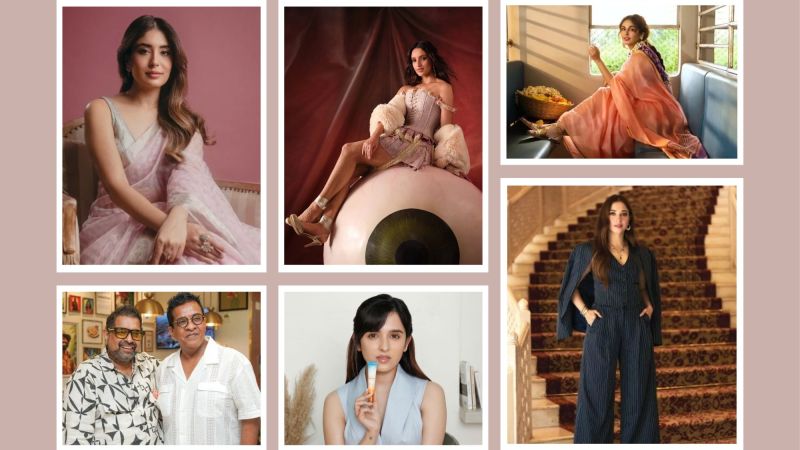
Founders
You're reading Entrepreneur India, an international franchise of Entrepreneur Media.
Creative Inc brings together a diverse set of individuals who are redefining creativity by making design an intrinsic part of how the world works. They challenge conventions, question established processes and find new ways to imagine, create, build and deliver. For them, design is not merely about aesthetics; it is a way of thinking that can transform products, businesses, industries and everyday experiences.
Some are putting India on the global map through distinctive ideas and homegrown innovations, while others are reimagining familiar products, materials and experiences through thoughtful design, technology, craftsmanship or unconventional problem-solving. What connects them is their ability to see possibilities where others see limitations. Here are six of their stories.
1. The New-age Draper: Huma Qureshi, Actor
For Huma Qureshi, the saree has always been more than a traditional garment. It is an expression of identity, craftsmanship and a cultural inheritance that continues to evolve. With Freefall, her recently launched collection with fashion label Dressfolk, she is turning that appreciation into an entrepreneurial pursuit that seeks to bring the saree to a new generation of women. The idea emerged from a longstanding association with Dressfolk, whose sarees Qureshi had worn for years, and evolved into a collaboration with a larger ambition: to take the saree beyond its conventional positioning and make it relevant to the contemporary Indian woman. “I feel it’s the perfect garment for the modern Indian woman. It’s chic, it can be traditional, it can be sexy, it can be modern, it can be so many different things,” she says.
Freefall was conceived for women who are comfortable embracing their individuality while remaining connected to their roots. “Normally, what happens is that when you think of a traditional garment, the traditions of the world around normally overpower the individual. But here we want to celebrate the spirit, the soul, the fire of the woman at the heart of it,” she says.
Coming from a business family, Qureshi says the transition feels natural. “I do think of myself as an entrepreneur right now,” she says. Her contribution extends beyond lending her name to a collection: she has participated in decisions around colours, motifs, sampling, design details and even the placement of the brand’s logo on the saree’s pallu, through months of discussions and iterations with Dressfolk founder Nitin and his team. She could not visit the manufacturing facilities for every stage, but remained involved through photographs, videos and regular exchanges. The techniques and traditions of Banaras, Gujarat and Madhya Pradesh each have their own distinct character. “The diversity of what we have to offer just completely blew me away, to be honest,” she says. Alongside creating contemporary designs, Qureshi wants to draw attention to the weavers and craftspeople whose skills sustain these traditions.
2. Crafting Her Golden Legacy: Tamannaah Bhatia, Actor and Founder, Tamannaah Fine Jewellery
For Tamannaah Bhatia, entrepreneurship has become an extension of the creative instinct that has guided her acting career. Two decades in front of the camera have given her an understanding of styling, aesthetics and the relationship between clothing, jewellery and personal expression, which she is translating into a business that brings her interpretation of contemporary glamour to a wider audience. The transition, she says, has less to do with celebrity branding and more to do with an innate tendency to become deeply invested in whatever she pursues. “I don’t operate or think like, ‘Oh, I’m a brand and I need to do this, I need to do that.’ I just naturally become obsessive. So right now, if you ask me, I am breathing jewellery,” she says.
The brand challenges the conventional association of fine jewellery with weddings, celebrations and other special occasions. “We call ourselves Beyond the Occasion because we believe that what you own is like a part of your body. So, it should move with you and everything that’s important and everything that’s mundane,” she says. Taking feedback in real time and making adjustments has been one of her most important lessons. “Sometimes in the way of creation, you want to do things that excite you, but the question is, do people really need that stuff?” she says.
Bhatia describes herself as a founder, producer and retail entrepreneur, overseeing the process from design and production to marketing and customer experience. The business is bootstrapped, with her own money invested. Manufacturing takes place at the company’s facility in Goregaon, Mumbai, where her father, a jeweller who has been producing jewellery for 14 years, has been instrumental in supporting the venture. The next phase of growth is centred on expanding the brand’s physical presence through its partnership with Taj Khazana. The initial expansion includes Delhi, with Bengaluru, Hyderabad, Chennai, Kolkata and Jaipur among the cities being considered as part of a wider plan spanning around 10 cities, and she intends to establish exclusive stores over time. Asked to describe the journey in one word, she chooses “golden”.
3. Co-Creating Her Next Chapter: Triptii Dimri, Actor
For years, the celebrity-brand relationship has followed a familiar script: the star lends the face, the brand writes the cheque, and the association ends somewhere between a campaign and a billboard. Triptii Dimri is testing a different model. Her appointment as Victoria’s Secret’s first Indian brand ambassador marked a significant step into the global beauty and fashion conversation, and her presence at Apple’s launch event at Apple Park placed her alongside one of the world’s most influential technology brands. Now she has stepped into the beauty business as an investor and co-creator of Peep Beauty, a brand built around coloured contact lenses and positioned at the intersection of beauty, self-expression and individuality.
“The first thing that struck me about Peep Beauty was that it wasn’t just creating a product, it was creating an entirely new way of thinking about beauty,” she says. “I am an actor first,” she adds, saying she wants audiences to know her primarily through her art. The commercial opportunities are a “bonus point”, but one that is increasingly acquiring a business dimension. Her approach is to build credibility first and let commercial opportunities emerge from it. “I would want my audience, people who love me, to know me through my art,” she says.
She points to Bulbbul as a clue to how she approaches risk. “Everybody advised me against it. But my gut said, yes, go do it.” Asked what she would pursue if she weren’t an actor or investor, she chooses fashion and beauty, with a qualification: “It would have to be something that’s more personal to me, something that connects me to my roots.”
4. Singing a Different Tune: Shirley Setia, Singer, Actress and Co-founder and CMO, Island Beauty
For Shirley Setia, entrepreneurship is less about diversifying beyond entertainment and more about building something rooted in her own everyday experiences. The singer and actor, who first found an audience through YouTube, is now co-founder of Island Beauty, a skincare brand that combines Korean formulation expertise with an understanding of Indian skin. Launched in August, it marks a move from being the face of brands to participating in building one. “I was very excited to join in as a co-founder and not just as the face of the brand,” she says. “It meant that I would get to learn a lot of new things. It meant that I wouldn’t be the smartest person in the room. And I think that’s the best thing because when you’re not the smartest person in the room, you get to learn and absorb a lot more.”
Having started her YouTube journey in 2013, she spent years experimenting with makeup and skincare. “When you work with brands, it’s always just some deliverables which you have to go and do as your role. You don’t get to partake in the actual product formulation,” she says. Island Beauty is built on the belief that skincare must account for the environment in which it is used, as India’s humidity, heat, pollution and everyday stressors influence how skin behaves. The Korean connection comes through co-founder Jinsun, a Korean skincare expert and formulator who has lived in India for five years. The team spent approximately two-and-a-half years developing its initial range of five products, testing 52 formulations. The products are manufactured in Gurugram and built around a barrier-first philosophy. Setia’s involvement has extended to product testing, texture, packaging, colours and communication.
5. Woven with Purpose: Kritika Kamra, Actor and Founder, Cinnabar
For Kritika Kamra, Chanderi has always been more than a name associated with a beautiful weave. The historic town in Madhya Pradesh is close to her family’s roots, and what began as a personal connection became the foundation of a venture that is less about rapid expansion and more about preserving a craft and creating a sustainable livelihood for its makers. The idea took shape during the Covid-19 lockdown, when a food drive to Chanderi brought her into conversations with local weavers whose incomes had disappeared. “I realised that no amount of compassionate things are great, but what they actually needed at that point was a dignified income,” she recalls. She used her Instagram page as a platform for the weavers, and enquiries continued even after life returned to normal.
Nearly five years on, the venture remains deliberately small and family-run. Kamra manages marketing, social media and brand outreach, while her mother handles much of the sourcing and production. “We’re an artisan-first brand. So they are at the front and centre of this,” she says. The brand operates exclusively through Instagram, where customers can speak directly with her mother. Depending on the design, only six or 12 sarees of a particular kind may be woven. “In the era of fast fashion… there are so many times when I step out in a T-shirt and see five other people wearing the same thing. That doesn’t happen with our sarees,” she says. Enquiries come from India as well as the US, Canada and Australia.
6. From Friends to Founders: Shankar Mahadevan and K. S. Ramakrishnan, Co-founders, Malgudi
For Shankar Mahadevan, music has always been about getting the details right. With Malgudi, the celebrated musician is applying a similar philosophy to food. Alongside entrepreneur K. S. Ramakrishnan, he is building a South Indian restaurant brand that seeks to go beyond the conventional quick-service format. The partnership began with friendship rather than a business plan, after the two connected over a decade ago through a shared love for food and travel. “We were friends first, and we are friends first now, more than anything else,” says Mahadevan.
Ramakrishnan, with experience in restaurant operations across India, Dubai and Bali, believed the gap was not in the cuisine but in how it was presented. “Everybody eats South Indian food, so there’s something missing in the experience,” he says. Malgudi sits within the broader Etopia portfolio of hospitality brands. Mahadevan joined as an investor and an active creative partner, helping curate the experience, from the menu and food philosophy to the interiors, colours, tiles and fabrics. Before launching, the team spent months refining recipes and working towards consistency. The brand has expanded across Mumbai, Delhi NCR and the UAE with 10 locations, with further growth planned in Europe, Southeast Asia, Australia and New Zealand.
Creative Inc brings together a diverse set of individuals who are redefining creativity by making design an intrinsic part of how the world works. They challenge conventions, question established processes and find new ways to imagine, create, build and deliver. For them, design is not merely about aesthetics; it is a way of thinking that can transform products, businesses, industries and everyday experiences.
Some are putting India on the global map through distinctive ideas and homegrown innovations, while others are reimagining familiar products, materials and experiences through thoughtful design, technology, craftsmanship or unconventional problem-solving. What connects them is their ability to see possibilities where others see limitations. Here are six of their stories.
1. The New-age Draper: Huma Qureshi, Actor
For Huma Qureshi, the saree has always been more than a traditional garment. It is an expression of identity, craftsmanship and a cultural inheritance that continues to evolve. With Freefall, her recently launched collection with fashion label Dressfolk, she is turning that appreciation into an entrepreneurial pursuit that seeks to bring the saree to a new generation of women. The idea emerged from a longstanding association with Dressfolk, whose sarees Qureshi had worn for years, and evolved into a collaboration with a larger ambition: to take the saree beyond its conventional positioning and make it relevant to the contemporary Indian woman. “I feel it’s the perfect garment for the modern Indian woman. It’s chic, it can be traditional, it can be sexy, it can be modern, it can be so many different things,” she says.

Punita Sabharwal • Managing Editor, Entrepreneur India
Entrepreneur Staff
Punita Sabharwal is the Managing Editor of Entrepreneur India.