TIS 2026: Cybersecurity & Governance: Securing the Digital Enterprise
Industry leaders gather to discuss building resilient architectures across cloud, data, and distributed workplaces and embedding security-by-design into products, processes, and enterprise culture, and lots more.
Entrepreneur India
Opinions expressed by Entrepreneur contributors are their own.
You're reading Entrepreneur India, an international franchise of Entrepreneur Media.
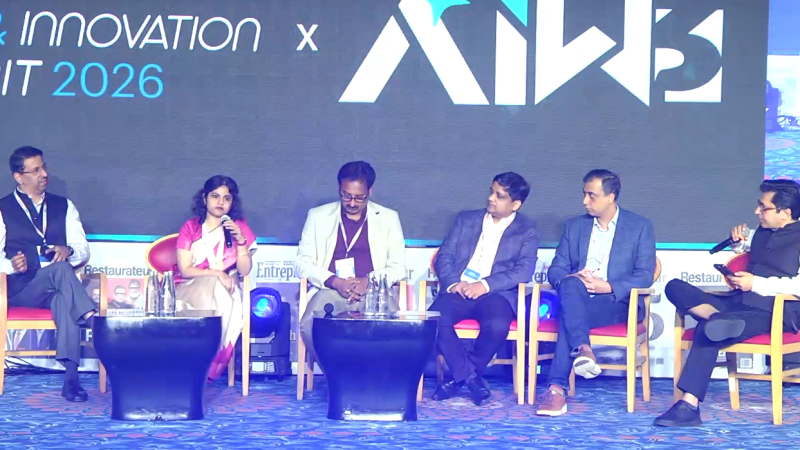
The cybersecurity landscape is at an intersection of technology, business, and even geopolitics. It’s now just about speed or scaling larger but also building trust. A powerhouse panel of industry leaders gathered at the Tech and Innovation Summit (TIS 2026), held in Bengaluru last month, to discuss different aspects of the evolving cybersecurity landscape.
Led by Sachin Marya (Editorial Director, Entrepreneur India), the panel saw participation from Bhanupreet Saini (Director and Head of Public Policy and Government Affairs, Palo Alto Networks), (Shankar Jayaraman, CISO & Co-Founder, Akasa Air & CISOGenie), Hitesh Garg (Vice President & India Managing Director at NXP Semiconductors), Ashish Gupta (Managing Director, India, and Head of Engineering, Rubrik), and Sudiptaa Paul Choudhary (Chief Marketing Officer, QNu Labs).
Resilience
Gupta of Rubrik notes that the cybersecurity regime is becoming increasingly fragmented which is being exploited by cyberattackers. He also cited the example of Mythos, Anthropic’s new tool which is capable of performing complex, multi-step cybersecurity tasks, including discovering and exploiting software vulnerabilities at an extremely fast pace.
“[they are] really upping the game, where what is going to happen is they—they’re going to discover like all the gaps between all these fragments. And what is needed is actually that there is—and this is what our focus has been—that you need to have one, an architecture that spans this entire real estate, is able to help you connect the dots…” Gupta said.
During the conversation, Gupta also noted that cyberattacks are unpreventable in nature but when it happens what matters the most is how well one can figure things out.
“How quickly can you figure out the blast radius? What sensitive data has been attacked? … which point should I go back to?… how do I make sense of this attack? How do I cover this entire surface area? And how do I leave no holes with a true zero trust architecture? These are very, very hard, very, very hard challenges, and these have been our areas of focus…” he explained.
Policy & Governance
India is making all-out efforts to keep up with the evolving dynamics in the technology space, especially in the wake of AI disruption. Saini of Palo Alto proposes for future-proof technology or product neutral policies even as threats are evolving at a fast pace. He also noted the threats having low barriers in the era of AI and post-quantum cryptography.
“… a lot of organizations probably feel that hey this is something still uh… some time away. There are various uh… you know roadmaps around migration, around uh… you know development and all of that stuff going to 2030 and whatever. But I think what’s important is that you need to undertake very, very measured and, you know, maybe very, very planned initiatives right from now on to be able to maybe accomplish some of those requirements,” he added
Saini also highlighted the recent report released by the Indian government on quantum computing under the National Quantum Mission (NQM).
“…our own structures are currently more focused towards, say, reactive defense. And we need to get into an active defense uh… kind of a mindset wherein we have the ability to have complete visibility across our network through various sensors, have the ability to receive the data from these multiple sources of—of—of—of the sensors which are deployed, and then maybe apply the power of AI and ML on all of this normalized telemetry data to be able to predict threats in real-time. Because unless and until we change this mindset, I think it’s going to be very difficult to counter the speed and the complexity of the threats which AI is enabling attackers to kind of maybe use to target some of these organizations and critical infrastructure.
Quantum of Challenge
As mentioned above, quantum computing at some point is likely to be a big enabler but like AI, it could be a big nightmare for conventional enterprises as well. India has taken a few steps, primarily the NQM which has an outlay of over INR 6,000 crore and is aimed at research and development in quantum computing. Choudhary of QNu Labs digs deeper into India’s readiness with quantum computing.
Highlighting the key milestones in quantum computing in the West, Choudhary stressed the need for proactiveness and identifying the technology that the attackers are using.
“So don’t use past technology but use tomorrow’s which is already available right now. And we are already working with the government and a lot of implementation has happened. We have also taken things globally as we are working with a few of the global partners,” she said.
“India is one of the top three countries today when it comes to coming up with their own innovation, coming up and working with the government, doing the design, doing the implementation, doing the support… And at QNu Labs, we have achieved a 500-kilometer quantum-safe network which has been done for India’s critical infrastructure. In March, we completed a 1,000-kilometer quantum-safe network for India’s critical infrastructure,” she added.
Chip Safety
Garg of NXP stressed the need for prioritising security at the chipset level even as the technology under the hood has gone through rapid upgradation in recent years.
He said that the security has to be a key part in all kinds of chips, be it microprocessor, microcontroller, even an AI processor.
“So we have to—to work with a certain structure so that it’s portable across devices, across technology, across companies. So I think that’s where this standardization is helping…” he said.
During the conversation, he also talked about the need to think in terms of systems at all levels.
“… we are building the system architecture for software-defined vehicles where we have the right domains partitioning, where the decisions are taken and how do we have those guardrails. So I think one is device-level security at every level [wherein] everything is loaded from truly trusted ones, the partitioning at the system level so that nobody is coming… even a system is a car is a system. Right? If you talk about robots, right? Or data centers. So everything is a system…” he added.
Tool Fatigue
Jayaraman cautioned against a possible “tool fatigue” wherein enterprises try to keep adding endless software without fixing their core processes.
“… the foundations need to be strong. More than buying more and more tools, just adding tools after tools after tools after tools, it is only going to get tool fatigue,” he said.
“… Most of the threats or risks you can reduce by getting the foundations right. Getting the CI/CD pipeline right, getting the security bolted on much early in the cycle rather than, you know, doing it later in the cycle. Many things that you can solve. And look for the tools which are more simple to use, you don’t need a CISO to sit next to you to configure the tools and make use of them … look for tools which are more outcome-based? …,” he added, while stressing the need for tools which help with compliance, reduction in risks, and help with better outcomes.
Stay tuned to this space to watch the full conversation. Also read our top picks from the TIS 2026:
Transforming a Nation: How Emerging Technologies Will Define India’s Next Decade
AI 2030: Future Skills, Public Good & the Next Leap in Human Development
The Promise, Potential & Impact of AI: Redefining the Future of Innovation and Society
The cybersecurity landscape is at an intersection of technology, business, and even geopolitics. It’s now just about speed or scaling larger but also building trust. A powerhouse panel of industry leaders gathered at the Tech and Innovation Summit (TIS 2026), held in Bengaluru last month, to discuss different aspects of the evolving cybersecurity landscape.
Led by Sachin Marya (Editorial Director, Entrepreneur India), the panel saw participation from Bhanupreet Saini (Director and Head of Public Policy and Government Affairs, Palo Alto Networks), (Shankar Jayaraman, CISO & Co-Founder, Akasa Air & CISOGenie), Hitesh Garg (Vice President & India Managing Director at NXP Semiconductors), Ashish Gupta (Managing Director, India, and Head of Engineering, Rubrik), and Sudiptaa Paul Choudhary (Chief Marketing Officer, QNu Labs).
Resilience