TIS 2026: AI Vision 2026
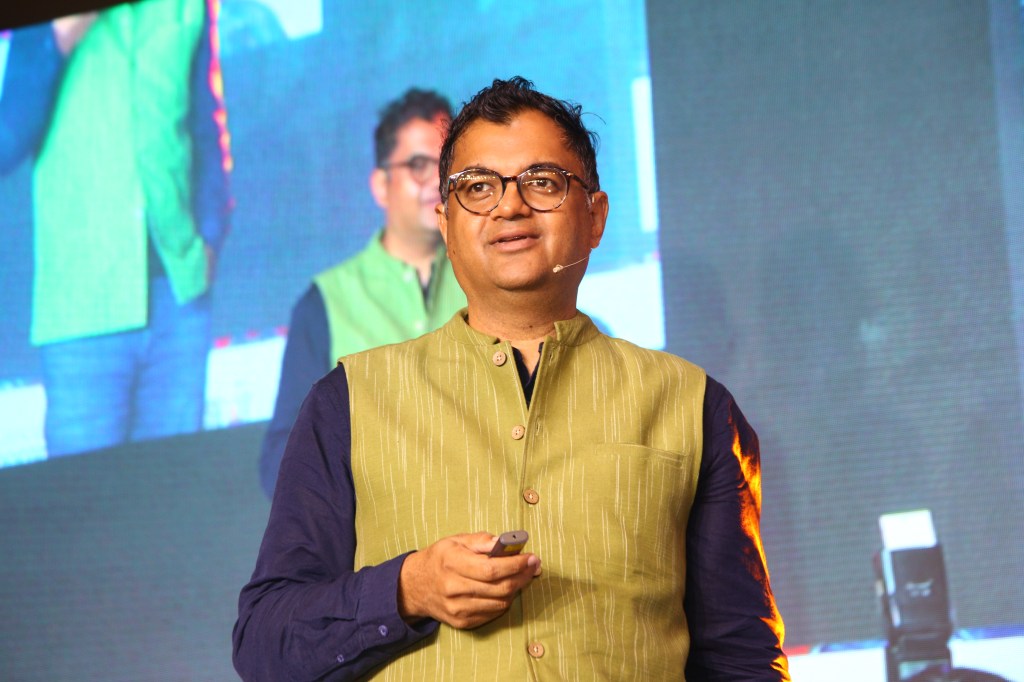
At the Entrepreneur India Tech & Innovation Summit 2026, Umakant Soni delivered a keynote that offered a reality check surrounding artificial intelligence and an expansive vision for the future of AI-led societies.
You're reading Entrepreneur India, an international franchise of Entrepreneur Media.
At the Entrepreneur India Tech & Innovation Summit 2026, Umakant Soni delivered a keynote that offered a reality check surrounding artificial intelligence and an expansive vision for the future of AI-led societies.
Opening with an audience poll, “How many of you are using ChatGPT now?”, Soni established the scale and immediacy of the AI moment. Drawing from over 16 years in the field, including early chatbot development in 2009 and founding AI-focused initiatives like Pi Ventures and Art Park, he positioned himself not just as an observer but as a builder who has “seen lots of errors in building technology, entrepreneurship, investing, and policy.”
To contextualize the speed of disruption, Soni invoked the classic example of New York City’s transformation.
“People were debating about what to do with the horse poop… and in just 13 years… none [of the horse carriages remained]. That’s the speed of change. Once humans adopt a technology, we move so fast. And suddenly the problem narrative may completely shift.”
Looking ahead, he said: “If you were to look at 2033… maybe it might be built for AI.”
A significant portion of his talk focused on dismantling the myth of fully realized AI. Despite the hype around large language models, Soni argued they fall short of true general intelligence. “Technically, if you ask me, they are not foundational at all… they are not able to generalize well across all the tasks. Artificial Jagged Intelligence, ”systems that perform exceptionally in some areas but fail in others.
Soni contrasted this with the remarkable adaptability of the human brain, recounting a story about an astronaut adjusting to zero gravity.
“In just seven days, the human brain adapted to the fact that there was no gravity… imagine, our brains are so plastic… we are doing all these different tasks with one single brain on 20 watts… to do equivalent things, it is taking us 20 megawatts.”
This gap, he argued, underscores the importance of a “humanity-centric perspective” in AI development.
Rather than chasing artificial general intelligence (AGI) in the near term, Soni advocated for augmenting human capability through AI systems. “Human intelligence combined with this jagged intelligence is still going to be good enough for a lot of tasks.”
Central to his vision is the rise of AI agents—autonomous systems capable of executing tasks. “Agents are very different because they have agency. They can do things on their own,” he said. He invited the audience to imagine a near future where individuals deploy personal agents to manage emails, perform research, and multiply productivity. “Imagine each of us gets to build their own agent… and that agent can then multiply their effectiveness by 1.5x or 2x.”
This idea feeds into what Soni calls ‘Universal Basic Intelligence,’ a framework aimed at democratizing access to AI capabilities at scale. Drawing parallels to earlier economic shifts, he noted, “In agriculture, the strongest muscles were prized… then machines came in… similarly, in the AI age, intelligence is going to get democratized.”
However, for this vision to materialize, Soni stressed the need for a new layer of infrastructure, what he termed “cognitive infrastructure.” Alongside physical and digital systems, this would enable seamless interaction between humans, AI agents, and robots. “The country that will actually be owning the most trusted cognitive infrastructure will win the future,” he said.
In India’s case, he pointed to Aadhaar as a potential backbone for authenticated AI agents. “If the agent is acting on your behalf, how do I know whether it’s you or not?” he asked. Embedding identity into agents, he suggested, could unlock entirely new economic models where “your agent goes into a company and it works for you and it gets paid.”
Soni also revealed ambitions behind Bharat1.ai’s experimental AI cluster, a “living lab” combining 25,000 people, an equal number of agents, and thousands of robots in a 70-acre digital-physical city. The goal: generate massive datasets, “one exabyte of data each year”, to power next-generation AI systems and “potentially become like a CERN for AI.”
In a world where “117 million new jobs are coming,” Soni left the audience with a clear mandate: adapt, build, and participate. “The place that will adapt and innovate will create the future… make sure that future is you.”
At the Entrepreneur India Tech & Innovation Summit 2026, Umakant Soni delivered a keynote that offered a reality check surrounding artificial intelligence and an expansive vision for the future of AI-led societies.
Opening with an audience poll, “How many of you are using ChatGPT now?”, Soni established the scale and immediacy of the AI moment. Drawing from over 16 years in the field, including early chatbot development in 2009 and founding AI-focused initiatives like Pi Ventures and Art Park, he positioned himself not just as an observer but as a builder who has “seen lots of errors in building technology, entrepreneurship, investing, and policy.”
To contextualize the speed of disruption, Soni invoked the classic example of New York City’s transformation.

Entrepreneur Staff • Editor
Entrepreneur Staff
For more than 30 years, Entrepreneur has set the course for success for millions of... Read more