Inside Krafton’s Fresh USD 150 Mn Bet on India: Op Synergy, Focus on AI & More
Krafton is ready with a new USD 150 million capital for the Indian market. We decode Krafton’s learnings from the Indian market, investment strategy, and next big bets.
BGMI Krafton
Opinions expressed by Entrepreneur contributors are their own.
You're reading Entrepreneur India, an international franchise of Entrepreneur Media.
Fresh off a new USD 150 million investment mandate, Krafton is looking to deepen its presence in the Indian tech landscape.
The fresh commitment builds on previous capital tranches of USD 150 million in 2023 and USD 140 million in 2021.
Having deployed capital into 18 companies and funds since its arrival in 2020, Krafton’s new approach to the investment mandate is more strategic than ever. It also takes into account of the changing tech landscape in the country i.e. AI while maintaining focus on its strength verticals like gaming and consumer tech.
The playbook is quite different from conventional VCs’ as Krafton is deploying the USD 150 million from its balance sheet.
Multi-dimensional Investment Matrix
Krafton’s investment mandate is anchored by a multi-pronged sector framework wherein it strives for long-term ecosystem play.
The company is best known in India for its blockbuster gaming franchise, BGMI. And it’s natural to associate its identity with gaming. But its investment history reveals a broader purview. It covers categories such as consumer tech, content platforms, and AI firms along with games.
In 2021, it acquired a minority stake in Kuku FM, an audio streaming platform, as well as invested in Pratilipi, a content tech platform. The non-gaming portfolio is also quite diverse with names like Cashfree Payments and One Impression.
“Let me divide this into a sectoral perspective,” explains Nihansh Bhat, Lead, Corporate Development, Krafton India, tells Entrepreneur India. “The overarching theme, of course, is strategic synergies that we can realize with the companies, because we’re not financial investors. All these investments are strategic in nature.”
First up is of course the core – gaming and esports. Krafton’s deployment in the sector is also multifaceted, ranging from equity ownership to incubator programs. Bhat says the company provides structured mentorship through its incubation initiatives. These different approaches come with different avatars of Krafton.
“Investment would mean basically we have a low-touch guidance with them… meet once a quarter or once a month in board meetings,” says Bhat. “The incubation program is designed for those companies where they need more active support, more active mentorship.”
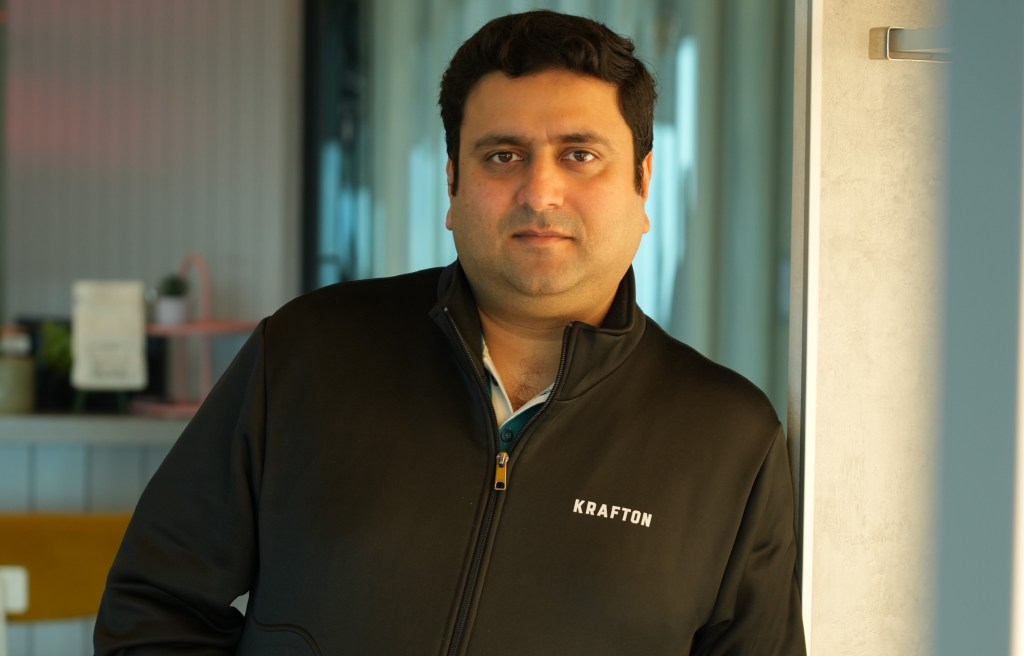
Nihansh Bhat, Lead – Corporate Development, KRAFTON India
Second is the consumer internet and content wherein it aims to find some sort of long-term synergy. For instance, it worked with Kuku FM to launch “Lone Survivor”, a popular audio series and an extension of its gaming IPs.
The third and relatively new addition is the AI. Krafton, however, is going much deeper into AI by backing physical AIs instead of much used consumer AI apps. Bhat cites the example of Ludo Robotics, an AI and robotics laboratory backed by Krafton.
The robotics company on its website explains: “Ludo is backed by KRAFTON, a global video game company best known for the genre-defining worldwide success PUBG: Battlegrounds, with deep experience building full-scale reasoning agents and AI partners in rich digital worlds. Game agents already perceive, reason, act, communicate, and collaborate through an embodied character. We are leveraging that expertise in digital embodied intelligence to bring capable agents into the physical world. The embodiment changes; the core agent loop remains.”
“… we are not just a gaming company, but a tech company as well,” emphasizes Bhat. “We are very actively working in AI, not only wherein it relates to gaming, but also in other areas. For example, we started this business called Ludo Robotics, which is going to work on software for physical AI… that’s completely different to something which is related to gaming.”
According to the Krafton executive, the new dimension – AI – could possibly dominate future fund deployments.
I won’t be surprised if 90% of our investments going forward will have some AI component, whether they be on the consumer side, or they be on the non-consumer side – physical or sovereign AI. AI is going to be probably front and center of our investment strategy for the foreseeable future,” he adds.
There’s another fourth dimension, which does not get much of the spotlight as the company’s gaming foray and investments in popular consumer internet companies.
This is the LP gateway.
Krafton acts as a Limited Partner (LP) in select VC funds which allows the company to achieve certain goals like gaining visibility and experience in unfamiliar sectors, and bridging the gap between global institutional investors and the Indian tech ecosystem.
For instance, Krafton has anchored funds from 3one4 Capital. It has also worked with Korean asset management giant IMM Investment helping the latter launch its USD 100 million India-focused funds.
“IMM India fund will focus on fostering innovation in India by investing in sectors such as Consumer Brands, Consumer Tech, SaaS, Fintech, Gaming and Media and DeepTech. The fund will primarily target growth stage companies that demonstrate a clear path to an IPO, supporting their growth and expansion. Through this partnership, KRAFTON India will channel South Korean capital into India, strengthening its commitment to drive long-term growth in gaming and complementary startup sectors,” said the India arm of the investment firm headquartered in South Korea with close to USD 7 billion AUM.
“We are one of the very few representatives of the tech industry in Korea and India,” explains Bhat. “For a lot of funds, we also help open the Korean ecosystem or capital ecosystem for them. One of the ways in which we do this is by introducing a lot of Korean capital into India as well.”
One of the most recent example of such amalgamation is the Unicorn Growth Fund – a massive USD 670 million vehicle – which is co-anchored by Mirae Asset, Krafton, and Naver Corporation, a Korean internet giant.
“Three of the biggest companies in Korea have come together, joined hands, to create this fund in India,” Bhat highlighted.
For Krafton, funds serve the purpose of not only educating about the space and helping understand the space better, but also making the right introductions, showing the companies from their portfolio which are doing well.
A new VC? Not.
As mentioned above, Krafton’s investment strategy is quite different from the conventional venture capital fund wherein there’s a typical 10-year-long lifecycle. In a conventional approach, VCs look for metrics like rates of return and liquidity opportunities with certain timelines, though not all of them and in all the cases.
Krafton’s Bhat explains the company’s approach is slightly different as they don’t have the pressure of typical VCs which enables it to double down on investments in the companies it is confident enough will pull through.
“We don’t have that pressure. We invest off of our balance sheet,” Bhat says. “We are, therefore, your best sort of long-term patient investor… because we have that strategic bent that we will work with you as well, not just invest money in you.”
Krafton’s follow-up fund deployment strategy is also pretty much out there. For instance, it joined multiple rounds of KuKu FM. It had first backed the firm in series A round and then joined subsequent rounds.
It’s worth highlighting here that Kuku FM is preparing for an IPO. Earlier this year, the audio streaming platform filed a DRHP (draft prospectus) with the regulator SEBI, seeking between INR 2,500 crore and INR 3,500 crore through the public issue at an estimated valuation of up to INR 15,000 crore.
Bhat also cites another example of Pratlipi wherein it invested nearly USD 50 million in the storytelling platform.
“…the thought process as a strategic investor and long-term patient capital is that we don’t just invest once in a company… In every single round [for Kuku FM], we’ve participated—not just to maintain our stake, but to increase it as well in some cases. So, if you look at the cumulative investment there, the investment amount would probably be higher than even Pratilipi,” he said.
The Evaluation Metrics
Different verticals are going to yield different returns, and of course, different timelines. Naturally, one can get curious about how giant like Krafton would evaluate whether their venture bet is paying off.
Bhat addresses this with a multi-axis tracking system which is based on the company’s financial growth but also operational synergy. For Krafton, it can mark down an investment internally if operational synergies fail even if the particular investment, in a hypothetical situation, generates high financial returns or valuation bump.
ALSO READ: Krafton’s ‘Once in a Decade’ Win, and Future Plans for India Market
“So, the the tracking of the performance is actually on the strategic initiatives that we are working on them with them. So, for example, if I were to evaluate Kuku FM, I will not just look at the pure revenue or profitability numbers, because that is, of course, part of the picture… whether the company has been able to grow its value, its revenue, etc.. all of that is part of the evaluation, which which is how a traditional financial investor would also evaluate,” Bhat says.
“But in addition to that, we also evaluate what is the progress that has been made on the business synergy front. So, for example, with Kuku FM, we’ve launched a bunch of our IPs on their platform, we’ve seen a lot of traction on their platform. So, of course, I can’t share some of those numbers, but, internally, we’re aware that we are seeing a lot of traction, we’re seeing significant sort of revenue coming from them. So, the point of the matter is for every company, it’s how closely, how well are we working with them, and how amenable they are to be working with us, how much attention they’re paying to us,” he continues.
Just to further simplify, Bhat gives us the hypothetical situation – let’s assume there is an investment which we invested at a valuation of USD 30 million, and today the company is valued at USD 300 million.
From a financial perspective, that has worked well for Krafton.
“But let’s say we have tried 10 different strategic projects with them, none of them has seen traction, founders have not paid attention to us in terms of driving those projects on a regular basis. For us, then the investment would be classified as somewhere in the yellow region—probably not red, but not green as well. Because while the financial performance has been good, the strategic synergy has not worked well.”
Winter Funding Aftermaths
Just around the pandemic, the capital inflow in the Indian startup ecosystem had reached an all time high. Several notable global investors were quite active. This phase saw several startups’ valuation exponentially growing in a shorter period of time. Then came a long funding winter which led to a lot of course corrections such as valuation markdowns, some startups completely collapsing, and more.
Krafton has witnessed all these phases. Now that it prepares to deploy the next USD 150 million tranche, the company is much more strategic and selective. And it won’t spray and pray for sure.
“A fund to some extent has a spray-and-pray strategy—like I invest in 100 companies, and maybe one or two of those will work and make up the return of my entire portfolio,” concludes Bhat. “That’s not our strategy. Our strategy is very focused. Since 2021, we’ve invested in about 18 companies. So, that’s pretty selective in the first place… You’re not investing in paper plans. You’re investing in companies which have hard businesses and products.”
To conclude, Krafton’s measured approach, backed by balance-sheet flexibility, exposure via LP gateway, and focus on operational synergy, indicates a new durable model in corporate venture capital in India. The deployment will also see a lot of focus on AI, which is pretty much the flavour of the season, and is likely to remain so for a longer period of time.
It remains interesting to see Krafton’s fresh USD 150 million bets fare in the Indian market.
Fresh off a new USD 150 million investment mandate, Krafton is looking to deepen its presence in the Indian tech landscape.
The fresh commitment builds on previous capital tranches of USD 150 million in 2023 and USD 140 million in 2021.
Having deployed capital into 18 companies and funds since its arrival in 2020, Krafton’s new approach to the investment mandate is more strategic than ever. It also takes into account of the changing tech landscape in the country i.e. AI while maintaining focus on its strength verticals like gaming and consumer tech.
The playbook is quite different from conventional VCs’ as Krafton is deploying the USD 150 million from its balance sheet.