India’s USD 300 Mn Microdrama Market is Just Taking Off
The gold rush is quite similar to the vacuum created after TikTok was banned in India in 2020.
Story TV
Opinions expressed by Entrepreneur contributors are their own.
You're reading Entrepreneur India, an international franchise of Entrepreneur Media.
Microdramas, snackable short-form videos and an increasingly popular mobile entertainment category, have gotten a big thumbs up now with the streaming giant Netflix entering the space.
Earlier this month, Netflix said it is adding video content from a bunch of publishers, including BuzzFeed Studios, Condé Nast, THR, Billboard, and more. The bite-sized version content will be available for subscribers in the US, Canada, the UK, Ireland, Australia, and New Zealand early next month.
Netflix’s dabble into microdrama appears to be an extension of efforts to reinvent itself as audiences have grown accustomed to typical binge-watch formats. The streaming platform is now adding newer formats like live videos, WWE, games, and podcasts to its catalogue.
India is missing in the first wave of Netflix’s microdrama efforts. This is despite the segment becoming massively popular and the fact that India is one of its key markets.
According to a Lumikai report, published in April 2026, India’s microdrama sector is worth USD 300 million. This jump is phenomenal given the category barely existed one year ago.
“That single data point reflects a broader shift playing out across the ecosystem, as a new generation of users moves beyond passive consumption toward formats designed for how they actually use their phones,” the report said.
In the last one year or so, the space has seen nearly 450 million downloads, 100 million monthly active users, and is projected to be worth USD 4.5 billion by 2030, the report added.
Rise of Microdrama
Even as microdrama may seem like a natural extension of some type of content on conventional social media, the format is said to be pioneered by platforms like Dramabox and ReelShort, which first gained popularity in China.
Appfigures, an app intelligence firm, reports that ReelShort hit nearly USD 1.2 billion in gross consumer spending in 2025, which is over 100% up from the previous year’s. DramaBox raked in USD 276 million in gross consumer spending in 2025.
Omdia reports that global microdrama revenues hit USD 11 billion in 2025 and are now projected to grow to USD 14 billion by 2026-end. A large chunk of the revenues, nearly USD 3 billion, is coming from markets outside China, and the US is the largest international market for such content.
According to reports, ReelShort also outperformed Netflix in terms of daily mobile watch time in the US, with users averaging 35.7 minutes per day on the microdrama app. In contrast, users spend 24.8 minutes on Netflix.
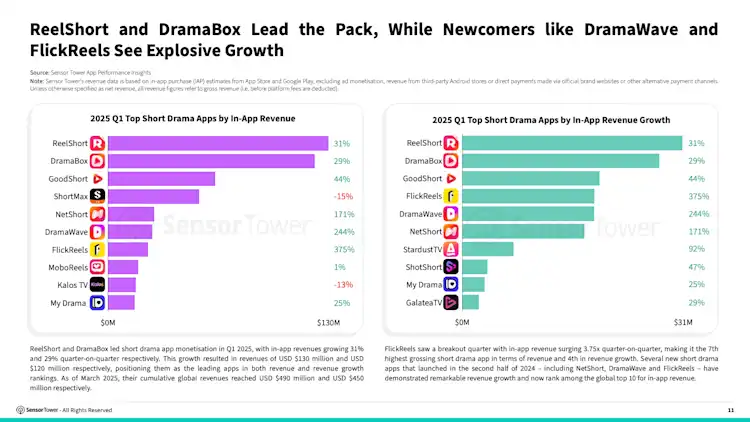
Evidently, there’s money and plenty of room for newer and older players to cash in. And everyone wants in too.
My Drama, backed by FOX Entertainment and viral digital creator Dhar Mann, will provide more than 200 exclusive and original vertical series. Founder Mann is said to have signed up for producing as many as 40 premium microdramas.
Similarly, NBCUniversal is working on “The Big Name” under its mainstream streaming platform, Peacock. Walt Disney is also making an effort through accelerator programs and other initiatives.
Even so, India is late to the party. A lot has unfolded in recent months, and it is not very different from what is happening in the West. Though, India and its economics remain unique.
In the last couple of years, a bunch of microdrama-focused platforms have emerged in India.
The gold rush is quite similar to the vacuum created after TikTok was banned in India in 2020.
Following the ban, a bunch of existing and new players emerged to tap into the gap—ShareChat had Moj, Times had MX TakaTak, Mitron, Bolo Indya, and lots more. Most of the newbies failed to sustain themselves after initial momentum and even fundraises. These companies failed to find a sustainable business model and eventually collapsed. Later, YouTube (Shorts) and Instagram (Reels) became the go-to platforms for short-form vertical videos.
Kuku FM, the popular audio streaming platform, has already ventured into this space via its Kuku TV. The platform has also raised up to USD 85 million from Krafton.
In an interview with Entrepreneur India, Krafton India CEO Sean Hyunil Sohn had also cited the success of Kuku FM and microdrama as a category.
READ: BGMI: Krafton’s ‘Once in a Decade’ Win, and Future Plans for India Market
Apart from Kuku TV, there are platforms like QuickTV (by ShareChat), Reelies, DashReels (by Dashverse), and StoryTV.
ShareChat is also betting big on microdrama, retreating from its efforts to take on conventional social media platforms. According to reports, the push is also paying off as user time spent on its ecosystem of apps has increased.
Revenue generation, however, is a story for a different day.
Big Bets
The goldmine has not gone unnoticed by the bigger content players in India. Take YRF for example. The studio recently made a strategic investment in Rusk Media.
Under the partnership, YRF will oversee the creative direction of original animation and vertical micro-drama IP. Rusk Media will be responsible for producing and distributing content through its Alright! TV platform and global digital channels.
“The instinct to evolve has always been central to YRF’s DNA. Platforms are infrastructure, content and IP are culture. Mayank and his team at Rusk Media have built a deep understanding of how the next generation discovers and inhabits stories, and that is exactly the kind of vision we want to invest in . Together, the aspiration is to build worlds, not just content,” Akshaye Widhani, CEO at Yash Raj Films, said in a statement.
JioHotstar is also experimenting with the category with Tadka, a dedicated micro-drama and short-series feature. It features over 100 vertical-format bite-sized shows. Similarly, Red Chillies is reportedly planning a foray into the same as well.
It is highly likely the volume of such content across platforms will definitely grow in the near future.
Some of the important takeaways from the last round of the gold rush are that content platforms need to figure out ways to monetise the audience to offset the burn happening through high customer acquisition costs initially. Even as subscription and advertising-driven models exist and work too to some extent, these platforms also need to focus on keeping users hooked through exclusive IPs.
Dashverse is an AI entertainment startup with over USD 18 million in funding from marquee investors like Peak XV Partners, Z47, and Stellaris Venture Partners.
Founded in 2023 by Sanidhya Narain, Lalith Gudipati, and Soumyadeep Mukherjee, Dashverse operates DashReels (a microdrama app) and Frameo.AI, which allows individuals to create micro-drama content. Dashverse recently revealed that the microdrama app had gone past 5 million downloads within a month of its launch.
Dashverse is betting big on AI for pushing the two platforms.
“At Dashverse, AI isn’t just a production tool—it underpins how we create, distribute and continuously improve stories. We’ve built an end-to-end ecosystem where stories are created using our AI production platform, Frameo, distributed through our consumer apps like DashReels and Shortfree, and watched by millions of users every day. This gives us a continuous feedback loop on what audiences love, where they drop off and what they want more of,” Tanveer Ali, VP – Partnerships told Entrepreneur India.
The spokesperson further added that instead of treating a micro-drama as a one-time release, they treat it as the beginning of an IP.
“Our retention strategy is simple—we keep investing in stories that audiences have already told us they love. Using real viewing behaviour, we identify breakout characters, themes and storylines, and expand them through new seasons, spin-offs and daily episode drops. This keeps audiences coming back while creating familiarity with recurring characters and story worlds, gradually building loyal fan communities around successful franchises. Rather than relying on intuition, our users shape what gets expanded through their viewing behaviour,” Ali added.
The approach is not very different from the Eloelo Group’s, which operates the popular Story TV micro-drama platform.
The Eloelo Group (parent company of Story TV, Master & more) has raised over INR 400 crore from investors including Lumikai, Play Ventures, Kalaari Capital, MIXI Investments, Griffin Gaming Partners, Waterbridge Ventures, Courtside Ventures, and Rocket Capital. It recently appointed former Yash Raj Films seasoned hand Manan Mehta as SVP – Content and Strategy.
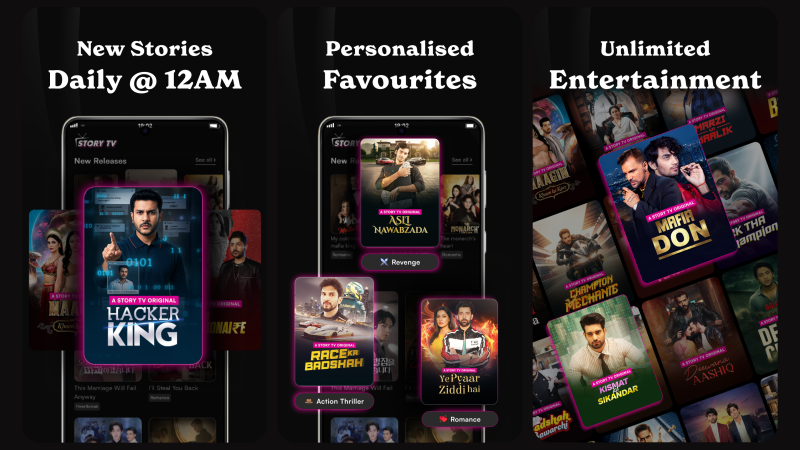
Speaking to Entrepreneur India, Story TV COO GSN Aditya disclosed that one of the company’s IPs, ‘Hacker King’, has crossed 170 million views. Moreover, the average daily time spent on Story TV is 90 minutes.
To put things in perspective, globally users spend on average 33 minutes per day on Instagram. According to DataReportal, Indians spend 58 minutes per day on YouTube and 24 minutes on Facebook.
“At Story TV we are already seeing the early stages of durable IP creation in the microdrama ecosystem. Amongst our slate of popular titles, one of our hit IP’s Hacker King has crossed 170 million views and became the first micro drama in India to have a sequel and prequel, each performing strongly. We have been able to build many such IP’s over the last 1 year,” Aditya said.
He also noted that the playbook of repeatable wins was built in months, not years.
“The strategy we deployed was discipline alongside volume: understanding consumer preferences, leveraging AI to study data trends, investing in casting, writer quality and genre diversity, supported by our AI assisted Script Prediction Engine that helps creative teams make sharper storytelling decisions. The retention proof is that users spend about 90 minutes per day on Story TV, and our newly launched Story TV Dailies(our daily episodic drop enabled programming) is turning that engagement into a daily habit,” he added.
But not everyone’s having a ‘chicken dinner’.
Pocket FM recently shut down its microdrama vertical, Pocket TV, sparking a debate over a possible limited-time appeal for such content.
“Pocket TV was launched as a beta product to explore the emerging microdrama category and is not a material contributor to Pocket FM’s business. As with any product experiment, we periodically evaluate performance and strategic fit, and any decisions related to Pocket TV are part of that normal process,” a company spokesperson said in a statement.
Separately, PocketFM cofounder Nishanth S. in a post on Entrackr highlighted the issue of retention for microdrama.
“…People don’t subscribe to Netflix because of one show, nor do they stay on Spotify because of one artist. They keep coming back because they know there will always be something worth consuming next. That expectation creates habit, and habit is what ultimately creates durable businesses. Until microdrama reaches that point, downloads alone will remain an incomplete measure of success…” he wrote in the post.
“…Better content creates stronger retention. Stronger retention creates healthier businesses. Healthier businesses can invest in even better content. That’s the virtuous cycle every entertainment platform ultimately tries to build,” he further said.
Aditya, however, is bullish on microdrama’s prospects in India.
“India has 10X more smartphones than connected TVs, and microdramas are the first professionally produced content built for that screen. On shelf-life, the industry concern assumes that microdramas are a trend. However from the early signals we see this is a structural shift in consumption behaviour. Cinema is community viewing, TV and OTT is family viewing, microdrama is personal viewing.
Each will have its own place and its own economics. Usage on Story TV peaks at 9 am, 5pm and dinner time, meaning microdramas now own the break time of India.
A format built on genuine daily behaviour does not expire and we are actively working to build this further with premium vertical storytelling,” Aditya added.
The Dashverse spokesperson also expresses confidence in the longevity of the format.
“As for shelf life, we believe it’s a challenge for weak stories, not for the format itself. Like every content business, only a small percentage of titles will become breakout successes. AI gives us the ability to experiment faster, learn from real audience behaviour and scale only the stories that genuinely resonate,” the spokesperson said.
“Once a story proves itself, AI allows us to localize and adapt it across languages and regions at a fraction of the traditional cost, opening it up to entirely new audiences and significantly extending its commercial lifecycle. Strong stories can then evolve through sequels, spin-offs and new seasons, creating value well beyond their initial release.”
That said, it’s evident that Indians and audiences around the world have the appetite for such microdramas. With AI, such content creation is likely to be further democratized, and most likely Bharat creators will have more options.
Microdramas, snackable short-form videos and an increasingly popular mobile entertainment category, have gotten a big thumbs up now with the streaming giant Netflix entering the space.
Earlier this month, Netflix said it is adding video content from a bunch of publishers, including BuzzFeed Studios, Condé Nast, THR, Billboard, and more. The bite-sized version content will be available for subscribers in the US, Canada, the UK, Ireland, Australia, and New Zealand early next month.
Netflix’s dabble into microdrama appears to be an extension of efforts to reinvent itself as audiences have grown accustomed to typical binge-watch formats. The streaming platform is now adding newer formats like live videos, WWE, games, and podcasts to its catalogue.