Gear Up For Canva AI 2.0
Canva is set for a major overhaul with the addition of a new suite of
tools that will turn the widely popular graphic design platform into a conversational, agentic platform, courtesy of AI.
Canva
Opinions expressed by Entrepreneur contributors are their own.
You're reading Entrepreneur India, an international franchise of Entrepreneur Media.
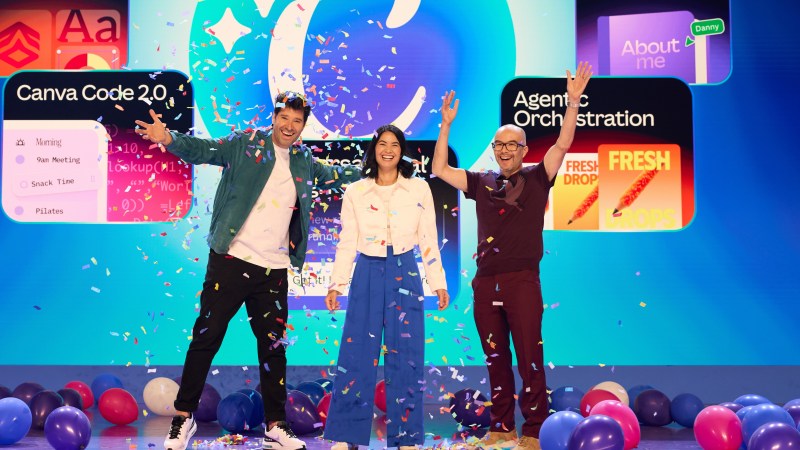
Called Canva 2.0, the platform promises a powerful architecture layer with conversational
design, agentic orchestration, object-based intelligence, and intelligent new workflows, among others. Essentially, the new Canva promises to be smarter, understand contextual commands, and ultimately be on par with what an app in 2026 with AI integration must offer.
A deeper push into AI is not very surprising if you have closely tracked the platform. The 14-year-old startup began introducing a few AI functions to its platform a couple of years ago, just around the time a new era of generative AI platforms had ushered in. Canva cleverly called these AI functions “Magic,” probably just to avoid resonance with something that could be very seasonal.
Canva has been quick on its feet to adapt to a dynamic technology landscape, ensuring the product remains relevant to its millions of users. For instance, it acquired professional
creative suite Affinity (Serif) in March 2024 for nearly USD 380 million. Some of its notable acquisitions include AI platform Leonardo.ai (2024), Cavalry (animation), MangoAI (video AI), Simtheory, and Ortto (2026).
And the AI bet has also paid off – it ranks third in the top 50 gen AI web products by unique monthly visits. Just to put things into perspective, it’s just behind Gemini (Google) and ChatGPT (OpenAI) in the list, published by Andreesen Horowitz’s VC firm a16z earlier this year.
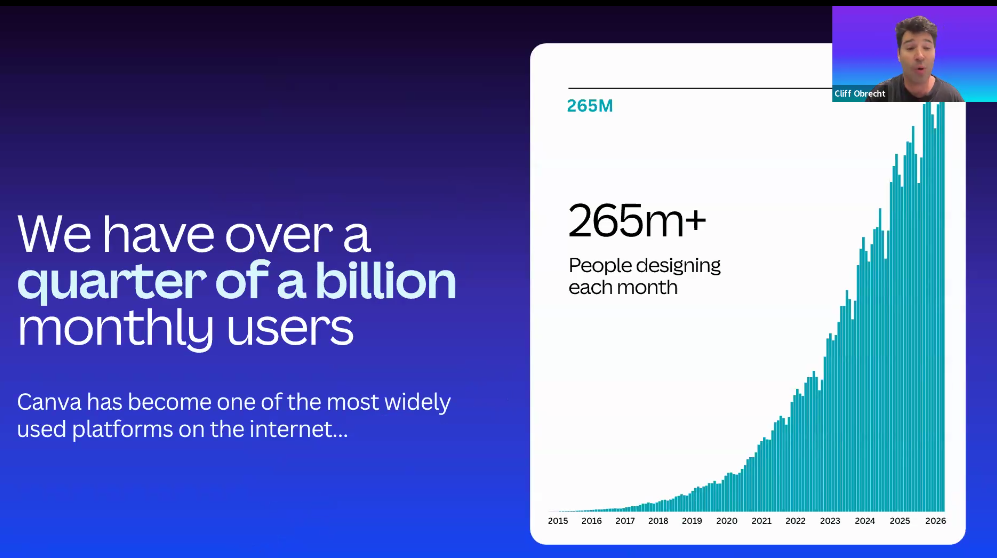
Cliff Obrecht, cofounder and Chief Operating Officer at Canva, revealed that the platform has raced to more than 265 million monthly active users (MAUs). According to Bloomberg, the company had over 100 million MAUs in 2023.
The cofounder further revealed that it now has more than 31 million paid users, up from 24 million this time last year.
The company now has over USD 4 billion in annualized revenue and remains profitable on a free cashflow basis, the cofounder added. Nearly USD 500 million of revenue comes from the company’s growing B2B business.
In the era of AI, Canva is already working with the likes of Claude and ChatGPT
to make the platform ubiquitous. According to Obrecht, its AI tools have been used 27 billion times, while the usage of Canva AI has tripled over the last year.
The cofounder noted that AI is not being leveraged by the world to its full potential yet and that the power of agentic AI is still in the hands of a limited few. An AI-powered Canva, however, looks to lead the democratization efforts.
The India Canvas
India’s base of over 950 million internet users makes it the go-to market for any new or old digital platform. For the longest time, the likes of Google, Meta, and Amazon have thrived on this user base. Even for newer firms like Perplexity or OpenAI, India remains a hot market. And this is also the case for something like Canva. Ankan Dey, Business Growth Lead – India at Canva, tells Entrepreneur India that India is Canva’s fourth-largest market and one of its fastest growing.
“In the last 12 months, we’ve seen over 1 billion designs created in India on Canva. India is also among the top three markets for Canva AI usage globally, and one of the few where Magic Write ranks among our top five AI tools. This tells us our users here aren’t just experimenting, they’re already building with AI. For us, India is very much a scale-first market, and we lean into that,” Dey said.
Dey also noted that the creation behaviour of India users is also shaping the company’s product itself. For instance, there’s a strong momentum around WhatsApp-first communication festival-led marketing, and a thriving startup presentation culture.
This has directly influenced the company’s focus on regional language templates, hyper-local seasonal content, and formats that are quick, collaborative, and easy to share. Canva is also extensively focusing on localising its product in India.
“Today, more than 500 Indian creators co-develop templates, and we engage with over 240,000 freelancers and a large ecosystem of educators who continuously help us improve the platform. Alongside this, we’ve invested in vernacular templates, culturally relevant content, and regional partnerships. Canva is now available in an array of languages, and in a market as diverse as India, the goal is simple, whether you’re building a pitch deck in Hindi or creating a local business flyer in Tamil, the experience should feel intuitive from day one,” he said. The company is looking to deepen its presence in India by investing in its on ground team, which doubled in size in 2024, and by building a product experience that feels truly local while remaining globally connected.
As mentioned above, Canva is also banking on its enterprise foray. Though it’s relatively smaller as of now, enterprise push could help earn more dividends in the future. However, a lot of digital companies have found it quite difficult to get Indians to pay up. They have explored unique strategies like limited time free offer, discounted subscription prices, and ad-based freemium models. Monetization, however, remains a big challenge.
“We are definitely seeing a shift in how enterprises in India think about visual communications. The need is really about speed, consistency, and less friction across creative teams,” Dey said. He noted that the Canva AI 2.0 strives to make that workflow simpler – one place, on-brand by default, and editable end to end.
“But for enterprises, trust is just as important as capability. AI safety is critical to us, and we are committed to deploying AI responsibly. Any new AI tools on Canva go through robust safety reviews and are built with the controls inside Canva Shield, including input and output moderation to help prevent harmful content. We believe AI can transform creativity and design, as long as it is delivered in a safe way that users trust,” he said.
Canva is also looking to tap into India’s SMBs segment, which is becoming increasingly digital savvy.
“We are building for how they actually operate – fast-moving, mobile-first. With offerings like Canva Grow, we are giving teams of all sizes access to advanced AI tools, brand management, and collaboration features in one place, helping them create faster, stay on-brand, and scale their marketing efforts efficiently,” the Canva executive added
Next up
Canva is well-funded – it has raised a total of USD 589 million over 19 funding rounds – and if the cofounder is to be believed, it is doing well financially as well. The AI pivot is likely to keep things fresh and interesting for users as well as industry watchers.
Canva’s exponential growth, strategic pivots, and product improvements give
enough reason not to doubt its resilience. The origin story of Canva – where founder and CEO Melanie Perkins saw multiple rejections in her early days to build a USD 42 billion empire – remains a study for business schools.
Perkins told Entrepreneur India: “It’s never been easier to start an idea but bringing it to life is still too complex and fragmented. We’ve been solving this for more than a decade, and today, more than a quarter of a billion people use Canva every month to turn their ideas into real, usable work.”
Called Canva 2.0, the platform promises a powerful architecture layer with conversational
design, agentic orchestration, object-based intelligence, and intelligent new workflows, among others. Essentially, the new Canva promises to be smarter, understand contextual commands, and ultimately be on par with what an app in 2026 with AI integration must offer.
A deeper push into AI is not very surprising if you have closely tracked the platform. The 14-year-old startup began introducing a few AI functions to its platform a couple of years ago, just around the time a new era of generative AI platforms had ushered in. Canva cleverly called these AI functions “Magic,” probably just to avoid resonance with something that could be very seasonal.