AI Summit 2026: India Joins US-led ‘Pax Silica’ AI Supply Chain Alliance
Pax Silica is said to serve as an alternative to China, which has a major control over critical minerals.
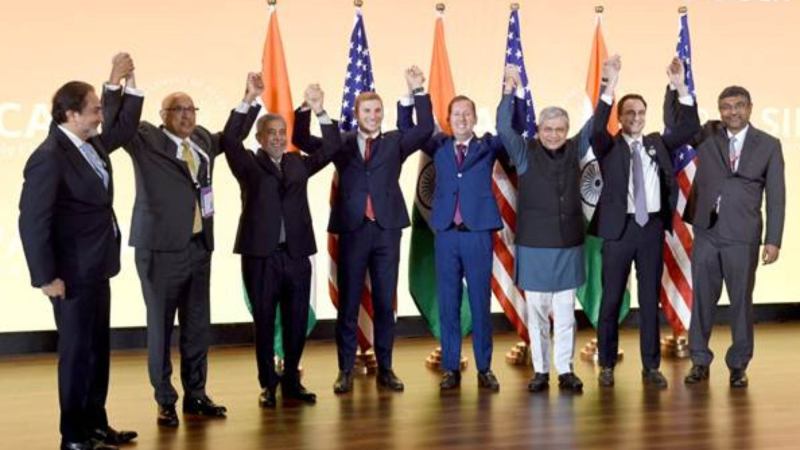
PIB
You're reading Entrepreneur India, an international franchise of Entrepreneur Media.
At the ongoing India AI Impact Summit in New Delhi, India has announced that it has formally joined the Pax Silica alliance.
Launched in December 2025, Pax Silica is a US-led strategic, economic, and technological alliance that focuses on streamlining of global supply chains with regards to semiconductors, artificial intelligence (AI) and critical minerals. The coalition includes Australia, Japan, South Korea, Singapore, the UK, Israel, the UAE, Greece, the EU, and Taiwan, among others.
Apart from securing a “silicon stack” for critical minerals, semiconductor fabrication, the coalition also focuses on reducing “overconcentration in global supply chains, prevent economic coercion, and ensure that emerging technologies are developed and governed by open, democratic societies.”
The announcement also comes amid the two-day India visit of US Under Secretary of State for Economic Affairs Jacob Helberg, who is here to be part of the US delegation to discuss strengthening cooperation on emerging technologies, reports Times of India.
Addressing the gathering, Minister of Electronics and Information Technology Ashwini Vaishnaw said: “We are not just holding a summit; we are building the future,” emphasising that new foundations and new opportunities are being created for the younger generation.
Drawing attention to the power of compounding growth since Independence, he added, “If we look at India’s growth since 1947, we can all imagine the impact of compounding.”
He also highlighted India’s growing semiconductor capabilities, saying, “Today, India’s talented engineers are designing the world’s most advanced two-nanometer chips. The semiconductor industry will require around one million new skilled professionals, and this is a very big opportunity for India.”
Speaking at the signing ceremony, Helberg said: “Today, as we sign the Pax Silica declaration, we say no to weaponized dependency, and we say no to blackmail. Together, we affirm that economic security is national security.”
ALSO READ: AI Impact Summit: Jio’s Billion Dollar Push, Google’s AI Commitment and More
Highlighting the broader ambition behind the initiative, he added, “We are securing the full stack of the future, the minerals deep in the earth, the silicon wafers in our labs and fabs, and the intelligence that will unleash human potential. Pax Silica is our declaration that the future belongs to those who build.”
That said, the coalition is also widely seen as an alternative to China, which has a dominance in the global critical mineral supply chain, necessary to power the next generation of technology.
Separately, Helberg told CNBC the Pax Silica alliance is not just about China.
“Pax Silica is really not about China, it is about America. We want to secure our supply chains,” the US executive is quoted as saying. “We view India as a partner to help de-risk and diversify those supply chains.”
Moreover, the US is also piloting a new “concierge service” designed to facilitate Pax Silica signatories to acquire US-made AI semiconductors more efficiently.
At the ongoing India AI Impact Summit in New Delhi, India has announced that it has formally joined the Pax Silica alliance.
Launched in December 2025, Pax Silica is a US-led strategic, economic, and technological alliance that focuses on streamlining of global supply chains with regards to semiconductors, artificial intelligence (AI) and critical minerals. The coalition includes Australia, Japan, South Korea, Singapore, the UK, Israel, the UAE, Greece, the EU, and Taiwan, among others.
Apart from securing a “silicon stack” for critical minerals, semiconductor fabrication, the coalition also focuses on reducing “overconcentration in global supply chains, prevent economic coercion, and ensure that emerging technologies are developed and governed by open, democratic societies.”

Entrepreneur Staff • Editor
Entrepreneur Staff
For more than 30 years, Entrepreneur has set the course for success for millions of... Read more