Woman of Intent
Through M3M Foundation, Dr. Payal Kanodia is building inclusive rural ecosystems across India, focusing on education, livelihoods, infrastructure, and empowerment to create sustainable community-led development.
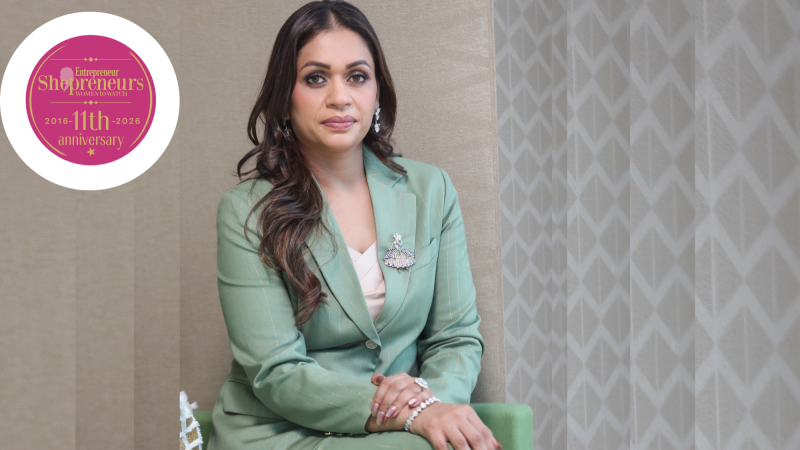
Dr Payal Kanodia, Chairperson & Trustee – M3M Foundation
You're reading Entrepreneur India, an international franchise of Entrepreneur Media.
In the boardrooms of India’s real estate corridors, capital builds skylines. Steel, glass, and ambition redraw the contours of cities. But beyond the towers and gated communities, in more than 1349 villages across 22 states, another kind of construction is quietly underway.
Dr. Payal Kanodia calls it ecosystem building. “I have always seen my elders giving back—from my grandmother to my father,” she says. “But when I studied medicine, I felt the pain that exists in society much more closely. That is when the purpose became stronger.”
Six years ago, that purpose took institutional form in the M3M Foundation. Today, with an annual outlay of nearly INR 100 crore, the Foundation has impacted over 4.9 million lives—spanning education, skilling, employment, women’s empowerment, heritage restoration, environmental conservation, sports, arts, and wildlife preservation.
For Kanodia, philanthropy is not an appendage to enterprise. It is a philosophy of leadership.
As Promoter of M3M Group, Kanodia operates in one of India’s most capital-intensive and scrutinised sectors: real estate. It is a business that thrives on aspiration, urban expansion, and large-ticket investments.
The contrast between luxury real estate and rural intervention is stark. But Kanodia rejects the idea that they are separate narratives. “Real estate builds cities and skylines,” she says. “But social work addresses the grassroots. It is essential for every corporate—not just real estate. If India has to grow, we cannot move forward by making the rich richer and the poor poorer. Everyone has to go hand in hand.” For her, nation-building is not abstract rhetoric. It is practical alignment. Economic growth cannot sustain itself without parallel investment in rural capacity, education, and livelihood. “If we do not address the needs of villages, women, children—those who do not even have means to educate themselves or earn livelihoods—the nation will never be able to grow.” This is not charity. It is systems thinking.
The 360-Degree Doctrine
Kanodia’s approach to philanthropy is structured around what she calls a 360-degree model. It begins with the family. “You cannot focus on one segment and say the job is done. Unless a family grows as a unit—a child, a woman, a youth, the bread earner—growth is incomplete.”
From there, the circle widens: village infrastructure, local leadership, regional ecosystems, national ambition, and ultimately planetary sustainability. The M3M Foundation’s flagship initiatives reflect this multi-layered design:
Sarvoday: Smart village development, including solar lighting, housing, sanitation, and schools.
Mashal: Youth empowerment.
Lakshya & Scholarship Programs: Education, sports development and skilling pathways.
Heritage & Architecture Restoration: Preserving India’s cultural memory.
Environmental & Wildlife Programs: Ecological regeneration.
In Nuh district—an aspirational yet historically underserved region—the Foundation operates across 67 villages. The transformation, Kanodia notes, has been significant. “We are working on complete development of villages—education, skills, sanitation, infrastructure. If these areas become self-sufficient, that is true development.”
The long-term goal is autonomy. Villages should eventually function independently of the Foundation’s daily involvement. “The idea is to make the places we’ve worked in independent—auto mode—so that we can move into new geographies and reach more needs.” Scale, for Kanodia, is measured not in expansion alone, but in replication.
Leadership as Privilege
Kanodia does not frame her role in philanthropic terms as a gendered calling. “It doesn’t come to me naturally because I am a woman. It comes naturally because I feel for the cause.”
Born and raised in a small town in Haryana, she says connecting to rural communities was never difficult. “Nobody is different. Everybody is human.” Her leadership ethos, inherited from family values, rests on one premise: empowerment.
“When you are blessed with means, giving it to the people around you is the most crucial thing. You only grow when people around you grow. You can never grow alone.”
This philosophy permeates the Foundation’s operating model. With about 70 direct team members and a much larger extended network of NGOs, local bodies, and volunteers, Kanodia sees the organisation less as an institution and more as a distributed family. “I’d rather say the entire country is my family.”
Strategically, this decentralised approach also strengthens outcomes. Local NGOs and community leaders drive implementation because they understand their own ecosystems better. “Local people have more impact on their communities. They understand them better.”
Technology and the Rural Future
The next frontier for the Foundation is digitisation. “In the next five years, we want to expand into new geographies and also bring in technology—AI, digitisation—so that rural youth become future-ready.” Her vision of development rejects migration as inevitability.
“A nation becomes truly developed when people do not have to migrate from rural to urban areas for employment, education, or survival.” Livelihood creation, she insists, is only part of the equation. The goal is ecosystem creation. “More than livelihood, we are creating ecosystems.” That ecosystem integrates infrastructure, education, skill-building, and technology—so rural India can compete without displacement.
Perspective and Privilege
Kanodia often visits villages personally. Listening, observing, absorbing. “The children I’ve worked for inspire me the most. Their stories make me feel even more blessed and more motivated.” The exposure reshapes perspective. “The problems we live with in cities are minuscule compared to real issues—no food, no clothes, no direction in life.” She does not diminish urban challenges like pollution. But context matters. When a child lacks parents, education, or daily meals, development debates shift from theory to urgency. This recalibration of perspective appears to anchor her leadership style—grounded, data-backed, but emotionally invested.
Capital with Conscience
The Foundation’s ₹100 crore annual budget is substantial—and growing. “It will keep increasing as needs increase and projects expand.” Unlike traditional CSR allocations tied to percentage mandates, Kanodia treats social investment as scalable capital allocation. Programs expand when they demonstrate impact; resources follow demand.
Her recent initiative, “Payal@40,” launched on her 40th birthday in 2025, is emblematic of that ambition. The goal: multiply the Foundation’s impact across all programs by 40 times by the end of 2026, creating ripple effects potentially 400 times larger. “It’s about making every initiative larger—reaching more and more people.” Milestones become multipliers.
Real Estate and Responsibility
Operating in real estate demands long-term thinking. Cycles are unpredictable; scrutiny is constant.
For Kanodia, credibility comes from consistency of values. “Leadership has always been about giving back.”
Her stewardship philosophy aligns business growth with community development—not as marketing optics, but as structural alignment. Urban growth cannot be sustainable if rural ecosystems collapse. Real estate builds physical assets; philanthropy builds human capacity. The interplay between the two, she suggests, is not contradiction—but continuity.
The Long View
In a decade obsessed with unicorn valuations and rapid expansion, Kanodia’s tempo is deliberate. Villages must become self-sustaining. Programs must integrate. Impact must be measurable. Scale must be responsible.
Her ambition is national—but rooted in local transformation.
When asked what defines success, she does not cite awards or metrics first. She returns to purpose. “If I am able to change one life, transform one life, my purpose is fulfilled.”
Yet the scale suggests she intends to transform millions more.
Woman of Intent
Dr. Payal Kanodia’s leadership sits at a rare intersection: capital-intensive enterprise and grassroots intervention. Few leaders straddle both with equal conviction. Her model reframes philanthropy from donation to design. From episodic intervention to ecosystem architecture. From optics to operating principle.
In a country negotiating rapid urbanisation alongside persistent rural disparity, her approach underscores a broader thesis: India’s growth story will be incomplete unless inclusion is engineered into its foundation. Skylines may define a city’s ambition. But ecosystems define a nation’s resilience. Kanodia is building both.
In the boardrooms of India’s real estate corridors, capital builds skylines. Steel, glass, and ambition redraw the contours of cities. But beyond the towers and gated communities, in more than 1349 villages across 22 states, another kind of construction is quietly underway.
Dr. Payal Kanodia calls it ecosystem building. “I have always seen my elders giving back—from my grandmother to my father,” she says. “But when I studied medicine, I felt the pain that exists in society much more closely. That is when the purpose became stronger.”
Six years ago, that purpose took institutional form in the M3M Foundation. Today, with an annual outlay of nearly INR 100 crore, the Foundation has impacted over 4.9 million lives—spanning education, skilling, employment, women’s empowerment, heritage restoration, environmental conservation, sports, arts, and wildlife preservation.

Entrepreneur Staff • Editor
Entrepreneur Staff
For more than 30 years, Entrepreneur has set the course for success for millions of... Read more