Karnataka Tech’s $868 Million Q1: Bigger Bets and Selective Exits
Bengaluru continued to overwhelmingly dominate Karnataka’s startup funding landscape, accounting for 98 per cent of total capital raised during the quarter at USD 848 million.
Opinions expressed by Entrepreneur contributors are their own.
You're reading Entrepreneur India, an international franchise of Entrepreneur Media.
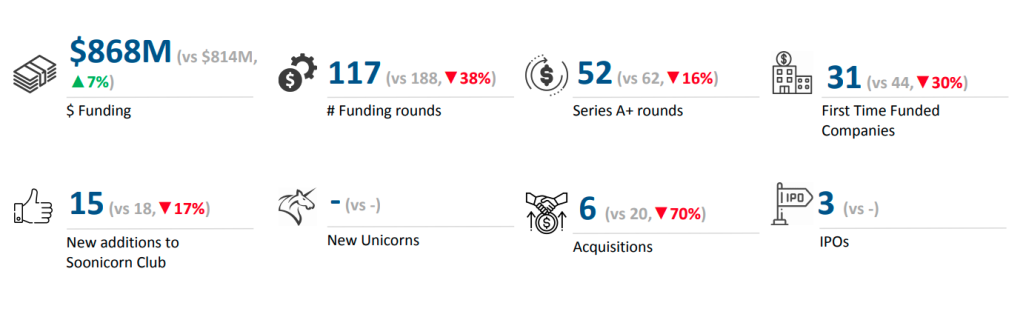
Karnataka’s tech ecosystem raised USD 868 million across 117 rounds during the quarter, with Bengaluru contributing 98 per cent of the total capital deployed, according to a Tracxn report.
While the topline funding number remained substantial, the quarter revealed a shift in investments: seed-stage funding accelerated sharply even as late-stage activity slowed, and all three IPOs from the quarter were concentrated within a brief January window.
Enterprise Applications, Retail, and FinTech continued to lead sector-wise capital deployment.
Seed Funding Surges Despite Slower Deal Activity
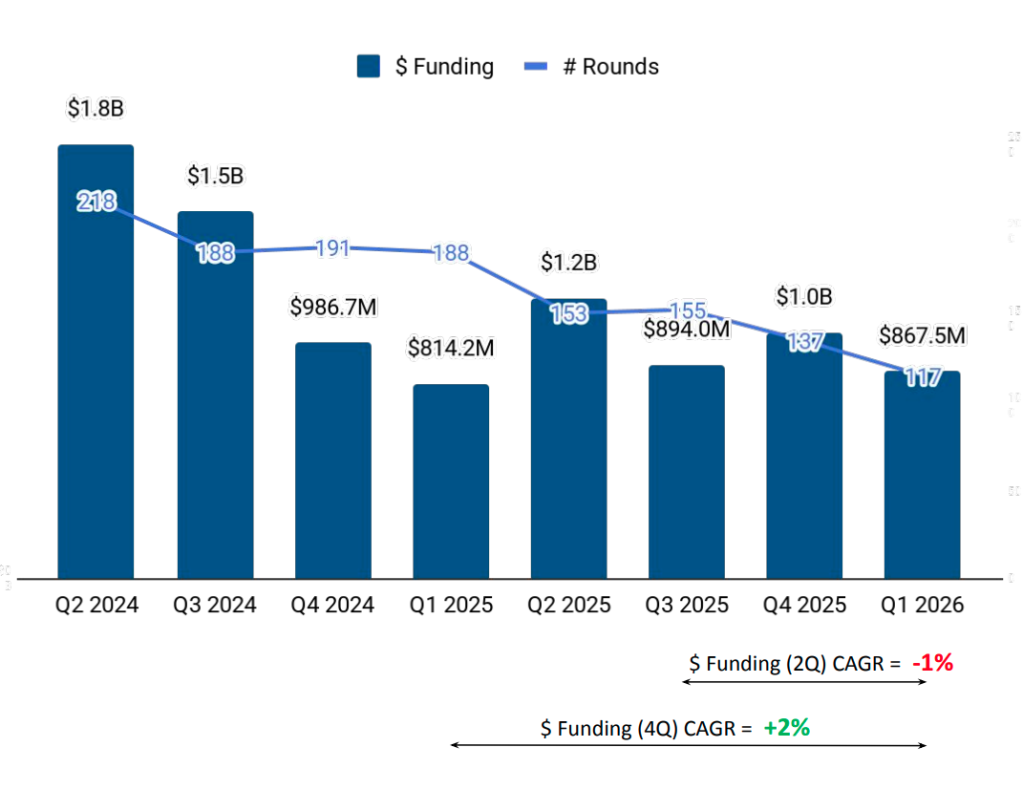
Karnataka-based startups raised USD 137 million in seed funding during Q1 2026, marking a 51 per cent jump from USD 90.5 million a year earlier. At the same time, the overall number of funding rounds fell 38 per cent, declining from 188 to 117 rounds. The trend suggests investors are becoming more willing to back companies at the formation stage while turning more selective toward larger growth-stage deployments.
Early-stage funding remained at USD 414 million across 41 rounds, up 7 per cent year-on-year. In contrast, late-stage funding fell sharply to USD 317 million across 11 rounds, down 43 per cent.
Among seed investors, Fundamentum, Blume Ventures, and Antler each completed three investments during the quarter.
Fundamentum invested in Olyv, which was its 11th and final investment from Fundamentum’s Fund II, launched in 2022. Mayank Kachhwaha, Investor and Fintech Thesis Lead at Fundamentum, said, “What makes this moment particularly relevant is the broader shift underway in India’s lending landscape. The ecosystem is entering its next phase of maturity, supported by the foundational rails of India Stack. Olyv’s credit-first, tech-led model is aligned with this shift.”
The firm also led teh USD 15 million invested in Whizzo, the material science-based manufacturing company.
Ashish Kumar, Cofounder and General Partner, Fundamentum, said, “Whizzo is a standout example of Fundamentum’s Applied DeepTech thesis in the B2B supply-chain domain, a business scaling rapidly while building defensible innovation at its core. The materials-science lab in particular is Whizzo’s strong long-term moat, enabling upstream research, rapid iteration, and IP creation.”
Capital-A also closed three deals through investments in InfinityBox, CraftifAI, and Misochain. Peak XV Partners led early-stage activity with six investments, followed by Lightspeed Venture Partners with five deals, more than quadrupling its Karnataka deployment compared to Q1 2025, while Accel participated in two rounds.
Venturi Partners emerged as the only active venture investor in that segment, participating in Supertails’ Series C round.
Mature Startups Dominate Large Funding Rounds
The largest funding round of the quarter came from Zetwerk, which raised ISD 53 million in a Series F round backed by Pantomath Group. It was followed by Ultrahuman’s USD 48 million Series C and Cult.fit’s USD 47 million Series G round backed by Temasek. Porter also raised USD 47 million in a Series F round from Wellington and Kedaara.
By business model, On-Demand Manufacturing Services attracted the highest capital deployment at USD 52.8 million, followed closely by DTC Fitness Tracker Brands at USD 48 million and Employee Healthcare Services at USD 47 million.
Further down the funding table, several Series A rounds ranging between USD 13 million and USD 30 million reflected broad-based investor appetite across sectors. These included fintech players such as Juspay, Stable Money, and Olyv, B2B payments company XFlow, aerospace startup Bellatrix Aerospace, and AI infrastructure companies Portkey and Nurix.
Among thematic sectors, Fitness-wellness Tech attracted the highest total funding at USD 97.1 million, followed by Employee Health IT at USD 67.5 million and Payments at USD 61.1 million, underlining continued investor interest in healthcare and financial infrastructure platforms.
IPO Activity Returns as Exits Slow Elsewhere
Three Karnataka-based companies went public during Q1 2026: Amagi at a market capitalisation of USD 858 million, Shadowfax at USD 782 million, and e2E Rail at USD 33.3 million. The listings signalled renewed confidence in Karnataka’s public market pipeline and the growing maturity of the state’s startup ecosystem.
On the acquisitions front, six deals were recorded during the quarter. The largest disclosed transaction was Marico acquiring Bengaluru-based Cosmix for USD 24.9 million. In another notable transaction, Unacademy was acquired by upGrad as consolidation within the edtech sector continued. WeCP was also acquired by Invisible Tech.
The six acquisitions marked a steep decline from 20 deals recorded during the same period last year, with acquirers spanning India, the United States, and Germany.
BharatAgri, which had previously raised USD 15 million in funding, was the only funded startup to be deadpooled during the quarter, a relatively contained outcome despite the broader slowdown in deal activity.
Meanwhile, Supertails and Assiduus entered the Soonicorn Club during Q1 2026, taking Karnataka’s total Soonicorn count to 120 companies.
Bengaluru Continues to Dominate Karnataka’s Startup Capital
Bengaluru continued to overwhelmingly dominate Karnataka’s startup funding landscape, accounting for 98 per cent of total capital raised during the quarter at USD 848 million.
Tiptur represented the remaining 2 per cent, attracting USD 19.3 million entirely through Akshayakalpa’s Series D round.
Karnataka’s tech ecosystem raised USD 868 million across 117 rounds during the quarter, with Bengaluru contributing 98 per cent of the total capital deployed, according to a Tracxn report.
While the topline funding number remained substantial, the quarter revealed a shift in investments: seed-stage funding accelerated sharply even as late-stage activity slowed, and all three IPOs from the quarter were concentrated within a brief January window.
Enterprise Applications, Retail, and FinTech continued to lead sector-wise capital deployment.

Prince Kariappa • Features Content Writer
Entrepreneur Staff