Deep Pockets, More Burn: India’s Instant Househelp Market Heats Up
The recent earnings report from Urban Company gives a glimpse of what it takes to scale an instant househelp ecosystem.

pixabay
Opinions expressed by Entrepreneur contributors are their own.
You're reading Entrepreneur India, an international franchise of Entrepreneur Media.
Instant househelp is a new category in the gig economy space and quick commerce – sort of – which is gaining massive traction at the moment.
Just recently, Pronto received $20 million in investment from Lachy Groom. The extended series B round valued the company at $200 million, which is nearly double of what it was a month ago. Founded in 2025 by Anjali Sardana, the company has raised $60 million to date.
Another new entrant in this space is Snabbit, which in April raised $56 million in a Series D round. The startup is backed by the likes of Susquehanna VC, Mirae Asset Venture Investments, and Bertelsmann India Investments. To date, Snabbit has raised $112 million in total funding.
Naturally, the two startups will be expanding their reach in the country in the coming months. Massive funding indicates a relatively aggressive pace of this, though.
Another company, a relatively larger one, to bet big on this space is Urban Company. The company had successfully completed its INR 1,900 crore Initial Public Offering (IPO) in September 2025.
Burning capital
The recent earnings report from Urban Company gives a glimpse of what it takes to scale an instant househelp ecosystem. For sure there’s a demand, but the cost?
UC reported a revenue of Rs 425.5 crore Q4 FY26 from Rs 298.45 crore in the same quarter last year. The instant househelp category is still at a nascent stage with revenue contribution of INR 8.94 crore during the quarter while majority of revenue is coming from the core business.
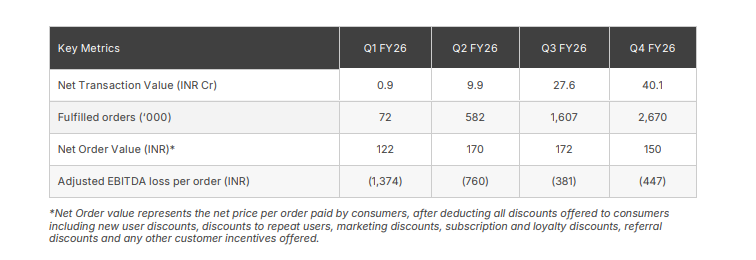
Source: Urban Company (shareholders’ letter)
The new segment has also pushed UC in the red. And this is likely to continue with the company planning to scale deeper and faster.
“InstaHelp, our high-frequency housekeeping service, is scaling quickly and remains our most aggressive investment. From near-zero at the start of FY26, we exited Q4 at ~2.7 million orders and INR 40 Cr of NTV, with March alone crossing 1.1 million orders. Q4 Adjusted EBITDA loss was INR (119) Cr, reflecting two sided subsidies to densify the network, supply onboarding, and marketing for new trials. Losses will stay elevated in coming quarters as we invest to cement leadership,” the company said in its shareholders letters.
“We are happy to have found InstaHelp. A business that did not exist until a year ago, fulfilled 2.7 million orders last quarter, with March alone crossing 1.1 million orders. Already rated 4.70 out of 5 by customers, it is approaching within its first year the quality benchmark of a platform built over a decade. Our most aggressive new vertical scaleup, and we are investing in it with conviction.”
But there’s a growing demand
Given the exponential demand and increasing competition, it’s understandable that the likes of UC are willing to burn and speed up expansion. Even as the UC has reported nearly 2.7 million orders with INR 40 crore of net transaction value in the Q4 2026. Moreover, it said in March alone it had recorded 1.1 million orders.
Meanwhile, Snabbit recently said it processed over 40,000 jobs daily and exceeded 1 million monthly orders. Pronto reported hitting 500,000 bookings and 22,000 daily orders in the month of March.
Likely, these numbers are going to inflate in the coming months and quarters.
Ajay Trehan, Founder and CEO of AuthBridge, explains that the quick househelp sector is witnessing significant growth because urban households are facing a very real gap between need and availability. Families are looking for dependable support for cleaning, cooking assistance, elderly care, childcare, repairs, and short-duration household tasks, but the traditional model continues to remain largely informal, referral-led and inconsistent. Platforms are now attempting to bring greater structure to this space by making availability, pricing, scheduling and service discovery more predictable.
He further said that the larger opportunity here is not just convenience, it is trust. When someone enters a home, the customer is not merely purchasing a service; they are making a personal security decision. This makes verification, identity checks, prior work records, address validation, grievance handling and service accountability extremely important.
“The challenge is that this sector cannot be built like a simple delivery model. Homes are sensitive environments, and workers also deserve dignity, fair treatment, and protection from arbitrary exclusion. The companies that will scale successfully will be those that combine speed with verified worker onboarding, transparent processes, and responsible platform conduct,” said Trehan.
Gig economy
India’s gig economy has largely been unorganized though it’s quite massive in size. According to NITI Aayog’s report titled India’s Booming Gig and Platform Economy, gig workers in India are expected to grow to 23.5 million (2.35 crore) by 2029–30.
In the past, the companies have had difficulties managing the gig space. For instance, back in 2022, Uber faced heat over driver commissions. Even UC was under the spotlight in 2023 over commissions and a safer environment for its gig partners.
Just recently, the Indian government asked quick commerce platforms to remove the 10-minute delivery deadline. Quick commerce companies had come under fire over allegations of inadequate conditions for their gig workers, essentially delivery partners who deliver items to customers’ doorsteps. On December 31, 2025, several delivery partners went on strike protesting against these quick commerce companies.
Earlier this month, the government notified the Code on Social Security, 2020 which aspires to bring India’s gig and platform workers into India’s social security framework.
Industry experts believe that customer trust and worker rights cannot be treated as separate conversations. In the quick househelp ecosystem, the two are deeply connected. Customers want confidence in who is entering their homes, while workers expect fair treatment, transparent payouts, and protection from arbitrary removal or bias.
“As the gig economy evolves towards greater accountability, companies can no longer scale on speed alone. The stronger and more sustainable model will be one where verification builds trust for customers, while transparent processes, grievance redressal, insurance support, and fair record management create a more secure and dignified ecosystem for workers,” Trehan added.
Instant househelp is a new category in the gig economy space and quick commerce – sort of – which is gaining massive traction at the moment.
Just recently, Pronto received $20 million in investment from Lachy Groom. The extended series B round valued the company at $200 million, which is nearly double of what it was a month ago. Founded in 2025 by Anjali Sardana, the company has raised $60 million to date.
Another new entrant in this space is Snabbit, which in April raised $56 million in a Series D round. The startup is backed by the likes of Susquehanna VC, Mirae Asset Venture Investments, and Bertelsmann India Investments. To date, Snabbit has raised $112 million in total funding.