TIS 2026: Beyond Equity, Debt & Structured Capital for Scaling AI Companies
The opportunity lies less in backing pure-play AI startups and more in enabling the broader ecosystem, tools, infrastructure, and applied use cases that will define India’s AI trajectory.
You're reading Entrepreneur India, an international franchise of Entrepreneur Media.
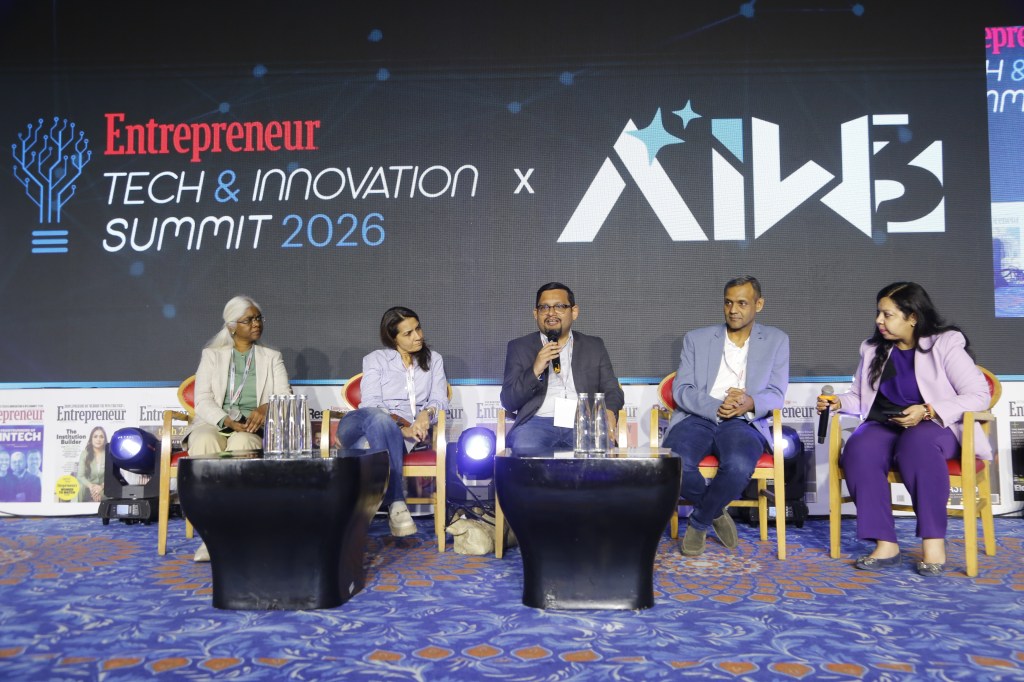
At Entrepreneur India’s Tech & Innovation Summit 2026, a panel of investors and technology leaders unpacked a critical question shaping India’s startup ecosystem: Is the country ready for AI financing at par with global markets, and does the traditional debt model even apply to this new paradigm?
For lenders like Ashish Gala, Managing Partner, VentureSoul Partners, the fundamentals remain unchanged. “Whether it’s AI or anything, we are lenders first… the fundamentals of the company in terms of their revenue model, their predictability, their cash flows, and the ability to eventually service debt… the credit 101 principles do not change,” said Gala. However, he acknowledged that AI’s rapid evolution demands closer monitoring and tighter collaboration with equity investors.
Arijit Sarkar, Partner, Trifecta Capital, pointed out the lack of historical data in India’s AI ecosystem. “There aren’t so many AI companies in India which have a track record of two, three years or more… we’re still very early in the journey,” he noted.
While infrastructure-heavy AI plays, particularly those involving hardware, are more amenable to debt due to tangible collateral, most AI startups in India are still experimenting with business models.
“Most of those questions are still open and unanswered,” he added, underscoring why venture debt players are still studying the space rather than aggressively deploying capital.
Tarana Lalwani, Founding Partner, InnoVen Capital, provided a global comparison, highlighting how debt has already played a significant role in funding AI infrastructure in markets like the US. “A lot of money has gone into these sorts of AI infra businesses,” she said, citing examples where debt has funded large-scale compute and platform plays. In contrast, India remains nascent. “Right now, debt has funded 2 per cent of AI… It’s a matter of time before it comes to India.”
From the demand side, Geetha Adinarayan, CTO, IBM Consulting, India and South Asia, offered a more ground-level view of AI adoption.
“AI is not just here… it is how do I get value from it?” Adinarayan said, pointing to real-world inefficiencies across sectors like insurance, banking, and healthcare.
She argued that while infrastructure and platforms are foundational, the real value in India lies in application-layer innovation. “The value seems to be on the top tier… I’m going to leverage these and then create the value,” she explained, adding that experimentation, though hard to finance initially, will eventually drive demand for capital.
When it comes to founders deciding between debt and equity, the panel emphasized balance and timing. Gala advised caution: “Only take that much that allows you to sleep at peace… don’t take it more, but don’t leave it at zero either.”
Sarkar reinforced that debt becomes relevant only after a startup achieves a degree of predictability. “As long as the mentality is around survival, debt can only be a small part of your journey… when the mindset starts shifting into efficiency and growth, that’s where debt really helps,” he said.
Beyond AI, the panel identified emerging sectors attracting capital. Climate tech, EVs, and green energy are seeing strong momentum, alongside a resurgence in deep tech spanning aerospace, defense, and space. “Very out-of-the-box, futuristic… ideas which require a lot of R&D,” Sarkar noted, highlighting the need for patient capital.
The conversation also touched on the role of imagination in investing, an area where human judgment still outpaces machines. “Imagination is more powerful than knowledge,” Adinarayan remarked. “The imagination is going to actually give you far more return than the past… that’s something that LLM doesn’t have access to today.”
Ultimately, the panel converged on a clear thesis: India’s AI financing ecosystem is still in its formative stages. While traditional debt frameworks remain relevant, their application will evolve alongside the maturity of AI businesses. For now, the opportunity lies less in backing pure-play AI startups and more in enabling the broader ecosystem, tools, infrastructure, and applied use cases that will define India’s AI trajectory.
At Entrepreneur India’s Tech & Innovation Summit 2026, a panel of investors and technology leaders unpacked a critical question shaping India’s startup ecosystem: Is the country ready for AI financing at par with global markets, and does the traditional debt model even apply to this new paradigm?
For lenders like Ashish Gala, Managing Partner, VentureSoul Partners, the fundamentals remain unchanged. “Whether it’s AI or anything, we are lenders first… the fundamentals of the company in terms of their revenue model, their predictability, their cash flows, and the ability to eventually service debt… the credit 101 principles do not change,” said Gala. However, he acknowledged that AI’s rapid evolution demands closer monitoring and tighter collaboration with equity investors.
Arijit Sarkar, Partner, Trifecta Capital, pointed out the lack of historical data in India’s AI ecosystem. “There aren’t so many AI companies in India which have a track record of two, three years or more… we’re still very early in the journey,” he noted.

Entrepreneur Staff • Editor
Entrepreneur Staff
For more than 30 years, Entrepreneur has set the course for success for millions of... Read more