TIS 2026: AI Banking, Predictive Risk & the Future of Financial Intelligence
The conversation around “Fintech 3.0” quickly moved past buzzwords into something more grounded: how AI is actually reshaping financial services in real time, and where it still falls short.
You're reading Entrepreneur India, an international franchise of Entrepreneur Media.
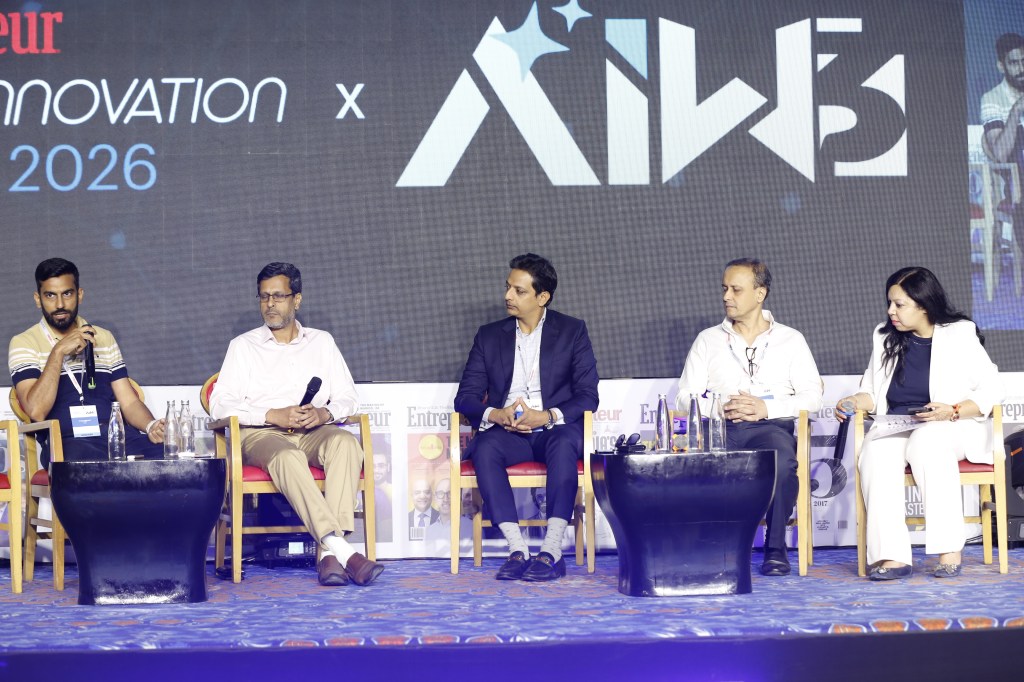
At Entrepreneur India’s Tech & Innovation Summit 2026, the conversation around “Fintech 3.0” quickly moved past buzzwords to something more grounded: how AI is reshaping financial services in real time and where it still falls short.
Opening the discussion, Managing Editor Punita Sabharwal posed a deceptively simple question: has AI fundamentally changed fintech? The answers from operators, investors, and technologists revealed a sector in transition, one where AI is no longer experimental, but not yet fully transformative.
Anup Agrawal, Co-Founder and CEO of Kiwi, said the shift is already visible at the consumer layer. Moving beyond generic campaigns, fintech is entering an era of hyper-personalization driven by behavioral data. Anup said, “You get an offer of 50 per cent off on your next gym, and the consumer doesn’t go to the gym… or maybe the renewal is in December, he’s getting the offer in the month of May. So, offer is irrelevant.”
Kiwi’s response is an agentic AI-driven offer engine that dynamically creates and deploys personalized offers at scale. “We want to issue 500 parallel offers real time on a weekly basis… generating the creative, the terms and conditions, and pushing into the app all real time,” Agrawal said, highlighting how traditional campaign-based systems are giving way to continuous, individualized engagement.
At the infrastructure layer, Ramkumar Venkatesan, CEO of Cashfree Payments, emphasized a problem set: fraud and security. With over USD 80 billion in annual transaction volume, the challenge is not just scale. “With that wealth of knowledge… we have a massive graph database of all the signals… With that, we are able to prevent fraud,” he said.
“If it takes more than a few seconds, people will cancel… So how do we scale security?” he asked, outlining adaptive systems that assess risk in real time without degrading user experience. The stakes are rising further with deepfakes and AI-generated fraud. “We use AI to beat AI… this is going to be a cat-and-mouse game,” he added.
From an investor’s POV, Sagar Agarwal of Beams FinTech Fund sees AI as both an opportunity and a filter. While conversations around AI dominate boardrooms, he remains cautious about measurable impact.
“There’s definitely a lot of conversations… we have to still see massive ROI change. We think about decades… what will happen in India in the next 10 years,” he said, pointing to opportunities across payments, lending, insurance, and wealth.
The most promising use cases, according to him, lie not just in customer-facing innovation but in internal transformation. “A lot of internal workflows were earlier driven by a bunch of human bodies… now AI is solving for a lot of that very fast.”
Joydip Gupta of Scienaptic Global brought in a regulatory dimension: explainability. In highly regulated domains like lending, AI cannot remain a black box. “If they say it is on the basis of the AI model… that’s not a good answer,” he said. His firm addresses this by breaking down decisions at an individual level. “We are able to explain why we declined that application or why we approved it, and exactly what parameters went in.”
This tension, between sophistication and accountability, remains one of the biggest constraints on AI adoption in financial decision-making.
As the discussion turned to fraud, the panel converged on a sobering reality: AI is amplifying both defense and attack. Companies like Cashfree have reduced fraud by 70 per cent. Gupta cautioned against simplistic metrics: “You detected 80 per cent, but classified another 1,000 as potential frauds… that just kills your fraud analysis team.”
Ultimately, when asked to pick where AI delivers the most value today, efficiency, personalization, or customer experience, the consensus leaned decisively toward efficiency. Agrawal was blunt: “Coding is a skill… not going to be any alpha creator… efficiency is clearly something which has panned out.”
But the broader impact may still be unfolding. As Venkatesan put it, “Efficiency will be the input metrics. But the outcome… all of us will be in a better place with AI helping humans.”
At Entrepreneur India’s Tech & Innovation Summit 2026, the conversation around “Fintech 3.0” quickly moved past buzzwords to something more grounded: how AI is reshaping financial services in real time and where it still falls short.
Opening the discussion, Managing Editor Punita Sabharwal posed a deceptively simple question: has AI fundamentally changed fintech? The answers from operators, investors, and technologists revealed a sector in transition, one where AI is no longer experimental, but not yet fully transformative.
Anup Agrawal, Co-Founder and CEO of Kiwi, said the shift is already visible at the consumer layer. Moving beyond generic campaigns, fintech is entering an era of hyper-personalization driven by behavioral data. Anup said, “You get an offer of 50 per cent off on your next gym, and the consumer doesn’t go to the gym… or maybe the renewal is in December, he’s getting the offer in the month of May. So, offer is irrelevant.”

Entrepreneur Staff • Editor
Entrepreneur Staff
For more than 30 years, Entrepreneur has set the course for success for millions of... Read more