The Shining Star
Tamannaah Fine Jewellery redefines everyday luxury with versatile, modern heirlooms blending timeless design, wearability, and contemporary elegance for urban consumers.
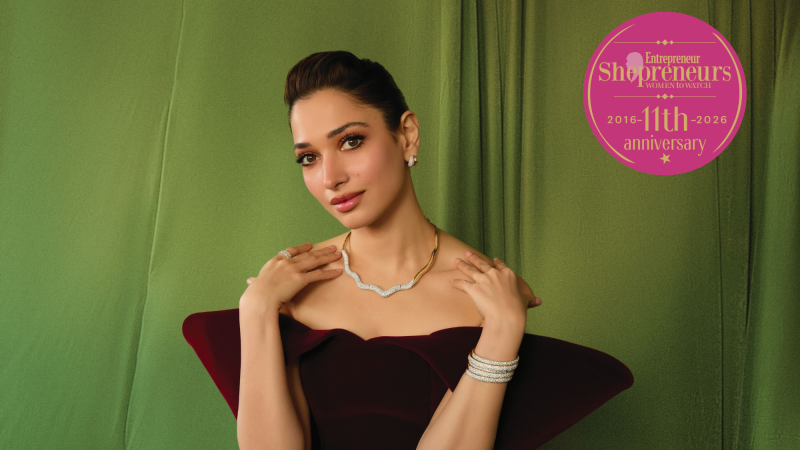
TAMANNAAH BHATIA, ACTOR & FOUNDER, TAMANNAAH FINE JEWELLERY
You're reading Entrepreneur India, an international franchise of Entrepreneur Media.
On a weekday afternoon, Tamannaah Bhatia isn’t on a film set. She’s inside her jewelry store, adjusting a display, speaking to walk-in customers, listening to what they like, what they hesitate over, what they try on twice before buying. “For someone like me who’s starting off in a completely new space,” she says, “it’s very important that I’m connected with my consumer.” For an actor who has spent nearly two decades in front of the camera—across Telugu, Tamil and Hindi cinema—that shift is telling.
The move isn’t as sudden as it sounds. Her father has been a jeweler for over 15 years, quietly building operations and understanding the rhythms of India’s fine jewelry market. Today, he supports her venture both commercially and operationally. “He’s the wind beneath my wings,” she says, without hesitation. But this is not a legacy extension. It is a reinterpretation. Under the label Tamannaah Fine Jewellery, Bhatia is attempting to redefine how urban India wears fine jewelry—not as locker-bound assets reserved for weddings, but as “better basics” for everyday luxury. “I see India wearing fine jewelry differently,” she says. “A lot of brands talk about ‘no locker jewelry’—wear it every day. But unless it’s truly wearable and elevated, it’s hard to do that.” Her solution: neutralized, versatile design. Hoops that double as ear climbers. Pinky rings with presence. T-bar necklaces that transition from T-shirt to pantsuit. “I want them to feel like modern heirlooms,” she says. “If someone passes down a piece, it should still feel relevant.”
Jewelry in India is crowded. Celebrity-backed brands are even more so. But Bhatia is clear: this is not a celebrity-led vanity project. “I don’t look at this as a celebrity brand. I’m a new jeweler,” she says plainly. Her differentiation lies in design language. She describes the space between generic everyday gold and high-design couture jewelry as underserved. Her bet is on elevated basics—designer pieces within everyday fine jewelry. Vintage forms, especially Victorian influences, inspire her. Duality—a recurring theme in her philosophy—finds its way into the brand’s core: masculine and feminine, sun and moon, strength and softness. “We celebrate duality,” she says. “We’re all dual. Like Ardhanarishvara—half man, half woman. That inspires me.”
Even expansion plans reflect balance. The brand currently operates one store and an online presence. Over the next one to two years, she intends to grow cautiously—perhaps one or two more stores—before scaling nationally across metropolitan and interior India. The long-term vision includes global expansion, but not prematurely.
For someone used to the collaborative chaos of film sets, entrepreneurship has required a different kind of discipline. The biggest challenge? Maintaining homogeneous communication—from product to retail space to website. “You feel like you can outsource these things,” she says. “But eventually, one voice must translate.” On a movie set, that voice belongs to the director. In this venture, it’s hers. Founder titles sound glamorous. The reality, she admits, involves “neck-breaking, back-breaking work.” And yet, her cinematic training has proved unexpectedly useful. “I’ve been part of commercial blockbusters,” she says. “Art is for people. Not for me consuming in my house.” That philosophy applies to jewelry. Designs must be wearable, accessible and repeat-purchase worthy.
In an industry often accused of typecasting women, Bhatia has sustained relevance across languages and formats—cinema and OTT alike. Her reinvention strategy is simple: openness. “I don’t get married to a version of myself that doesn’t serve my today or tomorrow,” she says. Pre-pandemic, she moved into streaming projects when peers questioned the shift. Today, the decision appears prescient. She speaks openly about AI and technological disruption, emphasizing adaptability over nostalgia. When it comes to negotiating power—creatively or commercially—she chooses her battles carefully. “I fight the battles that must be fought. I don’t get into teeny, exhausting ones,” she says. “My real power is my connection with people.”
Bhatia is part of a generation of women in entertainment who are actively shaping their own wealth narratives. She notes that today’s ecosystem offers more financial literacy, better advisory access and greater control than it did 10–15 years ago. Her own money philosophy is unconventional. “You should spend your money,” she says. “Money rotates. You have to give for it to come back.” It’s not recklessness—it’s circulation. Capital, in her view, must move to generate value.
When asked about long-term legacy—awards, assets or impact—she pauses. Before launching the brand, she says, she rarely thought about legacy. “I just felt there was a gap in the market.” But jewelry changes the equation. “I’m aware we are mortal,” she says quietly. “I will create as long as I survive. The good part is my fine jewelry will live on longer than I would.” For an actor whose performances are immortalized on screen, that statement carries weight.
On a weekday afternoon, Tamannaah Bhatia isn’t on a film set. She’s inside her jewelry store, adjusting a display, speaking to walk-in customers, listening to what they like, what they hesitate over, what they try on twice before buying. “For someone like me who’s starting off in a completely new space,” she says, “it’s very important that I’m connected with my consumer.” For an actor who has spent nearly two decades in front of the camera—across Telugu, Tamil and Hindi cinema—that shift is telling.
The move isn’t as sudden as it sounds. Her father has been a jeweler for over 15 years, quietly building operations and understanding the rhythms of India’s fine jewelry market. Today, he supports her venture both commercially and operationally. “He’s the wind beneath my wings,” she says, without hesitation. But this is not a legacy extension. It is a reinterpretation. Under the label Tamannaah Fine Jewellery, Bhatia is attempting to redefine how urban India wears fine jewelry—not as locker-bound assets reserved for weddings, but as “better basics” for everyday luxury. “I see India wearing fine jewelry differently,” she says. “A lot of brands talk about ‘no locker jewelry’—wear it every day. But unless it’s truly wearable and elevated, it’s hard to do that.” Her solution: neutralized, versatile design. Hoops that double as ear climbers. Pinky rings with presence. T-bar necklaces that transition from T-shirt to pantsuit. “I want them to feel like modern heirlooms,” she says. “If someone passes down a piece, it should still feel relevant.”
Jewelry in India is crowded. Celebrity-backed brands are even more so. But Bhatia is clear: this is not a celebrity-led vanity project. “I don’t look at this as a celebrity brand. I’m a new jeweler,” she says plainly. Her differentiation lies in design language. She describes the space between generic everyday gold and high-design couture jewelry as underserved. Her bet is on elevated basics—designer pieces within everyday fine jewelry. Vintage forms, especially Victorian influences, inspire her. Duality—a recurring theme in her philosophy—finds its way into the brand’s core: masculine and feminine, sun and moon, strength and softness. “We celebrate duality,” she says. “We’re all dual. Like Ardhanarishvara—half man, half woman. That inspires me.”

Punita Sabharwal • Managing Editor, Entrepreneur India
Entrepreneur Staff
Punita Sabharwal is the Managing Editor of Entrepreneur India.