Why Are Standalone AI Security Platforms Under The Spotlight?
Big tech companies, including legacy cybersecurity firms, are writing big checks to AISPs. But why?

pixabay
Opinions expressed by Entrepreneur contributors are their own.
You're reading Entrepreneur India, an international franchise of Entrepreneur Media.
Standalone AI Security Platforms (AISPs) are increasingly becoming a hot commodity in the global AI race. Big tech companies, including legacy cybersecurity firms, are writing big checks as well.
Last year, the global cybersecurity firm Palo Alto acquired Protect AI, a firm working toward securing Artificial Intelligence applications and models.
This year, Palo Alto said it would acquire Koi, an Israeli startup that builds Agentic Endpoint Security solutions, for nearly USD 400 million. Palo Alto has also acquired the global identity security giant CyberArk.
Similarly, Check Point took over Lakera, a Swiss AI security startup, for approximately USD 300 million. Zscaler has acquired SquareX to improve AI security when accessed via a browser, whereas SentinelOne acquired Observo AI. Another notable acquisition is Veeam’s Securiti AI.
Most importantly, hyperscalers are also rallying behind this trend. For instance, Google acquired Wiz for nearly USD 32 billion. Wiz is known for its cloud-native security solutions focused on vulnerabilities in AI data pipelines and multi-cloud workflows.
It’s natural to wonder why tech companies, including hyperscalers, are stepping up these acquisitions.
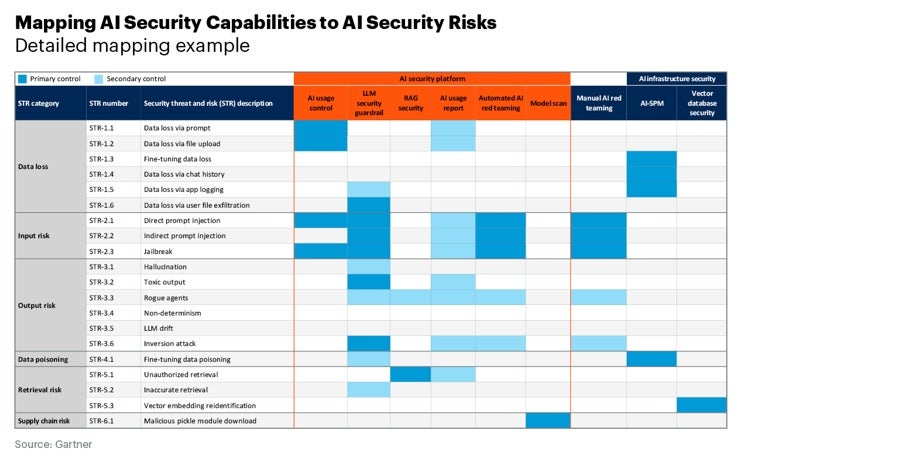
Speaking to Entrepreneur India on the sidelines of the Gartner Security & Risk Management Summit 2026, Manjunath Bhat, Distinguished VP Analyst, explained: “Think of AI security platforms as doing for AI what CNAPP (Cloud-Native Application Protection Platforms) did for cloud-native applications.”
“The first is what we call AI Usage Control. This pillar is primarily intended for securing the consumption of AI services. If you want to enable the secure consumption of AI, you would use AI usage control tools. The second pillar of the AI security platform is AI Application Security. This is primarily used by software engineers and security engineers; think of this as DevSecOps for AI,” he added.
In his keynote speech at the summit, he also stressed the importance of such AISPs for AI discovery and inventory management, AI access control, sensitive data protection, and risky AI management, among others.
Separately, Rahul Balakrishnan, Senior Director Analyst at Gartner, also backed AISPs, equating them with third‑party cyber-risk management (TPCRM).
He said: “As regulatory guidance around TPCRM has accelerated globally and in India over the last five years, cybersecurity leaders must use the expanding and prescriptive regulatory mandates to transform TPCRM risk into clear business requirements that drive the investment roadmap.”
“As developing GenAI applications in-house is costly, many organizations rely on third‑party LLMs or GenAI-enabled SaaS solutions, making it critical for CISOs to have a clear view of the data security controls these third parties have in place to protect the organization’s data held in third-party environments.”
According to Gartner, by 2028, 70% of organizations and vendors will use GenAI to complete and analyze TPCRM questionnaires, rendering the outputs increasingly unusable and disconnected from actual risk indicators. Therefore, it is essential to have human analysts validate the work done by GenAI for critical third parties.
Is there an AI overkill? It’s worth highlighting that several companies are now allocating large funds toward AI deployment, which is also leading to many job losses. One must wonder, in the age of automation, how to create the right balance.
Gartner’s Bhat says: “When it comes to agents, you still need people; after all, people are the ones building the agents. What we are suggesting here is the automated curation of MCP (Model Context Protocol) catalogs. These catalogs are a tool, and generally, there isn’t a manual pre-approval process. Instead, you would run a separate set of MCP security services to ensure those MCP servers are secure from the start. So, the process is automated rather than manual.”
“If you think about it, the equivalent in the pre-AI world would be the process of allowing open-source software. You essentially have two options. The first is letting developers go to GitHub and download anything they want, which is obviously not preferred. When you combine those two [curation and security tools], you create what we call a curated catalog of open-source software for developers to use. In the AI world, that is exactly what the MCP catalog becomes; MCP simply represents a specific kind of open-source software. That is how it works. Even in the era of autonomous agent development, the process still follows a regular agent development lifecycle, allowing you to incorporate these security best practices throughout.”
Speaking to Entrepreneur India, Abhishek Saikia, Co-Founder & CEO of Kusho AI, said that hyperscalers will always own the infrastructure security layer. “The question is whether AI-native security tooling can outcompete legacy approaches at the application layer, and I think the answer is clearly yes. Traditional security testing was built for a world where software changed slowly and attack surfaces were well-defined. Neither of those things is true anymore.”
“When we analyzed nearly 1.5 million test executions across 2,600+ organizations for our State of Agentic API Testing 2026 report, what stood out was how inadequate rule-based and signature-driven tools are for modern API and agentic workflows. AI-native platforms can reason about behavior, generate adversarial test cases dynamically, and surface vulnerabilities that static tools will never find. Hyperscalers are generalists by design, and an AI-native security company can go much deeper on a specific problem,” he said.
Saikia further noted that the tooling gap is quickly widening. “Across the organizations in our dataset, teams are shipping faster than their security testing can keep up with. Manual testing cycles and legacy scanners were not built for the velocity at which software ships in an AI-powered world. India’s engineering output, particularly in BFSI, healthcare, and government, makes that gap particularly costly here.”
For conventional security players, the shift required is more conceptual than technical. If your core product relies on humans writing rules and signatures, you are already falling behind. For SaaS companies, the opportunity is to embed AI-native security into the workflow rather than selling it as a standalone audit. Buyers in regulated sectors want assurance built into the development process.
Standalone AI Security Platforms (AISPs) are increasingly becoming a hot commodity in the global AI race. Big tech companies, including legacy cybersecurity firms, are writing big checks as well.
Last year, the global cybersecurity firm Palo Alto acquired Protect AI, a firm working toward securing Artificial Intelligence applications and models.
This year, Palo Alto said it would acquire Koi, an Israeli startup that builds Agentic Endpoint Security solutions, for nearly USD 400 million. Palo Alto has also acquired the global identity security giant CyberArk.