From Thin to Win: Hair Transplant in Turkey Explained
Considering a hair transplant in Turkey? Read expert quotes on planning, recovery, costs, and clinic vetting to make a confident decision.
Opinions expressed by Entrepreneur contributors are their own.
You're reading Entrepreneur India, an international franchise of Entrepreneur Media.

From Austin to Philadelphia, many men are considering a hair transplant in Turkey as a cost-effective option for achieving natural-looking coverage. Istanbul has become a global hub thanks to scale, specialization, and streamlined support for travelers.
One prominent voice in that scene is Dr. Levent Acar, a hair transplant surgeon and Medical Director of Cosmedica Clinic in Istanbul, Turkey, who has treated a wide range of international patients. “Hair transplantation has been practiced for over 80 years… Now, we’ve developed methods that look completely natural, so nobody can tell it was transplanted.”
Many hair transplant clinics now build all-in-one experiences for international travelers. “We organize everything: airport pickup, hotel, transfers to the hospital… And we don’t stop after the procedure. We follow up to make sure patients are happy with their results,” says Dr. Acar. That coordination matters when you’re flying from the United States for elective care.
So, what exactly delivers those natural-looking results? Here are the techniques U.S. patients ask about most.
Techniques U.S. patients ask about most.
Modern hair transplant procedures focus on minimally invasive detail:
- Follicular unit extraction removes tiny grafts one by one from the permanent zone. The approach protects the donor area and avoids a long strip scar common in older hair transplantation surgery.
- A Sapphire FUE hair transplant refines FUE by using sapphire tips to create smooth micro-channels, aiming for dense packing and quick healing.
- DHI direct hair implantation places grafts with an implanter pen, so channel creation and placement happen in one motion. This is often ideal for precise hairline work.
“When people look at a face, the density and hairline are immediately connected with youthfulness and health,” Dr. Acar explains. Technique selection should serve that goal: a believable frame and a natural hairline that ages well. Of course, the “best” method depends on your specific situation.
Are you a candidate?
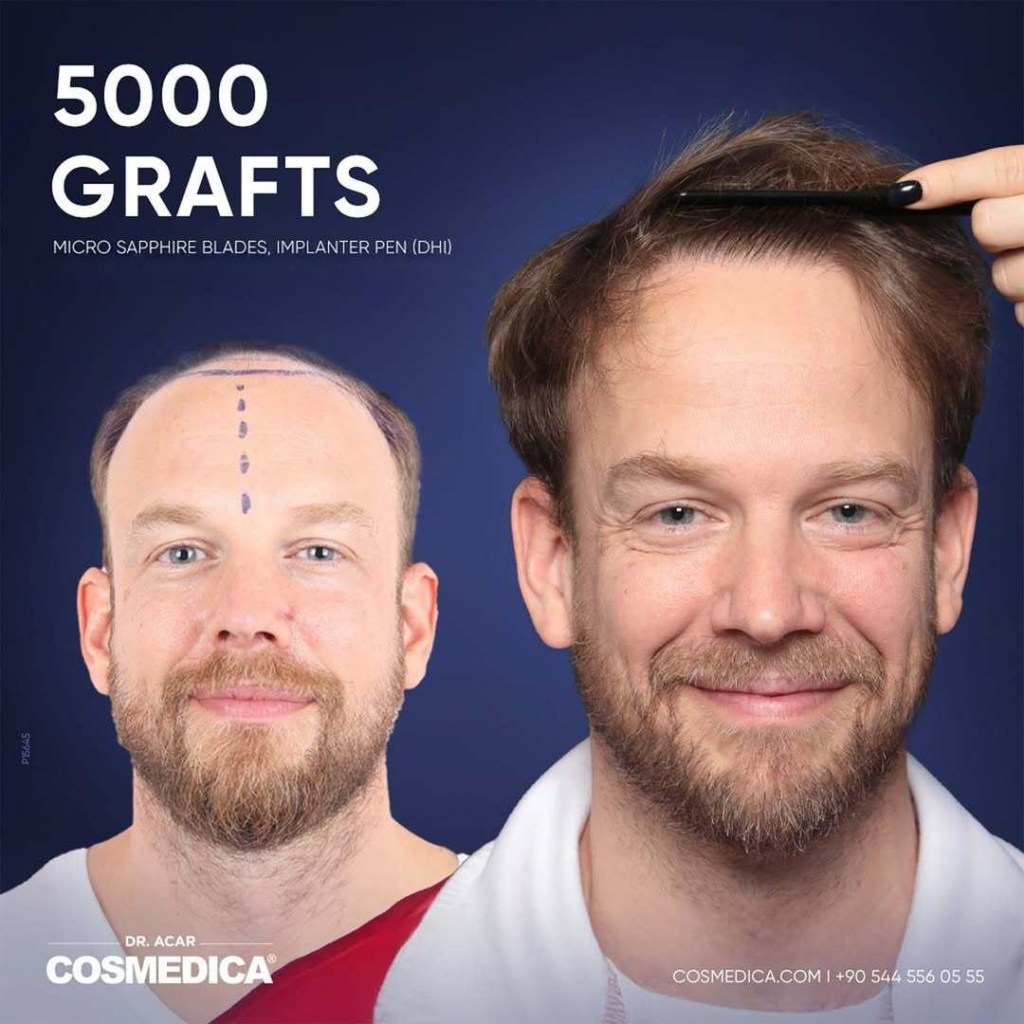
Candidacy is a balance of supply and demand: your pattern of hair loss versus the donor strength. “In all cases, transplantation is possible, but expectations must be explained clearly,” says Dr. Acar.
A thorough plan will map current loss and future risk, specify the number of grafts per zone, and protect donor reserves. “We calculate mathematically how much is needed for real density. If a patient needs 4,000, it’s better to do it in one session than make him come back three times.”
Different hair types require nuanced handling. “White patients usually have straight follicles. Afro-textured hair has curved, C-shaped follicles… if done correctly, results are excellent,” he notes. “Afro hair can grow deeper in the scalp, so we use longer instruments to extract it safely.” That attention to hair follicles helps lift outcomes across diverse patients.
With expectations aligned, let’s walk through the procedure step by step.
What the surgery day feels like
Most hair restoration surgery is performed under local anesthesia. “The surgery is pain-free. Recovery is just a bit uncomfortable. The best moment is after about 13 days, when the scabs wash away and you see the clean hairline,” says Dr. Acar.
After numbing, the team extracts grafts, stores them properly, and the surgeon designs channels that dictate angle, direction, and density. Whether you choose FUE alone or combine it with DHI, the aim is durable coverage that looks natural.
Travel timelines are concise. Many men book a two- or three-night window: assessment on day one, procedure on day two, and first wash on day three. “Flying the next day is safe,” Dr. Acar adds. Many hair transplant clinics in Turkey also include airport transfers to simplify the experience.
The appointment ends, but the real progress happens over the next few months—here’s what to expect.
Recovery, side effects, and growth
Typical side effects include temporary swelling and scabbing in the first week. Shedding (often referred to as “shock loss”) typically occurs between weeks three and ten.
Dr. Acar underscores the pace of hair growth: “The real results come after eight to 12 months. Patience is important.” Because grafts come from the DHT-resistant zone, durability is the expectation: “As the hair we take comes from the permanent donor zone, those follicles are not affected by DHT hormones, so once transplanted, they last for life.”
Dollars, value, and how to compare

Understanding the timeline makes it easier to weigh cost and value. Price matters, but value is about planning, execution, and aftercare. “Many patients used to come only for the price. Now, even wealthy patients come because of the quality. Our prices are fair because we want everyone to have access, but quality is always our focus,” Dr. Acar says.
When benchmarking, review transparent ranges for Turkey hair transplant cost and compare what’s included: first-wash training, meds, follow-ups, and hotel/transfer details.
You’ll also see bundled hair transplant packages from clinics in Istanbul. Packages should clearly outline medication lists, specify who performs each step, and describe how remote follow-up works once you’re back home. For proof, study a clinic’s hair transplant before and after gallery—look for cases that match your hair type, curl pattern, and degree of loss.
Once you’ve compared offers, it’s time to match them to the right approach.
Choosing the method for your goals
A blended plan is common: broad coverage with FUE and hairline detailing with DHI. For those with a limited donor supply, beard grafts may be considered for specific zones. “Beard hair is the strongest alternative donor source… we never use body hair for the frontal hairline,” Dr. Acar stresses. Where density targets are ambitious, a Sapphire FUE hair transplant can facilitate compact channeling; however, success still hinges on design and careful handling.
If expectations are high relative to the supply, your surgeon should clearly communicate this. “If someone is bald from the front all the way back to the donor zone, we cannot give them the density they had at 15 years old. But we can still give them a very good result, maybe 80% of what they want.” That honesty avoids overharvesting and preserves options for the future.
What to ask in consults (virtual or in person)
To make that choice stick, bring these questions to your consult. Whether you’re comparing a hair transplant in Turkey with a domestic quote in the United States, bring a checklist:
- Technique fit: Sapphire FUE or Micro Sapphire DHI?
- Design specifics: target densities by zone and a conservative, age-appropriate natural hairline.
- Graft accounting: confirm the number of grafts planned and how the team adapts if the yield is lower.
- Handling protocols: hydration, temperature control, and timing for graft survival.
- Roles: which steps the surgeon performs versus those performed by experienced technicians.
- Aftercare: first-wash session, meds, remote check-ins, and escalation paths.
Finally, look at the broader market context. As Dr. Acar observes, “Hair transplant used to be seen as something only for celebrities… Now, anyone can get it. The quality is equal, or better, than what Hollywood stars get.” That scale, especially among many hair transplants performed in major centers, supports consistent results.
Bottom line
This route can be a smart play when planning is candid and numbers are realistic. “In all cases, transplantation is possible, but expectations must be explained clearly.”
With the right match of donor supply, design, and technique, modern care delivers results that blend in. To start your due diligence, scan what’s included in a hair transplant package in Istanbul, Turkey, confirm the rationale behind the technique, and ensure that aftercare is robust once you’re home.
From Austin to Philadelphia, many men are considering a hair transplant in Turkey as a cost-effective option for achieving natural-looking coverage. Istanbul has become a global hub thanks to scale, specialization, and streamlined support for travelers.
One prominent voice in that scene is Dr. Levent Acar, a hair transplant surgeon and Medical Director of Cosmedica Clinic in Istanbul, Turkey, who has treated a wide range of international patients. “Hair transplantation has been practiced for over 80 years… Now, we’ve developed methods that look completely natural, so nobody can tell it was transplanted.”
Many hair transplant clinics now build all-in-one experiences for international travelers. “We organize everything: airport pickup, hotel, transfers to the hospital… And we don’t stop after the procedure. We follow up to make sure patients are happy with their results,” says Dr. Acar. That coordination matters when you’re flying from the United States for elective care.
Focuses on infrastructure, logistics, and the business implications of India's urban expansion.