WWDC 2026: Apple Intelligence & Siri AI Steal the Spotlight
Apple unveils next generation of Apple Intelligence, Siri AI, and more at its annual developer summit.
Opinions expressed by Entrepreneur contributors are their own.
You're reading Entrepreneur India, an international franchise of Entrepreneur Media.
Where does Apple stand in the AI race? This is a question that has been on the minds of technology enthusiasts as well as Apple loyalists for a while. And that is why there was so much anticipation around the Apple WWDC 2026, the company’s annual developer-focused conference where it showcases upgrades of its software for different platforms.
Apple Intelligence & Siri AI
To answer the above-mentioned question: Apple is indeed trying to make good AI, albeit the approach is a bit complicated. A lot of it is coming to Siri, Apple’s voice assistant which had begun to feel quite redundant in the era of ChatGPT and Gemini.
For the uninitiated, Apple and Google entered into a historic agreement under which the next generation of Apple Foundation Models will be based on Google’s Gemini models and cloud technology. These models were supposed to help power future Apple Intelligence features, including a more personalized Siri.
So is Apple Intelligence just a wrapper for Gemini? Not really.
The AI structure is based on the company’s Apple Foundation models, which were first introduced a couple of years ago. Under the hood, it has two on-device models and is coupled with three server-based models (AFM 3 Cloud and its iterations). Together, these models are said to bring superior output quality and capabilities. And as far as Google goes, Apple does not use the Gemini models that Google uses for customers, and Apple also does not use Google’s customer-facing infrastructure. Instead, these models are custom-made by Google for Apple. Moreover, the ecosystem is overtly under Apple’s deep OS-level integration and privacy guardrails.
“These four models that we just talked about — AFM Core, Core Advanced Cloud, and Cloud Image —all of these are custom built for Apple Silicon, trained using proprietary data with reinforcement learning and refined using outputs from Gemini frontier models,” Apple’s AI executive Amar Subramanya is quoted as saying.
Let’s talk about Siri. Nearly 16 years ago, Apple unveiled a voice-enabled personal assistant for iPhone users. Once disruptive tech, Siri was able to support a wide range of user commands such as phone actions, scheduling events, taking calls, and other basic tasks through voice commands. Siri did get expanded and improved over the years but instantly seemed behind the curve when OpenAI’s ChatGPT and Gemini brought in contextual searches and enabled agentic AIs.
Apple has rebranded Siri as Siri AI, and it does strive to become much smarter than before by being able to answer questions from the web on virtually any topic, and surfacing relevant information from a user’s personal messages, emails, photos, and more.
“With a bold new architecture uniquely designed to protect users’ privacy, Siri AI leverages the next generation of Apple Intelligence to bring state-of-the-art understanding and reasoning, along with powerful systemwide capabilities, to Apple’s operating systems. These features are available for developer testing starting today, and will be available as a beta to users later this year,” the company said in a press release.
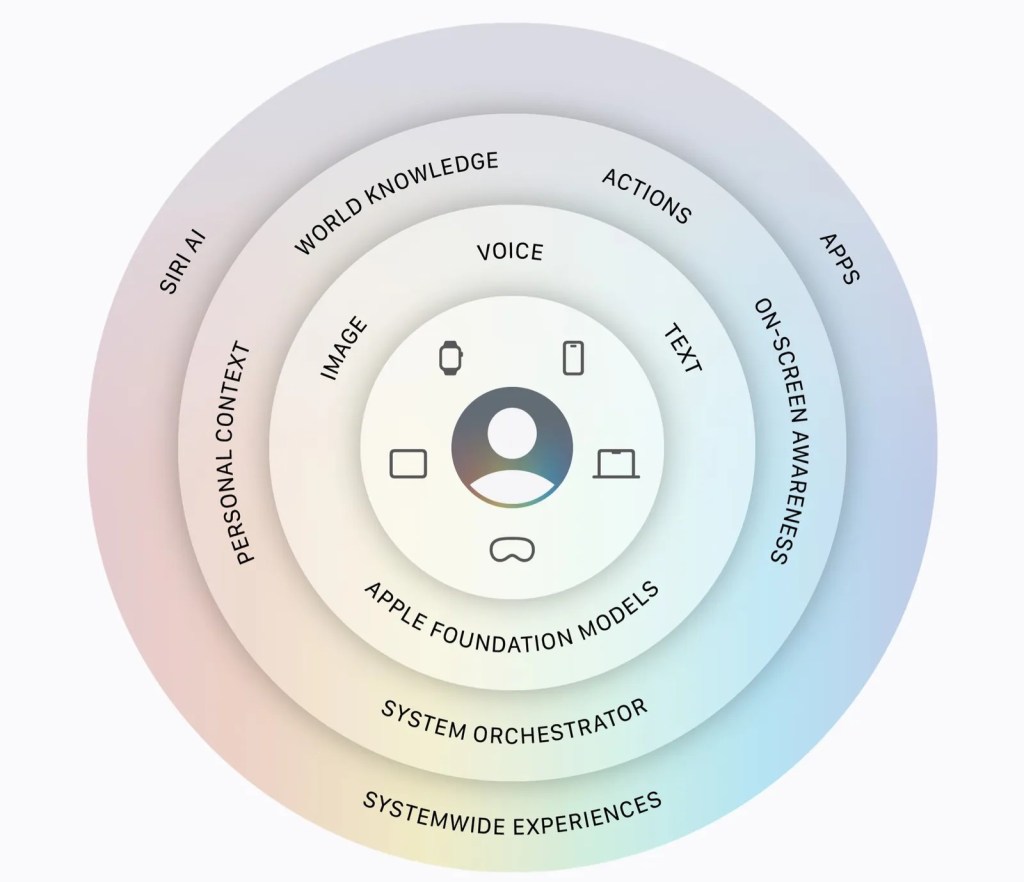
Subramanya further disclosed that its AFM Cloud Pro is equivalent to Google’s Gemini frontier models and runs in the cloud on Nvidia GPUs, which are part of Apple’s Private Cloud Compute infrastructure.
“We work with both Google and Nvidia to extend our private cloud compute infrastructure to Nvidia GPUs in Google’s cloud, while maintaining Apple’s unmatched privacy guarantees,” Subramanya added.
Apple is known for pushing its own services over third-party apps for select tasks. It’s likely the company will push the platform even more by integrating it with native apps across hardware platforms.
Overall, it appears that Apple users might get AI integration on par with what its rivals are now providing, thanks to a cocktail of proprietary tech and Google’s.
Other updates
Even as Apple Intelligence and Siri AI hogged the limelight, Apple’s other services did also get some major upgrades.
While intelligence is now at the core of the iOS, the overall operating system has now become much better and faster. For instance, Apple says the new iOS is now 30% faster than the previous iteration. Photos now load 70% quicker than earlier, whereas AirDrop gets an 80% speed boost. Moreover, Apple will be rolling out the new iOS to phones as old as the iPhone 11, keeping the experience uniform across its different iPhones through the decade or so.
The next iteration of MacOS will be called Golden Gate and is set to come with a host of intelligence features. It is the first Apple OS to work with MacBooks running Apple’s custom silicon processors.
Apple is also upgrading its Vision Pro, enabling a Siri Pro iteration for the wearable headset. It now allows users to ask Siri about things just by looking at them, from the content inside app windows to physical objects around them.
Apple also showcased a new parental lock feature allowing adults to better control and manage what content their children can access as well as who they can communicate with.
Moreover, Apple is extending its intelligence capabilities and expanding productivity features to its Xcode.
“Developers are at the heart of the Apple ecosystem, and our goal is to provide them with the best possible tools and technologies to build the future,” said Susan Prescott, Apple’s vice president of Worldwide Developer Relations. “With new intelligence frameworks and agentic coding in Xcode 27, developers have the tools they need to focus on what they do best: bringing their incredible ideas to life.”
Developers also get more ways to showcase their apps on the App Store with Creative Assets—rich images and videos that appear in the product page header and search results, according to Apple.
Where does Apple stand in the AI race? This is a question that has been on the minds of technology enthusiasts as well as Apple loyalists for a while. And that is why there was so much anticipation around the Apple WWDC 2026, the company’s annual developer-focused conference where it showcases upgrades of its software for different platforms.
Apple Intelligence & Siri AI
To answer the above-mentioned question: Apple is indeed trying to make good AI, albeit the approach is a bit complicated. A lot of it is coming to Siri, Apple’s voice assistant which had begun to feel quite redundant in the era of ChatGPT and Gemini.
For the uninitiated, Apple and Google entered into a historic agreement under which the next generation of Apple Foundation Models will be based on Google’s Gemini models and cloud technology. These models were supposed to help power future Apple Intelligence features, including a more personalized Siri.