Inside Bhavin Turakhia’s USD 30 Mn Bet to Fix Enterprise AI’s Biggest Gap
Not that AI is not being widely adopted by the organisations, but implementations still remain a huge challenge – which has been an industry-wide headache.

Neo
Opinions expressed by Entrepreneur contributors are their own.
You're reading Entrepreneur India, an international franchise of Entrepreneur Media.
‘Frustration is the genesis of entrepreneurship.’
Bhavin Turakhia, a serial entrepreneur who founded firms like Directi, Radix, Titan, and Zeta, is taking a huge bet – USD 30 million – on his new AI venture.
Be sure that the new venture, called Neo, also comes from the above-mentioned genesis:
“Most organizations fail to capture the value of AI because context is fragmented, knowledge lives in heads and Tools don’t talk. Neo is an integrated AI work platform that centralizes context, captures knowledge and makes AI a first-class participant in every workflow, not a tab beside it.”
Fragmentation Frustration
Turakhia, in a deep dive with Entrepreneur India, highlights that enterprise knowledge is fragmented across so many tools and so many platforms that AI can’t be effective because it doesn’t have the entire picture. Process knowledge is ephemeral and exists in people’s heads and memories.
“… if I have 10 employees, they might know how to do things, but there is no document or documented process or skill or SOP that might cover all of the things that are in people’s heads. So, if there isn’t a SOP, then what is AI going to operate on,” said Turakhia.
Not that AI is not being widely adopted by the organisations, but implementations still remain a huge challenge – which has been an industry-wide headache.
Enterprise environments often include legacy systems and fragmented workflows that have not been designed to support new technology, according to an IBM post.
Consequentially, poor integration can further mar the ability to elevate the internal operations and overall ecosystem.
“AI integration becomes more complex with agentic AI-powered systems. Autonomous systems often require access to multiple applications, application programming interfaces (APIs) and real-time data sources to effectively complete tasks. Integration problems can limit system performance, create bottlenecks or introduce security risks. And organizations can’t effectively scale AI if systems are disconnected from core business operations,” the IBM post adds.
Another concern is the disruption to the workflows. It could be due to the archaic structure or just humans. An ambiguous adoption and implementation could lead to poor quality outcomes.
On shoddy AI implementations, Turakhia adds: “There’ll be five people who’ll do something with AI, and then the remaining five people in the team will do something else, and each person is doing their own thing. There is no shared repository of skill libraries yet effectively created. There is no way to institutionalize and replicate what one person is doing, how can other people do it.”
This is where Neo is trying to come into picture. The platform is said to be engineered to bridge these exact gaps by capturing organizational context, institutionalizing skill sets, and providing a unified governance layer for enterprise workflows.
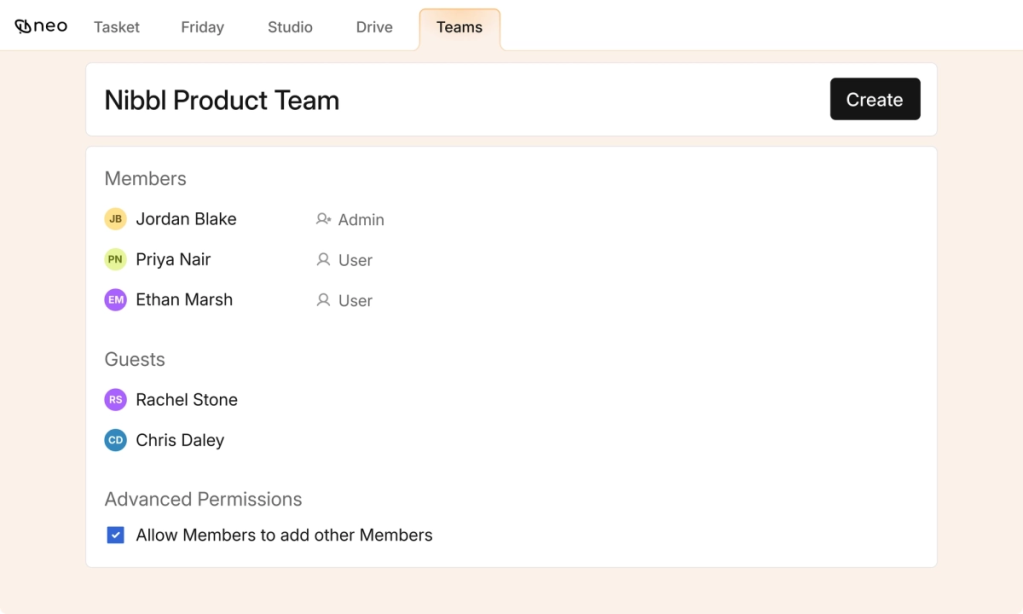
Neo’s Tasket: An AI-native work management platform for all functions
Most importantly, in an era when a lot of companies are building their own closed walled gardens to lock users into their ecosystems, Neo takes an open stance. The platform is LLM agnostic which means users can use frontier models from any platform, whether Anthropic, OpenAI or just open-source models.
“The world is going to be a multi-LLM world. And for each individual user, there will be… multiple models that they will need to use and will end up using for different combinations of… cost versus… the task at hand,” Turakhia added.
The Self-Funded Playbook
Turakhia’s USD 30 million investment in his new venture grabs attention. While not an uncommon move, it’s quite unlike the trend of seeking backing of prominent VCs, even if it’s for symbolism. And this is not the first time Turakhia has invested in his own venture, and evidently the strategy has worked.
“Directi was self-invested. We invested USD 500 that we borrowed from our father…” Turakhia recalls. “Radix, we invested USD 25 million of our own capital… Titan, I invested about USD 25-30 million.”
He invested nearly USD 40 million in Zeta. The cloud-native banking and financial technology company last year raised USD 50 million from Optum, pushing the valuation of the company to USD 2 billion.
Building sizable companies is also going to benefit Neo. Turakhia added that the platform is now being rolled out internally across his corporate portfolio.
Sometime in mid-August or late-August, Neo will start inviting external companies. The plan includes onboarding 10 to 15 companies initially. Around the first quarter of the next year Neo is planned to be available for public access.
According to Turakhia, the early focus areas will be mid-market knowledge enterprises before being rolled out to global enterprises, and then eventually being available to smaller businesses.
Neo currently has up to 70 employees of which more than half are engineers. As of now, the company is mostly spending on human resources, including engineers. Post-January, the company will gradually start spending on marketing and sales, aligned with the company’s above mentioned expansion plans.
David vs Goliath
Is there room for another enterprise AI platform? Hyperscalers like Microsoft, Amazon and others are aggressively doubling down on AI deployment within their ecosystems as well as consumer products. And then AI firms like OpenAI and Anthropic are fast trying to be consumer-enterprise superapps.
Anthropic, in particular, has been on a spree of launching industry-disruptive tools. Not long ago, breakthrough agentic AI product launches shook the conventional SaaS market – famously known as SaaSpocalypse – fearing AI agents will bypass traditional subscription software.
ALSO READ: SaaSpocalypse: Anthropic’s New Plugins Send IT Stocks In A Tizzy But is the Panic Overblown?
And some new companies like Notion are trying to push AI in workflows for businesses. Notion, now valued nearly USD 11 billion, allows one to capture context, find answers, and automate tasks with AI.
Will Neo find itself at loggerheads with the hyperscalers, AI firms and other new AI enterprise firms?
An unfazed Turakhia adds that nothing stops a conventional firm from competing with us or building something similar.
“I’m under no illusion that, you know, we’re competing with Microsoft or Anthropic or OpenAI or a multitude of companies out there that are going to be building pieces and parts solution, and there are probably going to be a dozen of more players that are trying to tackle the same problem… I’m quite certain there’ll be dozens of players, and our goal is to be one of the best, basically, but we’re not going to be the only player tackling this problem…” he added.
That said, the AI space is becoming increasingly crowded with hyperscalers and venture-backed firms doubling down to build closed walled gardens, as mentioned above. Turakhia’s playbook is not uncommon but a few things like open ecosystem and strategic roll-out stand out. And most importantly, the gap does exist which many organisations may sheepishly agree with. The premise of Neo is quite simple – fix the workflow, and the ROI will be the by product.
‘Frustration is the genesis of entrepreneurship.’
Bhavin Turakhia, a serial entrepreneur who founded firms like Directi, Radix, Titan, and Zeta, is taking a huge bet – USD 30 million – on his new AI venture.
Be sure that the new venture, called Neo, also comes from the above-mentioned genesis: