Q1FY27: Auto Firms Post Mixed Profits Amid West Asia Crisis
India’s auto majors navigated a turbulent Q1 FY27, balancing geopolitical headwinds and cost pressures with resilient demand.
Source: Freepik
You're reading Entrepreneur India, an international franchise of Entrepreneur Media.
Amid the West Asia conflict and rising input costs, India’s auto majors delivered a mixed bag of results in the first quarter of FY27. Maruti Suzuki reported a profit decline despite record revenues, Mahindra & Mahindra tightened its grip across SUVs, LCVs, tractors and EVs to post resilient gains, and Hyundai Motor India marked 30 years in the country even as profitability fell on production disruptions and weak exports.
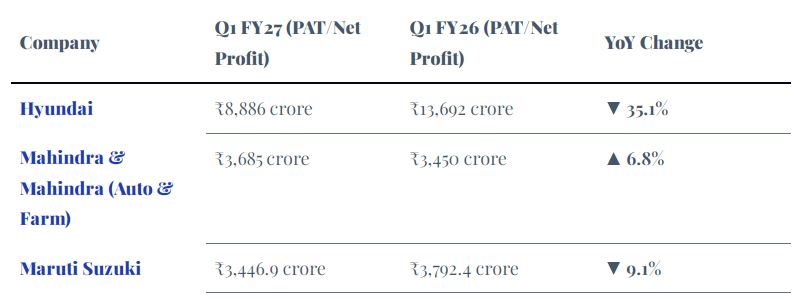
Maruti Suzuki India (MSIL) reported a consolidated net profit of INR 3,446.9 crore in Q1 FY27, down 9.1 per cent y-o-y from INR 3,792.4 crore. The decline was attributed to adverse commodity prices amid the West Asia conflict, currency fluctuations, higher fixed cost incidence due to inventory depletion, seasonal employee expenses, and depreciation linked to capacity expansion at its new Kharkhoda facility.
Despite the profit dip, consolidated revenue from operations surged 36 per cent y-o-y to INR 52,468.9 crore, compared to INR 38,605.2 crore in Q1 FY26. Vehicle sales rose 29.3 per cent y-o-y to 682,724 units, up from 527,861 units last year.
Domestic small car sales grew 34.1 per cent, while SUVs jumped 44.6 per cent. Exports also climbed 28.6 per cent y-o-y. The company credited its higher output to the commissioning of its second plant in Kharkhoda, noting that despite robust sales, network inventory remained lean at around 13 days.
Mahindra & Mahindra reported higher quarterly profit as strong demand for its high-margin sport-utility vehicles helped cushion the impact from the Middle East war.
Rajesh Jejurikar, executive director & CEO (Auto and Farm Sector), M&M Ltd, said, “Auto and Tractor business demonstrated strong resilience in Q1 F27. We have achieved a QoQ increase of 50 bps in SUV revenue market share and 150 bps in LCV (< 3.5T) volume market share. XEV 9S emerged as highest selling EV in India by Volume. Our Tractors business gained 280 bps QoQ to reach 44.9 per cent market share in Q1 F27. Auto business PBIT Margin excluding eSUV contract manufacturing is 8.3 per cent and our Core Tractor PBIT margin is 19.2 per cent despite commodity inflation.”
The company has tightened its grip across categories, emerging as the leader in multiple segments this quarter. With SUVs commanding a 25.0 per cent revenue market share and volumes rising 15 per cent in Q1, the company has reinforced its dominance in the fastest-growing passenger vehicle segment. In the LCV <3.5T space, it leads with a commanding 52.0 per cent share, while in tractors it holds 44.9 per cent, underscoring its strength in rural and agri-driven demand. The company has also raced ahead in the electric three-wheeler market, capturing 39.5 per cent share, a clear signal of its early mover advantage in clean mobility. Together, these positions the company as a diversified powerhouse, driving growth across passenger, commercial, agricultural, and electric mobility segments.
Hyundai Motor India reported its Q1 FY27 financial results announcing a net profit of INR 888.6 crore and flat revenue of INR 16,335 crore. Profit dropped 35.1 per cent y-o-y due to raw material inflation, a supplier-site fire, and weak exports from regional conflicts.
Marking 30 years in India, the company navigating a challenging first quarter of FY27. Despite temporary production disruptions that capped domestic volume growth at 5.4 per cent y-o-y and weighed on exports amid the ongoing West Asia conflict, the automaker reported strong traction across key segments.
The all-new Venue delivered its highest-ever quarterly sales in the domestic market, underscoring robust customer demand. CNG adoption continued to rise, contributing 18 per cent overall, with Aura and Exter recording their highest-ever CNG shares at 95 per cent and 32 per cent respectively. Rural penetration also accelerated, hitting an all-time high of 26 per cent.
Tarun Garg, Managing Director & CEO, said, “Q1 FY27 was a challenging quarter affected by multiple factors impacting volumes and profitability. With 100 per cent normalization of production, coupled with a healthy demand environment and upcoming product pipeline, recovery is likely to gain pace from Q2 onwards across both domestic and export businesses.”
Looking ahead, the company reaffirmed its FY27 guidance of 8–10 per cent y-o-y volume growth across domestic and exports, alongside an 11–14 per cent EBITDA margin, signaling confidence in sustained momentum despite external challenges.
Amid the West Asia conflict and rising input costs, India’s auto majors delivered a mixed bag of results in the first quarter of FY27. Maruti Suzuki reported a profit decline despite record revenues, Mahindra & Mahindra tightened its grip across SUVs, LCVs, tractors and EVs to post resilient gains, and Hyundai Motor India marked 30 years in the country even as profitability fell on production disruptions and weak exports.
Maruti Suzuki India (MSIL) reported a consolidated net profit of INR 3,446.9 crore in Q1 FY27, down 9.1 per cent y-o-y from INR 3,792.4 crore. The decline was attributed to adverse commodity prices amid the West Asia conflict, currency fluctuations, higher fixed cost incidence due to inventory depletion, seasonal employee expenses, and depreciation linked to capacity expansion at its new Kharkhoda facility.
Despite the profit dip, consolidated revenue from operations surged 36 per cent y-o-y to INR 52,468.9 crore, compared to INR 38,605.2 crore in Q1 FY26. Vehicle sales rose 29.3 per cent y-o-y to 682,724 units, up from 527,861 units last year.

Entrepreneur Staff • Editor
Entrepreneur Staff
For more than 30 years, Entrepreneur has set the course for success for millions of... Read more