Marketing has enough dashboards. Meet the AI agent that runs your organic growth.
Pepper launches Agent Atlas, its most ambitious product yet: the organic growth agent that does the work, not just the reporting
.
Opinions expressed by Entrepreneur contributors are their own.
You're reading Entrepreneur India, an international franchise of Entrepreneur Media.
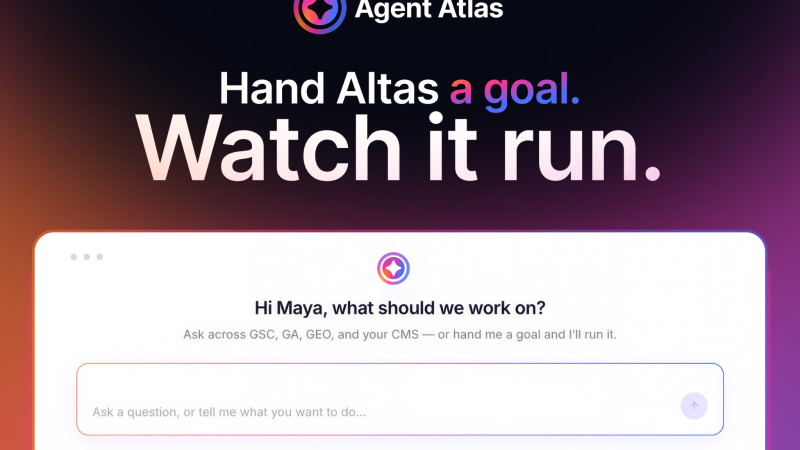
Pepper today launched Agent Atlas, the most ambitious product in the company’s eight-year history and, it argues, the first marketing platform built to do the work rather than just report on it. For most chief marketing officers, 2026 has turned AI search from a curiosity into a standing item on the board agenda. Buyers now put their questions to assistants such as ChatGPT, Perplexity, Gemini, Copilot, Claude and Google AI Overviews, and more and more of them act on the answer without ever visiting a website. The place a brand is judged has moved, and most teams are being asked to win there with the same headcount they had last year. Nearly every CMO now treats AI leadership as a priority, yet few believe their team is ready to scale it. The gap is not ambition. It is the distance between knowing what to do and having the capacity to do it.
Pepper, the organic growth engine used by more than 250 enterprises, is positioning Agent Atlas as the product built to close that gap, and as a shift in what a marketing platform is for. For two years the category has helped brands measure how they show up in AI answers. Atlas is the first layer that acts on what it finds: you tell it what you want in plain language, and it does the work.
The hard part, most marketing leaders will say, was never the dashboard. The industry shipped a great many of them, and a brand can now see how often it is mentioned in AI answers, which sources are cited, and how it ranks against its competitive set. All of that is useful, and Pepper built a good deal of it. But a dashboard hands you the finding and leaves the doing to you. The insight sits on a slide, the quarter fills up, and the work slips. That is where organic growth is actually lost, not in the strategy meeting but in the weeks after it, when the plan meets the calendar and the calendar wins.
Agent Atlas is the chat-first layer of Pepper’s GEO platform, and it removes that gap by doing three things a dashboard cannot.
The first is that it reasons across everything at once. Ask a real question, the kind that decides a quarter, and it draws on all of a brand’s connected data in a single pass:
- AI-search visibility across the engines buyers use
- Search Console rankings, clicks and impressions
- Analytics, so conversions weigh into the answer
- the competitive picture across the category
- the brand’s own content and pages
The questions that matter most have never lived in one tool. “What should we prioritise this quarter, across rankings, conversions and AI visibility together?” or “Where is our biggest opportunity?” cannot be answered from a single screen, which is why teams have spent years assembling those answers by hand across five tabs. Atlas assembles them for you and shows its working as it goes.
The second is that it never stops at the answer. This is the line that separates Agent Atlas from the wave of tools that surface a prioritised to-do list and leave the doing to you. Every finding arrives with a recommendation attached, ordered by the impact Atlas expects it to have, and every recommendation maps to a specific piece of work it can carry out. You approve the move, and it runs. There is no separate tool to open, no brief to write, no handoff. The person who understands the brand stays in control of every approval, and the agent takes on the volume.
The third is range. Atlas runs the workflows Pepper ships out of the box, such as content brief generation, content optimisation and refresh analysis, and it will build a new one when the job calls for it. You describe the task the way you would explain it to a colleague, and it assembles the steps, tests them on a single input, and then runs them across a whole list. A quarter of repetitive work that used to reach only the top ten pages can now reach all two hundred.
In practice, that means a marketer can hand Atlas the work they rarely have time for:
- Diagnose a change: “Our AI visibility dropped this month. What happened, and where?”
- Find the opportunity: “Show me the ten pages with the best AI-visibility upside this quarter.”
- Benchmark rivals: “How do we stack up against our competitive set across the engines?”
- Run at scale: “Create content briefs for these eight comparison clusters.”
- Build something new: “Build a workflow that audits a page and drafts a rewrite, then run it across the list.”
Ease of use is the point, not a footnote. There is no query language and no setup ritual. GEO tracking is on from the first day, so a brand can ask about its AI-search visibility immediately, and the answers grow sharper as it connects Search Console, Analytics and its content system. What a marketer needs to bring is a question, not a manual.
The result is a shift in what the software is accountable for. Most tools report a metric and own no outcome. Pepper’s model is different and deliberate:
- Agents provide the scale and the speed.
- A senior growth team provides the judgment and the relationships.
- Pepper stays on the hook for the number that actually moves.
It is the one thing few in the category will say out loud, because standing behind a result is harder than reporting on it.
“This is the most ambitious product we have ever built, and I would bet the company on it,” said Anirudh Singla, Founder and CEO of Pepper. “Marketing teams have been handed a decade of dashboards and told to figure out the rest. Agent Atlas is built on the opposite idea. You tell it what you want in plain language, it does the work with your team in control, and we hold ourselves to the number it moves. A tool that only reports was never going to be enough.”
The timing is not incidental. The AI-search landscape is fragmenting faster than any single team can track by hand. A year ago most generative-AI traffic ran through one assistant; today it is split across several, with Gemini and Claude both climbing fast, and winning in one engine no longer covers the audience. Brand presence is unstable on top of that: a brand cited in one answer often vanishes from the next, and holding a place across a run of related answers is harder still. Keeping up is no longer a periodic project. It is continuous work, and continuous work is exactly what an agent is suited to carry.
For eight years Pepper has run content and SEO for more than 250 enterprises, and that experience, grounded in more than ten million tracked prompts, is what Agent Atlas is built on. The company has long argued that organic is the channel a brand owns rather than rents. Agent Atlas is its answer to the obvious next question, which is how a lean team is supposed to own it end to end when the surface keeps moving. The measurement era gave marketers a way to see the problem. This is the one that goes and fixes it.
Agent Atlas is available now inside Pepper’s GEO platform. The company is unveiling it to marketing leaders at its Index summit in Bangalore, where teams can watch it run live on their own category.
Pepper today launched Agent Atlas, the most ambitious product in the company’s eight-year history and, it argues, the first marketing platform built to do the work rather than just report on it. For most chief marketing officers, 2026 has turned AI search from a curiosity into a standing item on the board agenda. Buyers now put their questions to assistants such as ChatGPT, Perplexity, Gemini, Copilot, Claude and Google AI Overviews, and more and more of them act on the answer without ever visiting a website. The place a brand is judged has moved, and most teams are being asked to win there with the same headcount they had last year. Nearly every CMO now treats AI leadership as a priority, yet few believe their team is ready to scale it. The gap is not ambition. It is the distance between knowing what to do and having the capacity to do it.
Pepper, the organic growth engine used by more than 250 enterprises, is positioning Agent Atlas as the product built to close that gap, and as a shift in what a marketing platform is for. For two years the category has helped brands measure how they show up in AI answers. Atlas is the first layer that acts on what it finds: you tell it what you want in plain language, and it does the work.
The hard part, most marketing leaders will say, was never the dashboard. The industry shipped a great many of them, and a brand can now see how often it is mentioned in AI answers, which sources are cited, and how it ranks against its competitive set. All of that is useful, and Pepper built a good deal of it. But a dashboard hands you the finding and leaves the doing to you. The insight sits on a slide, the quarter fills up, and the work slips. That is where organic growth is actually lost, not in the strategy meeting but in the weeks after it, when the plan meets the calendar and the calendar wins.
Covers consumer behavior, retail evolution, and brand storytelling in a digital-first economy.