India Investment Forum 2026: India’s Next Decade of Growth
Industry leaders said quality capital, infrastructure, exports and sustainability will power India’s next USD 5 trillion growth.
India Investment Forum 2026
You're reading Entrepreneur India, an international franchise of Entrepreneur Media.
India may soon achieve its USD 5 trillion economy milestone, but reaching the next USD 5 trillion will require better access to quality capital, stronger regional infrastructure, policy consistency, high-value manufacturing and sustainability-led growth, according to industry leaders speaking at a panel discussion on India’s next phase of economic transformation.
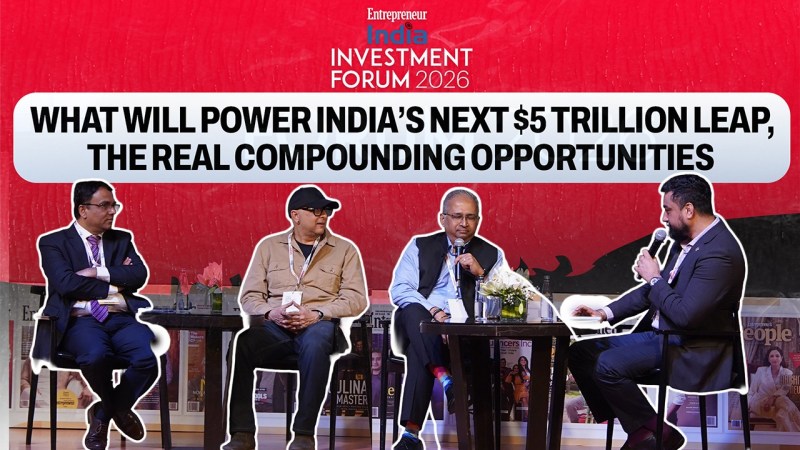
Sharing their views in Panel:” India’s Next Decade of Growth: What will power India’s next $5 trillion leap, the real compounding opportunities” were Karan Mehta Partner, Stride Ventures (Moderator), Manoj Chacko, Managing Director, Fly91, Naresh Shroff, Managing Director, and Rikesh Chand, Chief General Manager, India Exim Bank discussed the structural changes needed to position India as a developed economy.
“Access to good quality capital” remains the single biggest catalyst for India’s next growth phase, said Chacko, adding that the country already has entrepreneurial talent and ambition, but needs investors willing to support businesses beyond traditional sectors. “People who are willing to back entrepreneurs, till that access is not available we will struggle to get to where we need to get.”
Echoing the sentiment, Shroff said India’s growth story must become more inclusive, with greater financial access reaching entrepreneurs and regions that remain underserved.
Meanwhile, Rikesh Chand highlighted high-technology exports as the country’s biggest opportunity. While India has traditionally relied on sectors such as textiles and chemicals, he said industries including defence and aerospace could become the next engines of growth.
“Our high-tech export is hardly 9% of our total export whereas China does 35% and Korea does 40%. These are the sectors that will take us to the next level.”
Regional aviation also emerged as a key growth enabler. Drawing from Fly91’s expansion into Tier II and Tier III cities, Chacko said improved air connectivity has already begun transforming local economies by boosting tourism, business activity and employment.
Citing the airline’s operations in destinations such as Lakshadweep, Sholapur and Jalgaon, he said opening new air routes creates economic opportunities far beyond aviation.
“Air connectivity is a big driver for improving the local economies the development of a country is measured by how distance is measured in time and not in kilometres.”
However, he noted that infrastructure alone is insufficient without adequate financing and ecosystem development. While initiatives such as the UDAN scheme have supported regional aviation, he argued that banks must become more comfortable financing the sector as governance standards continue to improve.
On exports, Chand pointed to the government’s PLI schemes, free trade agreements and simplified regulatory processes as important enablers. He also cited examples of financial institutions supporting first-generation entrepreneurs in emerging sectors through innovative funding models combining debt and equity.
The discussion also focused on sustainability as a competitive advantage rather than a compliance exercise. Shroff argued that CSR should create long-term value instead of being treated as an annual spending obligation, while calling for greater alignment between corporate initiatives and government priorities. “CSR is not exactly used where it has to be used. We copy each other.”
Looking ahead, the panel identified policy stability, infrastructure planning and coordinated ecosystem development as critical factors for India’s next decade of growth. Chacko cautioned that infrastructure projects must be supported by last-mile connectivity and complementary services rather than being developed in isolation.
The conversation also underscored the growing importance of ESG compliance and low-carbon manufacturing for exporters. Chand noted that international markets increasingly evaluate companies on sustainability credentials alongside price and quality, prompting banks to finance cleaner technologies and energy-efficient manufacturing.
Concluding the session, the speakers expressed optimism about India’s long-term trajectory, with aspirations ranging from becoming a developed economy ahead of 2047 to creating thousands of jobs through entrepreneurship and strengthening regional infrastructure across the country.
India may soon achieve its USD 5 trillion economy milestone, but reaching the next USD 5 trillion will require better access to quality capital, stronger regional infrastructure, policy consistency, high-value manufacturing and sustainability-led growth, according to industry leaders speaking at a panel discussion on India’s next phase of economic transformation.
Sharing their views in Panel:” India’s Next Decade of Growth: What will power India’s next $5 trillion leap, the real compounding opportunities” were Karan Mehta Partner, Stride Ventures (Moderator), Manoj Chacko, Managing Director, Fly91, Naresh Shroff, Managing Director, and Rikesh Chand, Chief General Manager, India Exim Bank discussed the structural changes needed to position India as a developed economy.
“Access to good quality capital” remains the single biggest catalyst for India’s next growth phase, said Chacko, adding that the country already has entrepreneurial talent and ambition, but needs investors willing to support businesses beyond traditional sectors. “People who are willing to back entrepreneurs, till that access is not available we will struggle to get to where we need to get.”

Entrepreneur Staff • Editor
Entrepreneur Staff
For more than 30 years, Entrepreneur has set the course for success for millions of... Read more