India Investment Forum 2026: The Consumer Opportunity in India Premiumization vs Mass Consumption Digital-First Brands and Omnichannel Evolution Tier 2/3 Markets as the Next Frontier
India’s consumer startups are poised for rapid growth, driven by premiumization, AI, omnichannel commerce, and rising demand in Tier II & III markets.
India Investment Forum 2026
You're reading Entrepreneur India, an international franchise of Entrepreneur Media.
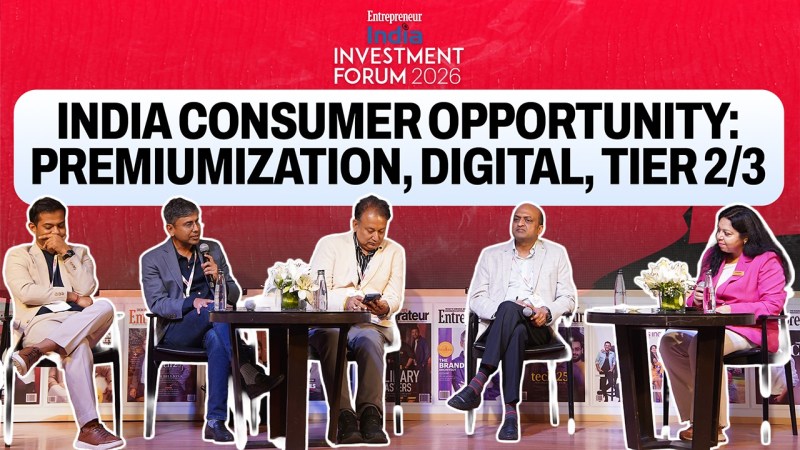
India’s consumer startup ecosystem is set to witness a phase of growth fueled by premiumization, omnichannel commerce, AI-led innovation and rising aspirations in Tier II and Tier III markets, according to investors and founders at the Entrepreneur India Investment Forum 2026. During the session “The Consumer Opportunity in India: Premiumization vs Mass Consumption, Digital-first Brands and Omnichannel Evolution, Tier 2/3 Markets as the Next Frontier,” moderator Punita Sabharwal was joined by Sumit Keshan, Managing Partner, Wipro Consumer Care – Ventures; Dr. Apoorva Ranjan Sharma, Co-founder, Venture Catalysts & President, TiE Mumbai; Dipanjan Basu, Co-founder & Partner, Fireside Ventures; and Sibabrata Das, Co-founder & CEO, Atomberg Technologies.
The panel agreed that India’s consumer market was set to see a much larger growth in the next decade. “I think it will be significantly bigger than what we have seen so far. There is close to USD 200 billion that has been invested in Indian startups over the last ten years, the coming decade could see almost USD 400 billion in consumer investment in India today,” said Keshan. He added that the startups are now hitting INR 200 crore revenue in 4 years and INR 300 crore in 5 years, which was previously unthinkable. “There are many companies which are already making money every year because of much better execution,” he added.
Meanwhile, Sharma noted that investors are now looking at creating global brands from India. In addition to the premiumization of consumer products, he expects collaborations with legacy international brands, consumer financing, and engineering-led innovations to drive quality. “With rising purchasing power, there will be demand for affordable premium and premium,” he said.
According to Basu, India will see nearly USD 1-1.5 trillion incremental consumption in the next 5 years. He identified four themes:
- Preventive healthcare
- Branded consumption in rural India
- Gen Z-led demand
- Innovation-first products
“India’s youth will disrupt categories ranging from beauty and food to health and fashion,” he said, adding that rural India is transitioning from generic to branded products.
“Innovation will be more important than distribution for consumer startups,” said Das, adding that they are a product-first and not a distribution-first consumer company. He noted that when they started Atomberg in 2015, crossing INR 100 crore in revenues was something to cheer about, but now startups are targeting INR 500 crore as the Indian consumer market is growing so rapidly.
The discussion also turned to exits as the US private equity firms are now showing interest in buying Indian consumer companies. Keshan said that apart from acquisitions, IPOs and strategic investments also provide an exit option for founders. Sharma added that large consumer companies are now looking at differentiated products and innovation from startups as the next-gen consumers are no longer interested in traditional categories. On the other hand, Das said that omnichannel has become critical for scaling up as digital is important for discovery, but “offline is still very, very relevant” for high-involvement purchases such as durables.
AI figured prominently in the conversation as well. Das said that they have an AI Centre of Excellence to drive innovation in engineering, customer intelligence, and sales. “AI should be looked at as a growth enabler and not just a cost optimization tool,” he said, noting that if companies can leverage AI as a technology to accelerate growth, they should prioritize revenue growth over cost savings.
While wrapping up the session, the investors said that fundamentals will continue to matter despite the need for aggressive growth in the current environment. According to Keshan, innovation, founder quality, and unit economics will be more important than revenue, while Basu emphasized that building capabilities and R&D will be more valuable than customer acquisition. Das, on the other hand, shared his fundraising experiences, saying that entrepreneurs should not change their pitch based on what investors want to hear.
India’s consumer startup ecosystem is set to witness a phase of growth fueled by premiumization, omnichannel commerce, AI-led innovation and rising aspirations in Tier II and Tier III markets, according to investors and founders at the Entrepreneur India Investment Forum 2026. During the session “The Consumer Opportunity in India: Premiumization vs Mass Consumption, Digital-first Brands and Omnichannel Evolution, Tier 2/3 Markets as the Next Frontier,” moderator Punita Sabharwal was joined by Sumit Keshan, Managing Partner, Wipro Consumer Care – Ventures; Dr. Apoorva Ranjan Sharma, Co-founder, Venture Catalysts & President, TiE Mumbai; Dipanjan Basu, Co-founder & Partner, Fireside Ventures; and Sibabrata Das, Co-founder & CEO, Atomberg Technologies.
The panel agreed that India’s consumer market was set to see a much larger growth in the next decade. “I think it will be significantly bigger than what we have seen so far. There is close to USD 200 billion that has been invested in Indian startups over the last ten years, the coming decade could see almost USD 400 billion in consumer investment in India today,” said Keshan. He added that the startups are now hitting INR 200 crore revenue in 4 years and INR 300 crore in 5 years, which was previously unthinkable. “There are many companies which are already making money every year because of much better execution,” he added.
Meanwhile, Sharma noted that investors are now looking at creating global brands from India. In addition to the premiumization of consumer products, he expects collaborations with legacy international brands, consumer financing, and engineering-led innovations to drive quality. “With rising purchasing power, there will be demand for affordable premium and premium,” he said.

Entrepreneur Staff • Editor
Entrepreneur Staff
For more than 30 years, Entrepreneur has set the course for success for millions of... Read more