TIS 2026: Future Farming, Tech, Data & Sustainability
The discussion ultimately underscored a larger reality about Indian agritech: innovation succeeds only when technology adapts to the farmer, not the other way around.
You're reading Entrepreneur India, an international franchise of Entrepreneur Media.
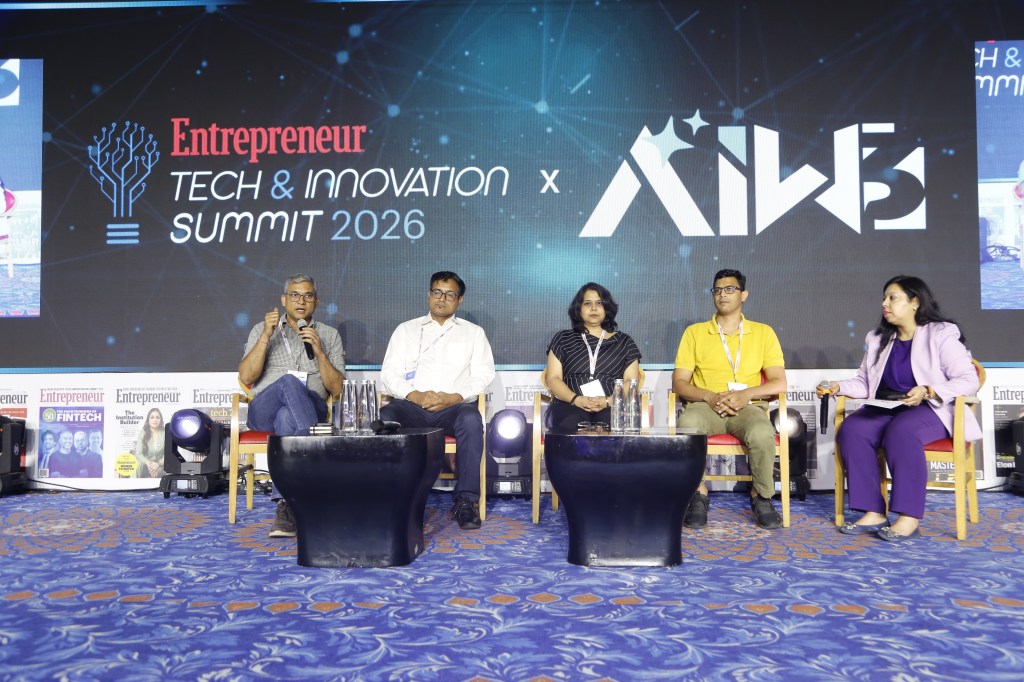
At a time when agriculture is increasingly intersecting with artificial intelligence, biological sciences, fintech, and digital marketplaces, agritech founders are discovering that technology alone cannot transform Indian farming.
Trust, affordability, and local adaptability remain equally important. That was the central theme emerging from a panel discussion at Entrepreneur India’s Tech & Innovation Summit 2026, where leaders from the agritech ecosystem shared their experiences of building solutions for India’s farmers.
Moderated by Punita Sabharwal, the leaders in the panel described the core agricultural problems they were solving. Arya.ag focuses on helping farmers decide when and where to sell their produce, while BioPrime develops biological agricultural inputs aimed at reducing climate-related uncertainty. BigHaat works on improving access and market linkages for farmers, and Scimplify operates across the agrochemical value chain using AI-led platforms for manufacturing and R&D.
As the conversation shifted toward technology adoption among farmers, the panelists unanimously agreed that early assumptions around “technology solving everything” were unrealistic.
Prasanna Rao reflected on Arya.ag’s early learnings. “Initially when we started, we came with this utopian thought that technology will solve everything for farmers. Very soon in our journey we figured that technology’s role in the lives of smallholder farmers was focused on two aspects — improving access and giving assurance. Access to markets, finance and infrastructure, and assurance that whatever is promised to the farmer is actually held true,” said Rao.
He stressed that affordability determines adoption. “Technology which is not affordable could solve a lot of problems, but that is not what is meant for the farmers in India. Affordable technology for access and assurance is what has worked for us.”
Renuka Diwan shared how difficult it was to build trust in biological agricultural products despite a clear need in the market. Recalling BioPrime’s early days during the 2016 El Niño year, she said farmers still hesitated to adopt new solutions.
“Even when the problem existed and the solution was right in front of them, there was a lot of hesitation from the farmer’s side because the trust in this entire ag-input segment had eroded to such a great extent,” she said. “It’s taken five years to build back that trust,” said Diwan.
According to her, farmers only care about one thing: consistent value delivery. “Can you deliver value consistently, can you deliver value across cropping systems, and can it be very easy for him to adopt? This is a segment which wants more, expects more, but at a less cost.”
The founders also highlighted how India’s agricultural diversity forces startups to rethink products region by region.
Diwan explained that BioPrime initially built solutions around Maharashtra’s relatively advanced irrigation systems, only to face a reality check in eastern India. “It was kind of a rude shock for us when we went to UP, Bihar and Jharkhand. We realized we cannot scale until we convert this formulation into granular or foliar formats.”
Similarly, Arya.ag learned that simplifying technology drastically improved adoption. Rao recalled how the company’s first app was overloaded with features and saw less than 2 per cent adoption. After stripping it down to only four essential pieces of information related to loans, adoption jumped to nearly 99 per cent.
“The agri domain is fundamentally solving for the trust gap. The warehouse owner not trusting the farmer, the lender not trusting the borrower, the buyer not trusting the seller. Technology that bridges this trust gap is what scales,” said Rao.
Sudheer Kumar added on farmer behavior and technology adoption, he said: “There is always the part of how many are early adopters and leaders. So same kind of pattern also exists here where 20-30 per cent of any particular village would go for all kind of, they would try new things, they would try the apps, they would try to see some platforms.”
He also pointed out that farming decisions are rarely made by a single individual:
“Farmers are not individual farmers, generally we can tackle it by being the part of tackling the entire family system, who is making decisions, who is doing ploughing, who is doing spraying. So the right kind of spoke for each thing, if it is targeted, I think technology can reach out to the right people and the adoption can be faster.”
Kiran Reddy Singam pointed to changing farmer behavior, noting that many farmers are now actively searching online for technical information, including pesticide molecules, dosage instructions, and even AI-generated recommendations.
“Farmers are searching and getting the right information from the internet. Even they are using AI nowadays. They are becoming very particular about diseases, chemical traces, and the quality of their harvest,” said Singam.
The panel also explored what enables agritech companies to scale. Partnerships emerged as a recurring theme.
Diwan said, “Agriculture is such a complex problem that you cannot solve it alone. She credited government biotech grants and incubation support for helping deep-tech startups like BioPrime survive their early years. “A lot of biotech startups in the country today are here thanks to this support.”
Rao added that scaling required collaboration between investors, lenders, multilateral institutions, and farming communities themselves. Arya.ag today operates across nearly 60 per cent of India’s districts, aggregating commodities worth thousands of crores.
Toward the end of the session, the panelists discussed policy bottlenecks. While they acknowledged the importance of regulations in agrochemicals and biologicals, they argued for simpler and more centralized licensing systems.
“If government brings centralized policies instead of state-based policies, that would really help,” said Singam, pointing to the delays agritech firms face while securing approvals across states.
The discussion ultimately underscored a larger reality about Indian agritech: innovation succeeds only when technology adapts to the farmer, not the other way around.
At a time when agriculture is increasingly intersecting with artificial intelligence, biological sciences, fintech, and digital marketplaces, agritech founders are discovering that technology alone cannot transform Indian farming.
Trust, affordability, and local adaptability remain equally important. That was the central theme emerging from a panel discussion at Entrepreneur India’s Tech & Innovation Summit 2026, where leaders from the agritech ecosystem shared their experiences of building solutions for India’s farmers.
Moderated by Punita Sabharwal, the leaders in the panel described the core agricultural problems they were solving. Arya.ag focuses on helping farmers decide when and where to sell their produce, while BioPrime develops biological agricultural inputs aimed at reducing climate-related uncertainty. BigHaat works on improving access and market linkages for farmers, and Scimplify operates across the agrochemical value chain using AI-led platforms for manufacturing and R&D.

Entrepreneur Staff • Editor
Entrepreneur Staff
For more than 30 years, Entrepreneur has set the course for success for millions of... Read more