How Mobility Startups Are Rewiring Costs Urban Efficiency, Investors Need to Catch Up
From drone-led healthcare logistics to AI-optimised urban transport, a new class of deep-tech startups is emerging to tackle structural inefficiencies.
Opinions expressed by Entrepreneur contributors are their own.
You're reading Entrepreneur India, an international franchise of Entrepreneur Media.
India’s mobility space is no longer just about moving people; it is now also about moving critical services efficiently, affordably, and at scale. From drone-led healthcare logistics to AI-optimised urban transport, a new class of deep-tech startups is emerging to tackle structural inefficiencies. But while the use cases are compelling, the capital stack and market expectations around these companies remain misaligned, especially when put against global peers.
Dr. Devi Prasad Shetty, Founder and Chairman, Narayana Health, pointed out, “The cost of healthcare is beyond the reach of more than 75 per cent of the population.”
“For us, the cost of health care has to go down. Contrary to popular perception, we believe that the cost of health care will go down dramatically, and health care will become affordable to everyone. And why we are so attracted to AirBound is because of the philosophy that a blood sample or any sample should reach from point A to point B for less than one rupee,” Dr. Shetty told Entrepreneur India.
The implication is stark, with mobility presented as not just a logistics problem, but a cost problem.
Mobility as a Cost Lever
Startups like Airbound are reframing mobility not as transportation, but as cost-compression infrastructure. Shetty’s emphasis on reducing delivery costs, if achieved, would enable a broader shift toward centralised healthcare systems. This is where diagnostic labs and blood banks operate at scale rather than being duplicated across hospitals.
This highlights how high-throughput models in other sectors reduce marginal costs. When Narayana Health’s Electronic City hospital processes 25,000 blood tests daily, economies of scale kick in. Drone logistics becomes the connective tissue that allows such centralisation to function geographically.
Globally, companies like Zipline in Africa have demonstrated that drone logistics can cut delivery times by over 80 per cent in rural healthcare systems while lowering costs. Zipline has raised over USD 800 million in funding and operates at a national scale in countries like Rwanda and Ghana.
The parallel is clear: India’s opportunity is not just invention, but localisation and cost innovation, which Airbound is prioritising.
Deep-Tech Mobility Meets Indian Capital Constraints
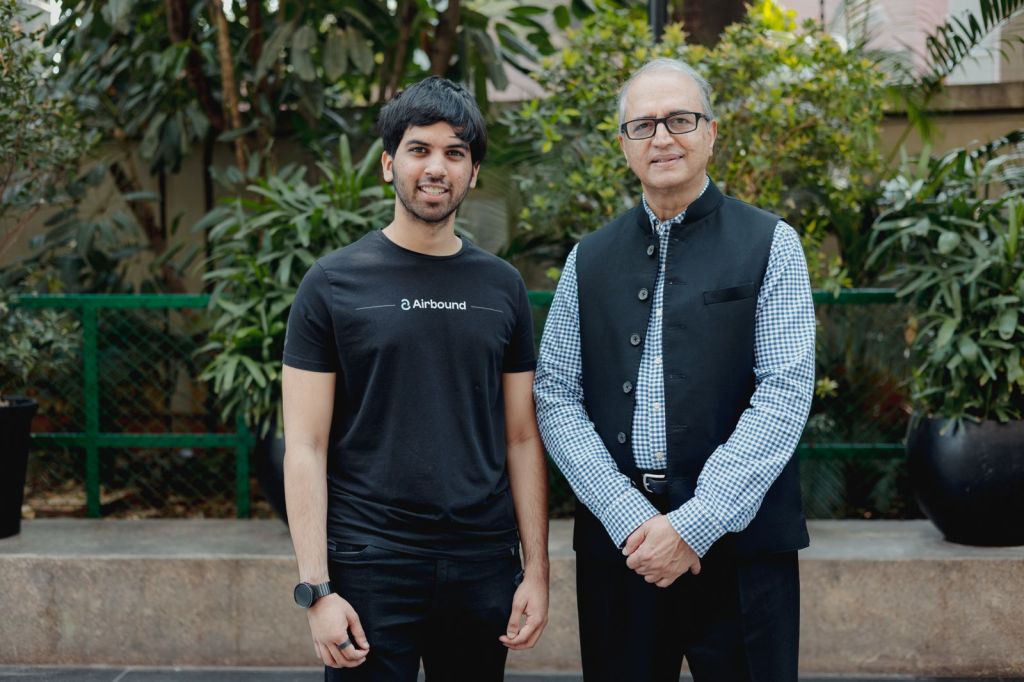
However, building such infrastructure requires patient, risk-tolerant capital. Naman Pushp, Founder & CEO, Airbound, said that India is still a developing story. While India is the third-largest startup ecosystem globally, it lacks USD 100 billion+ outcomes.
“We don’t get USD 100 billion outcomes in India. USD 50-100 billion plus outcomes are common across places in Korea, Europe, the Middle East, and you obviously get them in the US and China. And I think that needs to change. I think so far, India has been a country that’s been a little afraid to dream, right? We’ve always been told to conform to the norm,” said Pushp.
Airbound has raised over USD 10 million in total funding, with a recent USD 8.65 million round in October 2025 led by Lachy Groom, Lightspeed, and others.
Investor behaviour has direct implications for mobility startups, especially those in deep tech. Unlike SaaS or fintech, these companies are capital-intensive, pre-revenue for long periods, and dependent on breakthrough scale.
“If investors believe a company will at most become a USD 20-30 billion company, the fund economics don’t work,” said Pushp.
This is where India diverges from markets like the US or even China. In the US, investors back companies like SpaceX or OpenAI at high valuations because they underwrite extreme outlier scenarios: 100x to 1000x returns. In India, capital is still optimised for predictable 10–20x outcomes, which fundamentally misprices deep-tech risk.
Public Markets: A Misfit for Deep-Tech Mobility? (For Now)
While India has seen a wave of public listings. Companies like Groww, Meesho, and upcoming IPO candidates such as Zepto have fundamentally different profiles. These are cash-flow-driven, consumer-facing businesses.
Deep-tech mobility startups don’t fit that mould, according to Pushp.
Globally, even mature mobility players have struggled post-IPO. Rivian, once valued at over USD 150 billion at listing, trades significantly below its peak.
“There is no deep tech company out there that will be genuinely IPO ready at a lower valuation. The examples you’ve seen have usually been IPOs that have just really missed because the public markets don’t know how to value these companies. Maybe there’s a world where the public markets learn how to value deep tech companies, but I do think the short-term nature of public markets makes them not the best place for deep tech companies,” said Pushp.
The Airbound founder predicts that companies like Airbound may only IPO at USD 100 billion+ valuations, aligning with global trends.
AI-Led Mobility: Immediate ROI vs Long-Term Bets
While drone logistics represents a long-term infrastructure bet, companies like MoveInSync are operating at the other end of the spectrum, delivering immediate efficiency gains through AI.
Deepesh Agarwal, Cofounder and CEO of MoveInSync, said their platform uses agentic AI and machine learning to optimise routing, reduce idle time, and improve fleet utilisation. The results are tangible, with 8-12 per cent improvement in fleet efficiency, 99 per cent accuracy in traffic forecasting, and significant reductions in emissions and commute times.
“In congested cities like Bengaluru and Mumbai, this deep tech turns employee transport from a cost centre into a strategic advantage, ensuring safer, greener, and more reliable commutes for over 1 million daily users,” said Agarwal.
Instead of building new infrastructure, AI-driven platforms extract more value from existing
systems. In investor terms, these businesses are easier to underwrite; they have clear unit economics, faster revenue cycles, and measurable ROI.
Globally, this segment has attracted strong capital flows. Companies like Via (valued at ~USD 3.5 billion) and Optibus (over USD 1 billion valuation) have built large businesses around transport optimisation software, not hardware.
Scaling from $10M to $1B+
Pushp noted that while raising USD 1-2 million rounds was feasible earlier, the ecosystem now supports USD 10 million rounds for deep tech. But the real challenge lies beyond that, scaling from USD 10 million to USD 1 billion+ valuations. This “missing middle” is where many Indian deep-tech startups stall.
According to reports from Nasscom and BCG, India’s deep-tech startups attracted close to USD 2.3 billion in funding by the end of 2025, but late-stage capital remains disproportionately low compared to the US and China.
Ultimately, the question is whether India’s capital markets can evolve fast enough to support these new mobility paradigms.
Pushp attributes it to a mindset issue; India needs to dream bigger. “I think that mindset needs to change because if at the end of the day, you know, let’s say you need to invest in deep tech companies at a higher and higher valuation,” said Pushp.
With India, the constraint is no longer technology, but capital imagination. And until that catches up, the most ambitious mobility startups may continue to look outward for validation, even as they solve India’s most pressing problems at home.
India’s mobility space is no longer just about moving people; it is now also about moving critical services efficiently, affordably, and at scale. From drone-led healthcare logistics to AI-optimised urban transport, a new class of deep-tech startups is emerging to tackle structural inefficiencies. But while the use cases are compelling, the capital stack and market expectations around these companies remain misaligned, especially when put against global peers.
Dr. Devi Prasad Shetty, Founder and Chairman, Narayana Health, pointed out, “The cost of healthcare is beyond the reach of more than 75 per cent of the population.”
“For us, the cost of health care has to go down. Contrary to popular perception, we believe that the cost of health care will go down dramatically, and health care will become affordable to everyone. And why we are so attracted to AirBound is because of the philosophy that a blood sample or any sample should reach from point A to point B for less than one rupee,” Dr. Shetty told Entrepreneur India.

Prince Kariappa • Features Content Writer
Entrepreneur Staff