Entrepreneur 2026: Nothing’s Akis Evangelidis on Hardware Innovation, India foray, and more
Nothing also focused on gradually building product capabilities, including paying attention to software.
.
You're reading Entrepreneur India, an international franchise of Entrepreneur Media.
“We used to call that the ‘sea of sameness’…”
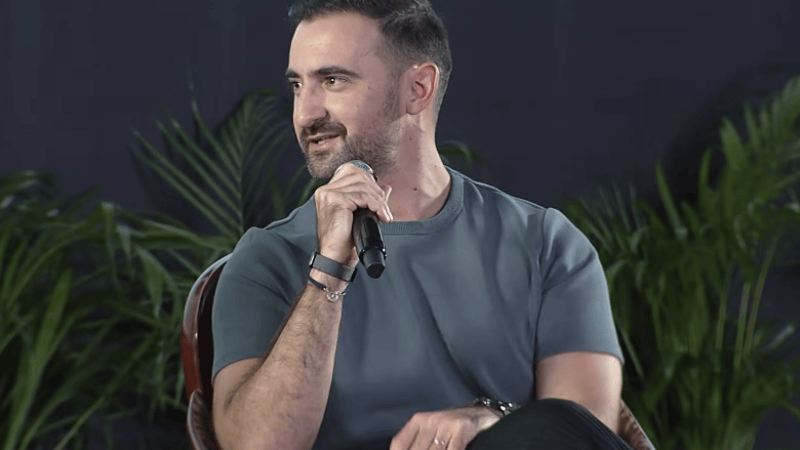
Nothing cofounder and India president Akis Evangelidis recalled the smartphone market a few years ago when design and innovation appeared to have hit a saturation point.
“At the time, my co-founder Carl Pei and I had just left OnePlus. We were entering our 30s, and I guess we were a bit bored with what the industry had to offer. We had spent a decade in the industry. I had just gotten married at the time, and Carl went on a two-month holiday, but then he got bored and wanted to get back into it,” Evangelidis said in a fireside conversation at the recently held Entrepreneur Summit in New Delhi.
“We thought, “Okay, we’re entering our 30s. It’s time to take a stab at bringing back that excitement and optimism around tech that we had when we were growing up,” because we felt that was lacking. There was a lot of negativity. Now with AI, there’s a mixed feeling, but you can see a positive way forward. Back then, it was just quite boring.
Our first bet was: can we bring excitement through design differentiation? That was our entry strategy. We focused on earbuds at the time… it was an exponentially growing category, cheaper and easier to do than smartphones, even though we found out the hard way that pulling off a semi-transparent design was actually a big hassle,” he added.
While the initial strategy was to come up with out-of-the-box design, Nothing also focused on gradually building product capabilities, including paying attention to software. Evangelidis noted that Indian consumers’ preferences have evolved in the recent years as they’re buying experiences and aspirational brands rather than purely focusing on value for money.
While value for money still remains a key factor, Evangelidis highlights that people buy their products because of the OS experience.
“That’s why even after increasing our average selling price (ASP) by over 50% this year, we’re still able to maintain growth,” he commented.
Nothing is also quite serious about its India foray. This includes leveraging Indian talent as well as a market.
As far as manufacturing goes, Evangelidis says: “… India is the second-largest manufacturing hub and on its way to potentially surpassing China if growth continues in that direction. To sustain this, as my co-founder recently mentioned, India needs to transition from a manufacturing hub to an innovation hub. Government policies made localizing manufacturing almost a must, which built the current ecosystem… But the struggle now is that a lot of IP and innovation still happen abroad because real R&D hasn’t yet been anchored in India.”
“If you look at China, that was the essence of building their innovation hub. Foxconn got the Apple manufacturing contract, which drove scale. Gradually, local Chinese brands emerged with their own R&D and requirements for screens, camera modules, and so on. That pushed the whole supply chain ecosystem to drive more innovation. Before the Chinese brand era, leading screen manufacturers were companies like Samsung and LG. Now, three of the top five screen manufacturers are Chinese, and that only happened because local players with local R&D pushed supply chain requirements,” he continued while stressing the need for more R&D to widen the ecosystem.
Smartphone makers as well as conventional electronics companies are currently bearing the brunt of the chip crisis, forcing some of them to delay product launches as well as increase prices.
Evangelidis acknowledges this challenge.
“To be honest, there is no easy solution. Memory prices are increasing and will keep increasing. For context, the memory chips used in smartphones are the same ones used in AI data centers, so it’s a demand-and-supply game. Memory prices have gone from around $30 to over $150 a piece depending on the configuration, which has a massive impact on the bill of materials (BOM). That’s why our ASP went up by 50% in just one year. Historically, it took five years to raise ASPs by that much across the industry,” he said
He, however, sees this as an opportunity.
“Brands that built their equity purely on value for money can no longer offer the specs they did last year at those price points. For us, because we spent years building hardware design differentiation and a unique software experience, value for money ranks fourth or fifth on the list of why people buy our products. People buy primarily for the OS experience and hardware design, meaning they are willing to spend a bit more for something unique. That’s why we are doubling our product portfolio next year,” he explained.
Watch the full conversation here:
Read our coverage from Entrepreneur 2026 below:
HFCL’s Mahendra Nahata Calls for Infra, Data Centre Expansion, and R&D Investment
Uno Minda Shares 6 Leadership Lessons for Indian Entrepreneurs
Entrepreneur 2026: ‘The IPO is Just the Beginning’
Entrepreneur 2026: Swiggy’s Rohit Kapoor on Building for Next Gen Consumers in India
“We used to call that the ‘sea of sameness’…”
Nothing cofounder and India president Akis Evangelidis recalled the smartphone market a few years ago when design and innovation appeared to have hit a saturation point.
“At the time, my co-founder Carl Pei and I had just left OnePlus. We were entering our 30s, and I guess we were a bit bored with what the industry had to offer. We had spent a decade in the industry. I had just gotten married at the time, and Carl went on a two-month holiday, but then he got bored and wanted to get back into it,” Evangelidis said in a fireside conversation at the recently held Entrepreneur Summit in New Delhi.

Entrepreneur Staff • Editor
Entrepreneur Staff
For more than 30 years, Entrepreneur has set the course for success for millions of... Read more