The Hidden Cost of Power Businesses Can’t Actually Use
Equipment trips, processes slow down, and demand charges increase. This creates a disconnect between what is documented and what is actually experienced on the ground.
Opinions expressed by Entrepreneur contributors are their own.
You're reading Entrepreneur India, an international franchise of Entrepreneur Media.
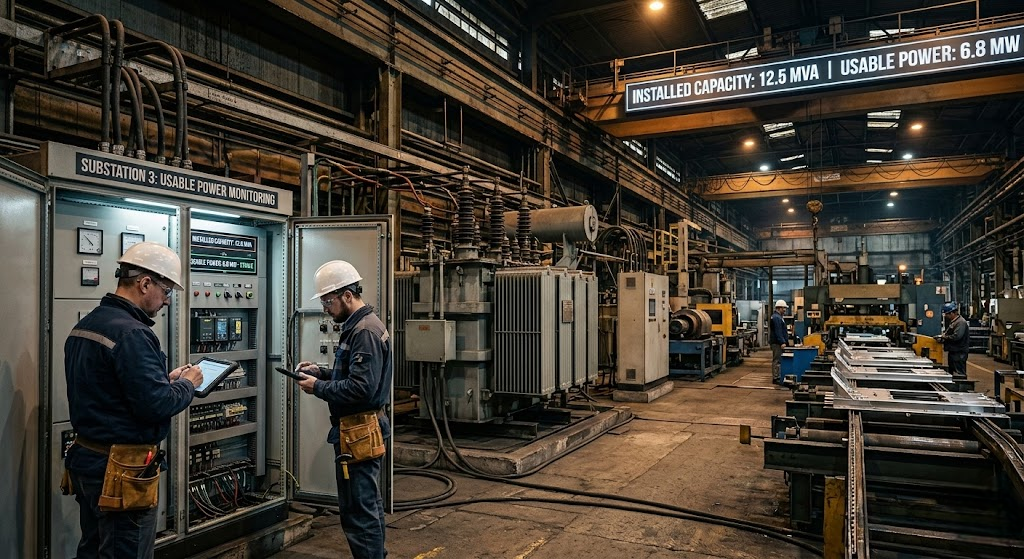
Most commercial and industrial sites have clear records of their electrical capacity. Transformer ratings are documented, generator capacities are defined, and grid connections are formally approved. On paper, these numbers often suggest that there is more than enough power available.
However, during periods of high demand—such as production ramp-ups or operational stress—many of these same facilities begin to experience limitations. Equipment trips, processes slow down, and demand charges increase. This creates a disconnect between what is documented and what is actually experienced on the ground.
The underlying issue is straightforward: installed capacity and usable power are not the same. Installed capacity reflects theoretical capability under ideal conditions, while usable power represents what can be reliably delivered in real-world operating environments.
This gap is where inefficiencies—and costs—begin to accumulate.
Electrical systems rarely operate under perfect conditions. Voltage fluctuations, phase imbalances, and harmonic distortions are common, especially in facilities with dynamic or non-linear loads.
While these factors do not reduce installed capacity, they affect how effectively that capacity can be used.
For example:
- Motors may draw more current to maintain performance
- Transformers may carry loads that do not translate into productive output
- Cables may heat up before reaching their rated limits
- Protection systems may act more conservatively under stress
Over time, these conditions reduce system stability and create what can be described as “hidden derating.” The system still has capacity on paper, but its reliable operating range becomes narrower.
From an external perspective, the facility may appear underutilized. Internally, however, operators often recognize that the system is already operating close to its practical limits.
This difference between theoretical and usable capacity becomes especially visible in billing.
Many utilities calculate demand charges based on short-duration peaks. Even brief spikes—caused by uneven load changes or temporary instability—can set the demand benchmark for the entire billing cycle.
These peaks often occur during moments when the system is already under strain. Small voltage dips or imbalances can lead to higher current draw, which is then recorded as peak demand.
As a result, businesses may be billed based on short-lived events rather than sustained usage. This creates the impression of paying for power that was never consistently used.
A common response to these challenges is to increase capacity through larger transformers, additional generators, or higher grid allocations.
While this may raise the theoretical limit, it does not necessarily improve how effectively power is utilized.
If underlying issues such as voltage instability, imbalance, or poor control persist, the same constraints tend to reappear. In some cases, additional infrastructure can introduce further complexity, making the system harder to manage and more sensitive to disturbances.
As a result, facilities may end up with more equipment but little improvement in operational confidence.
Solar installations are often effective in reducing energy costs and lowering grid dependency. They improve the overall energy balance and can make financial sense in many scenarios.
However, solar does not inherently address issues related to power quality or system stability.
Production data from solar systems reflects energy generation, but it does not capture how the electrical system behaves during transitions or disturbances. Facilities can generate significant solar power and still experience equipment trips or demand spikes due to instability in the broader system.
In this sense, solar improves the arithmetic of energy consumption, but not necessarily the behaviour of the electrical system.
Battery systems are often introduced to improve reliability or manage energy costs. Their effectiveness, however, depends largely on how they are integrated and controlled.
Systems designed primarily for backup or manual switching may not respond quickly enough to address short-duration disturbances or demand spikes.
In contrast, systems that respond rapidly—supporting voltage, absorbing transient spikes, and smoothing transitions—can improve how existing infrastructure performs. In such cases, the perceived usable capacity of the system increases, even though the physical components remain unchanged.
The key factor is not just storage capacity, but responsiveness and control.
Across different sectors and facility types, a similar pattern is often observed: sufficient installed capacity, but limited confidence in using it fully.
When power quality and system behaviour are addressed, facilities often find they can operate closer to their rated capacity without instability or unexpected costs.
This suggests that the issue is less about how much power is available and more about how effectively it can be used under real conditions.
The financial impact of this mismatch is rarely immediate or obvious. Instead, it appears gradually through:
- Conservative operating practices
- Higher-than-expected energy bills
- Increased equipment wear
- Investments that underperform expectations
Because facilities seldom reach their theoretical limits, capacity is often not seen as the problem. In reality, the issue lies in how much of that capacity is practically usable.
A more useful question, therefore, is not how much power is installed, but how much can be reliably used during demanding conditions.
Until this distinction is clearly understood, businesses may continue to incur costs for electrical capacity that exists in theory but remains difficult to utilize in practice.
Most commercial and industrial sites have clear records of their electrical capacity. Transformer ratings are documented, generator capacities are defined, and grid connections are formally approved. On paper, these numbers often suggest that there is more than enough power available.
However, during periods of high demand—such as production ramp-ups or operational stress—many of these same facilities begin to experience limitations. Equipment trips, processes slow down, and demand charges increase. This creates a disconnect between what is documented and what is actually experienced on the ground.
The underlying issue is straightforward: installed capacity and usable power are not the same. Installed capacity reflects theoretical capability under ideal conditions, while usable power represents what can be reliably delivered in real-world operating environments.
Reports on emerging technologies, data-led enterprises, and the intersection of innovation and regulation.