Google I/O Connect India 2026: Agentic AI, Enterprise, and Other Key Announcements
Google’s Play, Android ecosystem generated INR 5.3 lakh crore revenue contribution to Indian app publishers and digital economy in 2025.

pixabay
You're reading Entrepreneur India, an international franchise of Entrepreneur Media.
Google made a bunch of announcements at the 2026 edition of I/O Connect India, an annual conference that focuses on the developer community, businesses and more. The event saw participation of over 1,500 developers and eight startups – Adya.AI, VideoSDK, Sivi, Superjoin, Knit, PolicyBazaar, Emergent, and RedBus.
As expected, the 2026 edition of the conference extensively focused on AI. Some of the highlights include availability of specialized cybersecurity agent Sec-Gemini V3 to Indian testers, Gemini on Google Distributed Cloud to enable on-premise innovation with frontier AI, and expanding capabilities of Gemini Live to include over 25 Indian languages and dialects.
Preeti Lobana, Country Manager, Google India, said: “India’s builders are already deploying AI faster than almost anywhere else. As we drive the shift into the agentic era, where AI moves from answering queries to securely executing tasks, our focus is on providing the underlying infrastructure and guardrails the ecosystem needs to scale safely. Today, we are delivering just that across the board – from flexible on-premise cloud environments for highly regulated sectors, to open security protocols for developers, to localized tools for healthcare and classrooms. We want to ensure that the next wave of Indian innovation is secure, trusted, and built on locally relevant foundations.”
Dr. Manish Gupta, Senior Director for India and APAC at Google DeepMind, adds: “The ultimate metric of AI progress isn’t just model parameters, but also in the positive transformation it enables. India is championing this as it adopts AI across every tier of the economy – from local merchants to national health initiatives. In bringing our frontier AI, on-premise capabilities, and commitment to safety, we aim to accelerate this momentum, and look forward to the country’s AI learners, educators, builders, and innovators leading India’s AI ambition from the front.”
Before we hold forth with the key announcements, let’s take a look at Google’s mammoth Play and Android ecosystem in India.
Massive App Economy
The company says that the ecosystem generated INR 5.3 lakh crore revenue contribution to Indian app publishers and digital economy in 2025.
According to Google, In 2025, there were 1,080 crore app downloads from the Play Store for Indian developers, with 230 crores from overseas users and 850 crores from domestic users, marking the highest domestic download rate in the APAC region.
Meanwhile, there remains a growing global appetite for India-made apps and games, with overseas downloads growing 92% since 2024. Indian app publishers’ earnings from overseas consumers is over 2x their domestic earnings with INR 690 crores in 2025. Titles like Ludo King help put Indian apps on the global map, seeing nearly 10 crores downloads from abroad.
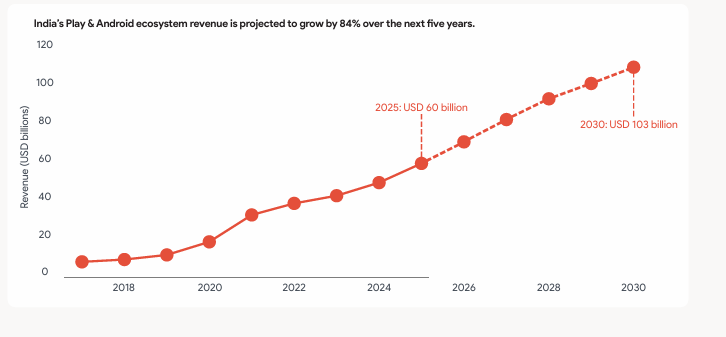
It’s estimated that as many as 39 lakhs direct, indirect and spillover jobs were created by the Google Play app ecosystem in India in 2025. Moreover, India had the 3rd largest number of
active developers on Google Play globally, and 72% of them had overseas users in the same period. Importantly, INR 690 crores (USD 79M) were earned by Indian app publishers from overseas consumers through Google Play in 2025 — over 2x their domestic earnings.
Google also highlighted that users are now spending more time and engaging with its AI platform, Gemini. On an average, users spent 4.5 hours per week on Android Gemini using AI tools for everyday tasks on their phones. 76% of the internet-using adult population in India – the equivalent of 54 crore people – say they would be interested in using AI tools to vibe code their own app.
“On average, we estimate that AI tools could increase Play and Android developer efficiency by 33% each year, allowing developers to boost their earnings and work faster and smarter,” said Google in its report.
Health, Education, Inclusivity
Google DeepMind is bringing its rigorous AI Research Foundations curriculum – a free 56-hour program that equips learners to build and fine-tune Large Language Models, and drive high-impact AI research. Learners can earn industry-recognized Google Cloud Skill badges and certificates upon completion.
Along with being available on the Google Skills platform, Google has partnered with NASSCOM and IISc Bangalore to scale the program with institutions across India, while AVPN, a network of social investors, will work with local partners to bring it to learners under the Google.org APAC AI Opportunity Fund.
Google DeepMind has also introduced something called “ATL Saathi” to “deepen” its collaboration with the Atal Innovation Mission. ATL Saathi is a desktop web application that gives teachers a Gemini-powered assistant to help deliver the Atal Tinkering Labs’ curriculum and curate hands-on experiments for students. ATL Saathi is being rolled out to 100 schools this year, with an aim to eventually reach 10,000 schools served by the Atal Tinkering Labs program.
Google added that researchers at AIIMS Delhi are now leveraging Google’s multimodal MedGemma open models to develop new India-specific models for leprosy and sexual and reproductive health. These models have the potential to help patients and healthcare professionals identify and manage conditions based on images and text inputs. AIIMS will make the outcomes of all these localized clinical health models available to the Indian developer ecosystem.
Gemini Live now supports 25 Indian languages and dialects, including Sanskrit, Bhojpuri, and Maithili.
Cloud, Agentic AI
Google said it had recently expanded its commitment to India’s digital sovereignty by making Gemini 3.5 Flash accessible to Indian enterprises and startups via the Gemini Enterprise Agent Platform and the Gemini Enterprise app. Starting now, this model will be available with strict in-country machine learning processing commitments. .
Google is also enabling Indian enterprises, including regulated industries and the public sector, to run Gemini on Google Distributed Cloud from within Indian data centres.
“Enterprises and public sector organizations can now build with frontier AI entirely within their own perimeter, with supporting services also fully disconnected from the public internet,” the company said.
As mentioned above, Google is bringing Sec-Gemini v3, its specialised cybersecurity agent, to trusted government and enterprise testers including Flipkart. Sec-Gemini can reason across complex security data and help teams investigate incidents at machine speed.
Google is open-sourcing a secure runtime environment known as CAPSEM (Capabilities Security for Agents) to help startups build securely with agentic AI. CAPSEM places each AI agent inside an isolated virtual machine. If an agent is compromised or encounters a malicious prompt, the wider system remains fully protected.
Google has also established new collaborations with IIT Delhi and IIT Madras to drive research in agentic safety, including early threat detection and the development of next-generation Guardian Agents that help mitigate institutional risks.
Google made a bunch of announcements at the 2026 edition of I/O Connect India, an annual conference that focuses on the developer community, businesses and more. The event saw participation of over 1,500 developers and eight startups – Adya.AI, VideoSDK, Sivi, Superjoin, Knit, PolicyBazaar, Emergent, and RedBus.
As expected, the 2026 edition of the conference extensively focused on AI. Some of the highlights include availability of specialized cybersecurity agent Sec-Gemini V3 to Indian testers, Gemini on Google Distributed Cloud to enable on-premise innovation with frontier AI, and expanding capabilities of Gemini Live to include over 25 Indian languages and dialects.
Preeti Lobana, Country Manager, Google India, said: “India’s builders are already deploying AI faster than almost anywhere else. As we drive the shift into the agentic era, where AI moves from answering queries to securely executing tasks, our focus is on providing the underlying infrastructure and guardrails the ecosystem needs to scale safely. Today, we are delivering just that across the board – from flexible on-premise cloud environments for highly regulated sectors, to open security protocols for developers, to localized tools for healthcare and classrooms. We want to ensure that the next wave of Indian innovation is secure, trusted, and built on locally relevant foundations.”

Entrepreneur Staff • Editor
Entrepreneur Staff
For more than 30 years, Entrepreneur has set the course for success for millions of... Read more