AI & Its Metal Marvels
AI in the metal industry empowers manufacturing, production, quality control, supply chain management, and
predictive maintenance.
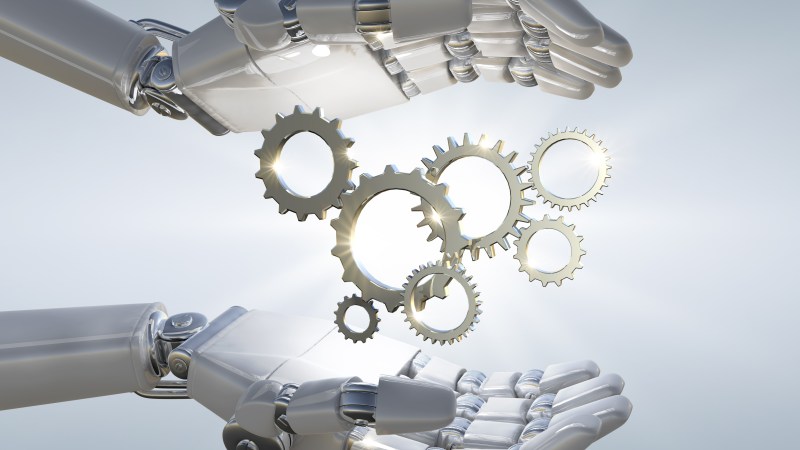
magnific
3D rendering robot hand holding metal 3D mechanical gear in light overlay background.
Opinions expressed by Entrepreneur contributors are their own.
You're reading Entrepreneur India, an international franchise of Entrepreneur Media.
Artificial intelligence is revolutionizing metal production and manufacturing by optimizing complex smelting temperatures, predicting equipment failures, and automating quality control.
Advanced AI technology like machine learning, computer vision, and natural language processing helps the industry in being more efficient, productive, and innovative.
For years, the industry celebrated efficiency as the headline promise of digital transformation – faster lines, leaner operations, fewer errors. That promise was delivered. But it was always the opening act, not the main event.
AI in the metal industry empowers manufacturing, production, quality control, supply chain management, and predictive maintenance. This integration automates repetitive tasks, optimizes decision-making, enhances product quality, and streamline operations, ultimately driving business growth.
The most common mistake an organisation can make with AI is evaluating it on short-term returns. Automation and legacy machine learning earned their keep through immediate productivity gains and they still do. But generative AI, the current frontier of the technology, is not primarily an efficiency engine. It is a knowledge partner.
“Manufacturers who measure AI ROI over 18 months will consistently undervalue it. Those who take a five-to-seven-year view will see it as among the most consequential investments they made this decade,” said Jayanta Banerjee, Group CIO, Tata Steel.
At Tata Steel, the AI shift began with data infrastructure – moving to the cloud, standardising definitions, building a foundation before deploying intelligence on top of it. AI-driven predictive maintenance, with the use of predictive and prescriptive models for critical gearboxes, fans, and motors, reduces delays in super-critical equipment by 92 per cent. The manufacturing facilities are increasingly sophisticated, with 78 per cent of its steel now coming from World Economic Forum-recognised Global Manufacturing Lighthouses. But the more instructive investment has been in building systems that don’t just process data – they map organisational knowledge and business context.
“The ambition is not a smarter dashboard. It is something closer to an institutional knowledge partner. That distinction matters, and arriving at it takes time. The high-performing enterprise of the future may not be the one with the most sophisticated AI stack. It may well be the one whose people ask better questions, bring more diverse perspectives to the system, and learn faster through that engagement,” the CIO added.
At RUSAL, a leading global aluminium producer and one of the largest makers of primary aluminium and low-carbon aluminium worldwide, AI technologies have become an integral part of the production chain.
“The application of AI-enabled processes helps us increase productivity, enhance quality control, and improve safety during production,” Roman Borisov, regional sales director, RUSAL.
Rusal has been developing advanced technological and production processes based on artificial intelligence technologies, including intelligent decision-support systems, digital twins, information and simulation modelling, computer vision, predictive diagnostics, and language models.
“The digital solutions, tailored to specific practical tasks, help improve the safety of production processes and enable real-time management, product quality monitoring, supply chain and logistics optimisation, management decision-making, and the minimisation of environmental impact. Over the years, RUSAL has consistently invested significant resources in improving operational performance and labour productivity,” he said.
RUSAL has developed and deployed proprietary software to automate control of anode baking furnaces at its Aluminium Smelter as part of a wider modernisation programme to improve production efficiency, process flexibility, and operational performance.
The solution claims to improve furnace operation efficiency and enables production teams to adapt and extend system functionality to meet evolving operational requirements.
The implementation formed part of a phased modernisation of all three anode baking furnaces at Sayanogorsk, completed this year with a total investment of approximately $200 million. Following the upgrade, annual baked-anode production capacity is expected to rise from 480,000 tonnes to 535,000 tonnes.
Baking is one of the most energy-intensive and technically sensitive stages of anode production; process stability directly affects anode quality, furnace efficiency, and overall smelter performance. Automated control systems are being adopted across the aluminium industry to optimise energy use, improve process consistency, and reduce operational downtime.
RUSAL says the software architecture supports further development of advanced process-control methods, including neural-network-based approaches for furnace management and optimisation.
“In 2026, we plan to implement 15 digital solution projects utilising artificial intelligence across the production facilities of the Aluminium Division,” Borisov added.
Furthermore, as technologically advanced sectors scale, aluminium’s role is evolving from a traditional industrial material into a critical component of the hardware required for the digital economy. The rapid adoption of production automation is a primary factor supporting stable demand. Specialized aluminium alloys are increasingly utilized in the mechanical components of industrial robots and automated systems due to their weight-saving properties and durability.
Ever since the advent of industrialisation, the manufacturing landscape has been the hub of innovation, invention, and revolution. With AI, the stainless steel industry is also evolving. Digitalisation, smart production, and advanced materials are no longer optional; they are the levers that will define global standing. If we get this right, India will move from being a volume player to becoming a trusted supplier of high-performance, sustainable stainless steel. “The adoption of AI is a core component of the broader Industry 4.0 movement, which involves the integration of digital technologies into manufacturing processes and aims to create smart factories where digital and physical systems collaborate seamlessly. AI isn’t just a technological upgrade; it’s a strategic move that will keep our industry competitive in the global market and help us become safer, smarter, and more sustainable,” said Abhyuday Jindal, MD, Jindal Stainless.
AI’s role is expanding along two axes in the metal industry: It is getting deeper and wider at the same time.
The organisations that treat AI as a knowledge infrastructure – one built carefully on quality data, led with intention, and measured over the long term – will find themselves in a different competitive position five years from now. That is the real promise of smart manufacturing. And it is worth the work.
Artificial intelligence is revolutionizing metal production and manufacturing by optimizing complex smelting temperatures, predicting equipment failures, and automating quality control.
Advanced AI technology like machine learning, computer vision, and natural language processing helps the industry in being more efficient, productive, and innovative.
For years, the industry celebrated efficiency as the headline promise of digital transformation – faster lines, leaner operations, fewer errors. That promise was delivered. But it was always the opening act, not the main event.
Shrabona Ghosh • Former Senior Correspondent
Entrepreneur Staff
I write on corporates and lead a project called 'Corporate Innovations', wherein I cover large... Read more