Ecosystem Play: How Rahul Sharma is Preparing Bhagwati Products for the Next
Rahul Sharma details Bhagwati’s pivot to an integrated ecosystem play, unit economics of manufacturing, and how Indian players can take on global giants like Foxconn and Pegatron.

.
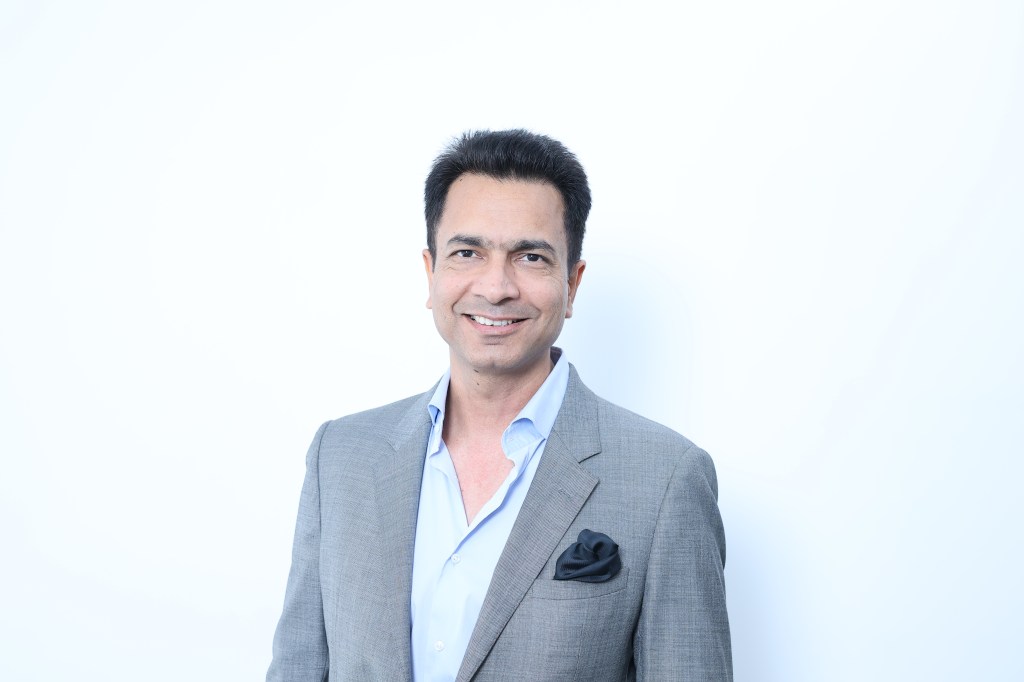
Rahul Sharma, Co-Founder of Micromax, MiPhi & Bhagwati Products Limited
Opinions expressed by Entrepreneur contributors are their own.
You're reading Entrepreneur India, an international franchise of Entrepreneur Media.
Union Minister Ashwini Vaishnaw recently addressed criticisms surrounding Indian manufacturing, particularly the “screwdriver assembly” jibes, stating that India has successfully transitioned from box assembly to the manufacturing of modules, and is now reaching component and raw material production.
Evidently, the government is aiming to help foster an ecosystem for electronics manufacturing, which is more or less the face of the ambitious Make in India initiative. In a newer phase of local production campaign, there are allround efforts to have more private players enhance their capabilities, and with the right nudges they can quickly scale up.
At the center of this push is Rahul Sharma, co-founder of Bhagwati Products Limited.
Sharma, known for building Micromax which at one stage competed with the global names in the smart market, is now in a new space, though not far from the electronics industry, and in a far more capital-intensive and tightly competitive environment.
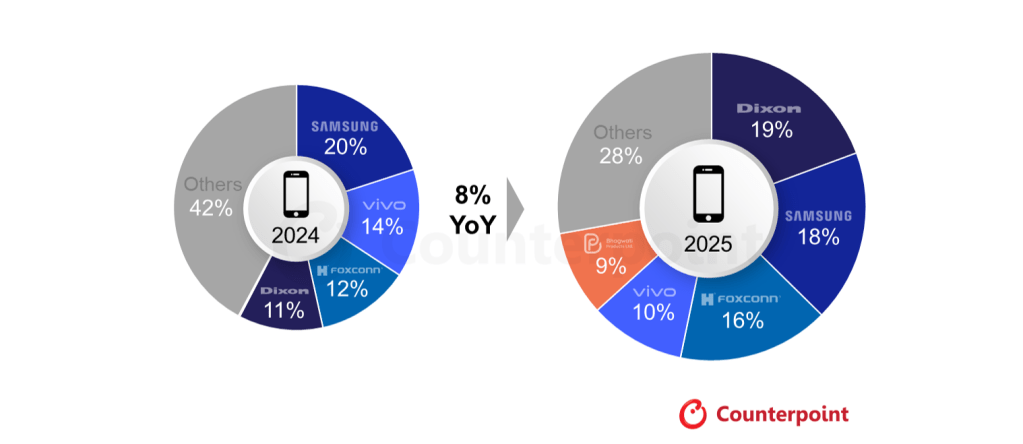
To put things into perspective, ‘Made in India’ smartphone shipments grew 8 percent YoY in 2025, driven by a 28 percent YoY growth in experts and a 1 percent YoY growth in domestic sell-in, according to Counterpoint Research’s report, published in April.
Exports contributed to nearly one-third of all smartphones manufactured in India.
Foxconn Hon Hai emerged as the key beneficiary with a 48 percent YoY growth in its exports, driven by strong Apple shipments. Tata Electronics, also a key assembler of Apple devices, further contributed to this export surge. Samsung’s in-house production saw an uptick in its export contribution as well, recording a 4 percent YoY growth, the report added.
Manufacturer-wise, Dixon Technologies saw a growth of 89 percent YoY owing to increased orders from Motorola, Realme, and Xiaomi.
On Sharma’s Bhagwati Products, the report notes:
“vivo’s strong performance in India, coupled with its decision to outsource production beyond its in-house facility, has led to a significant surge in phones manufactured by Bhagwati Products Limited (BPL), establishing it as one of the top five smartphone manufacturers in India. Orders from OPPO and realme further contributed to BPL’s growth.”
Increased outsourcing from vivo, OPPO and realme helped Bhagwati join the top 5 league.
Riding high on ample demand, the electronics manufacturer is now mounting a major ecosystem play following government approval for its two projects worth INR 1,015 crore under the Electronics Component Manufacturing Scheme (ECMS).
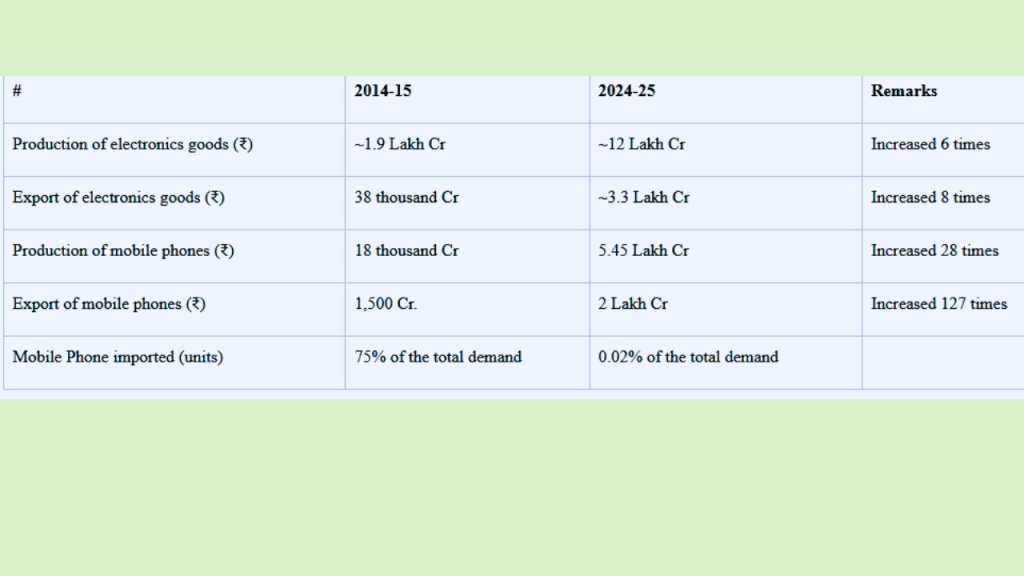
For the uninitiated, ECMS is a financial incentive program aimed at fostering a self-sustaining electronics supply chain in India. The Union Budget 2026-27 brought an increase in the outlay for the scheme to INR 40,000 crore, indicating all-round support for boosting local manufacturing capabilities.
Source: PIB
For Bhagwati Products, the two projects – display manufacturing and precision moulding – align directly with this ecosystem approach. They also help bridge a critical gap in the domestic manufacturing landscape, which has grown exponentially in value but faces criticism of delivery lower-than-expected domestic value addition, currently averaging just 18% to 20%.
“…the whole idea is to bring the whole supply chain of components now in the country, and get deeper into the value chain so that India is not only manufacturing, but is also creating opportunities in the component ecosystem…,” Bhagwati Products cofounder Rahul Sharma tells Entrepreneur India.
Sharma continued that India needs to have a comprehensive ecosystem in a longer-term, and that’s what the government objective is. “And keeping that in mind we have been working very, very deeply on the whole ecosystem, and here we are with display and precision molding…” he added.
Execution and The 70% BOM Math
Bhagwati Products is pursuing its display project via TXD India’s facility in Haryana’s Bawal. It may be recalled that Bhagwati owns a majority (51%) stake in TXD India. The total allocation for this project is INR 450 crore.
According to the company, the Haryana facility will ship 1.5 million mobile phone displays per month, and is likely to scale this up to 3 million to 4 million in the longer term. The company also plans to diversify its portfolio to tap into automotive display manufacturing. As far as precision moulding goes, it has earmarked INR 565 crore for its Greater Noida facility.
“Both projects, expected to commence production this year, are expected to generate additional employment opportunities across manufacturing facilities and take the overall strength to over 10,000 employees,” according to a company statement.
For Sharma, controlling these critical components is essential to moving beyond simple box assembly.
“If you break down a smartphone, 70% of the Bill of Material (BOM) cost is concentrated in just five core component categories: the chipset, memory, display, camera module, and precision-moulded enclosures,” Sharma explains, stressing the need for self-reliance in these categories to break away from the assembler tag.
Sharma added that the company is building memory via its semiconductor arm, MiPhi Semiconductors. And soon, Bhagwati Products will be adding camera module manufacturing to its portfolio. Diversification plans also include tapping into automotive screens among others.
“… smartphone is one ecosystem… when I say ecosystem, smartphone is at the center, then everything surrounding that, which is TWS, watches, IoT camera… all that comes from one ecosystem. The second ecosystem is an IT ecosystem, where you have a laptop at the center, then everything surrounding that, which is servers, desktops, hyper-scalers, switches, routers, everything… that is a very promising ecosystem. And the third is an automotive ecosystem, where you have display clusters, ECU, VCU, all of that. We see opportunities in all these areas, and we are going to incubate all these ecosystems one by one,” he explained.
Margin Call & The Domino Effect
As mentioned above, the ecosystem play allows Bhagwati Products to help increase margins. Without divulging a ballpark number, Sharma noted that the ecosystem approach will help increase margins in what’s a very competitive market.
“It will help in enhancing the total EBITDA for the organization, that is for sure,” he remarked.
Even as improvement in margin is certain, Sharma is also expecting a domestic industrial domino effect.
“Take display assembly,” Sharma notes.
“You cannot build a localized component industry in a vacuum. Once you assemble display modules at scale, you create local demand for flexible PCBs. Once flexible PCBs are made locally, a vendor sets up a facility for driver ICs or glass substrates. Substrates require specialist chemical manufacturing, which in turn brings industrial gas suppliers to your doorstep. But if nobody builds the display module first, every single layer below it remains 100% imported.”
Shark vs Shark: Strategic JVs as a Scale Wedge
Bhagwati Products has been quietly beefing itself up to take on global giants like Pegatron or Foxconn.
For instance, it has entered into a joint venture with Huaqin Technology, one of the largest ODMs (original design manufacturers) of mobiles, tablets and laptops, which owns a 27.9 percent market share. In the memory space, it has partnered with Taiwan’s Phison Electronics to launch MiPhi, which potentially unlocks opportunities for categories like enterprise, AI, and more.
“People ask how a domestic player competes against the capital expenditure of global behemoths,” Sharma said. “We aren’t small fish. Through our JV with Huaqin and alliances with leaders like Phison, we hold world-class design capabilities and scale right here in India.”
According to reports, Bhagwati Products has gone past the INR 17,000 crore revenue mark, courtesy its JV with Huaqin. Sharma expects to close the fiscal year at INR 20,000 crore. For the semiconductor business, he predicted the number to go past INR 1,000 crore, recording an exponential 10x growth.
Sharma also addressed the industry chatter around a public market debut. “We will tap the public markets when the time is right and when capital needs align,” Sharma stated. “Right now, our growth is fully fueled by internal accruals and strategic JVs.”
Union Minister Ashwini Vaishnaw recently addressed criticisms surrounding Indian manufacturing, particularly the “screwdriver assembly” jibes, stating that India has successfully transitioned from box assembly to the manufacturing of modules, and is now reaching component and raw material production.
Evidently, the government is aiming to help foster an ecosystem for electronics manufacturing, which is more or less the face of the ambitious Make in India initiative. In a newer phase of local production campaign, there are allround efforts to have more private players enhance their capabilities, and with the right nudges they can quickly scale up.
At the center of this push is Rahul Sharma, co-founder of Bhagwati Products Limited.