Nikhil Kamath and Yuval Noah Harari Confront Fragile Global Order and Institutional Trust Crisis
Harari emphasised that large-scale human collaboration has historically depended on shared belief in institutional frameworks rather than force alone.
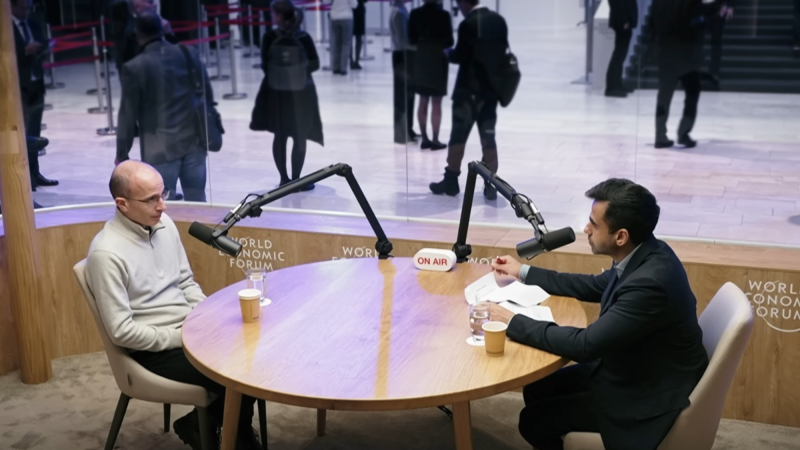
[L-R] Yuval Noah Harari & Nikhil Kamath
You're reading Entrepreneur India, an international franchise of Entrepreneur Media.
Amid rising geopolitical tensions, growing polarisation, and declining faith in institutions, Zerodha co-founder Nikhil Kamath engaged historian and bestselling author Yuval Noah Harari in a wide-ranging conversation on the future of global cooperation and the role of trust in sustaining modern civilization.
Recorded on the sidelines of the World Economic Forum annual meeting in Davos, the discussion explored structural challenges facing democratic systems, alliances, and global governance. Rather than focusing on day-to-day politics, the dialogue examined deeper forces shaping stability and cooperation.
Harari emphasised that large-scale human collaboration has historically depended on shared belief in institutional frameworks rather than force alone. Financial systems, nation-states, treaties, and legal systems function because people trust common narratives that transcend individual leaders. When that collective trust weakens, predictability declines and stability becomes fragile.
“Humans control the world not because we are stronger than other animals, but because we cooperate better. And cooperation depends on storytelling,” Harari said.
A key theme was the shift from institutional loyalty toward personality-driven politics. Harari shared that when political commitments become personal rather than structural, long-term agreements lose resilience. He stressed that democracy relies not only on elections, but also on confidence in procedures, shared facts, and institutional continuity.
The conversation also addressed how emerging artificial intelligence systems could reshape governance, authority, and the creation of meaning. Beyond economic disruption, the speakers questioned how societies can preserve human agency and shared truth as machines increasingly generate information and narratives.
Reflecting on the discussion, Kamath drew parallels between markets and geopolitics, noting that both depend on confidence.
“If trust is the foundation of finance, it is also the foundation of geopolitics,” Kamath said.
The exchange situates People by WTF within broader debates on institutional resilience, democratic durability, technological transformation, and the evolving architecture of global order.
Amid rising geopolitical tensions, growing polarisation, and declining faith in institutions, Zerodha co-founder Nikhil Kamath engaged historian and bestselling author Yuval Noah Harari in a wide-ranging conversation on the future of global cooperation and the role of trust in sustaining modern civilization.
Recorded on the sidelines of the World Economic Forum annual meeting in Davos, the discussion explored structural challenges facing democratic systems, alliances, and global governance. Rather than focusing on day-to-day politics, the dialogue examined deeper forces shaping stability and cooperation.
Harari emphasised that large-scale human collaboration has historically depended on shared belief in institutional frameworks rather than force alone. Financial systems, nation-states, treaties, and legal systems function because people trust common narratives that transcend individual leaders. When that collective trust weakens, predictability declines and stability becomes fragile.

Entrepreneur Staff • Editor
Entrepreneur Staff
For more than 30 years, Entrepreneur has set the course for success for millions of... Read more