Crafting a Stain-less Business: Abhyuday Jindal, MD, Jindal Stainless
Abhyuday Jindal stepped into the company in 2014 at its toughest hour, steering it from crisis to confidence. Today, he has reshaped the business with bold domestic focus, investments in new-age applications, and a vision for stainless steel in India’s growth story.
Opinions expressed by Entrepreneur contributors are their own.
You're reading Entrepreneur India, an international franchise of Entrepreneur Media.
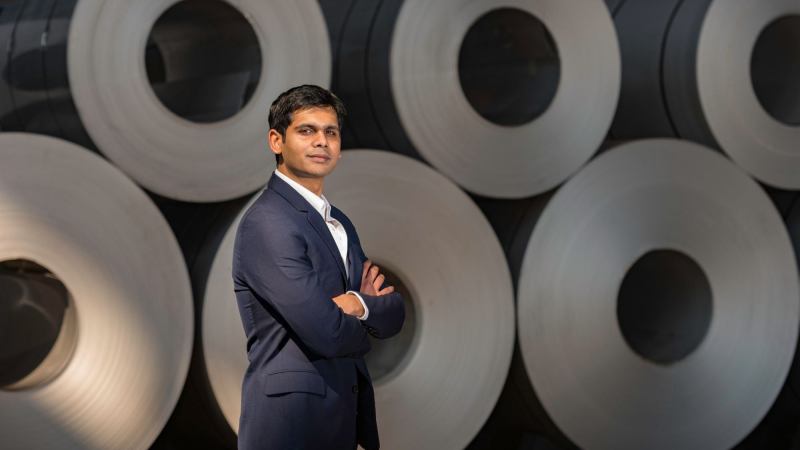
“It was a baptism of fire,” recalls Abhyuday Jindal as he speaks about his initial years of joining Jindal Stainless (JSL).
He stepped into the company in 2014 at its toughest hour, got his hands dirty, and steered the company out of crisis into confidence.
One of the biggest challenges was giving stainless steel more presence in India’s economy. Back then, awareness was limited—most people thought of it as only used in utensils. He spent years educating ministries and markets that stainless steel is vital for high-end, critical applications. Today, acceptance has grown.
“I no longer need to spend half an hour explaining what Jindal Stainless stands for. It was a very difficult time, I had to get my hands dirty and look into every aspect of the business. I credit my learning to that phase, had I joined the company during a growth phase, I wouldn’t have grown at length as an entrepreneur,” says Jindal, MD, Jindal Stainless.
One of the critical areas of concern he initially worked upon was supply chain. Earlier, Jindal Stainless faced several challenges in its supply chain, particularly regarding raw material procurement, external trade policies, and logistics, especially during the COVID-19 pandemic and periods of high import volumes.
The delivery time of raw material would then vary from almost 12 weeks to 20 weeks. “How do we plan our supply chain?” Jindal says it was his disquiet.
“I spent a lot of effort to change the supply chain of the organization. We used to buy most of our raw materials from the US and Europe. I changed that completely. Now 90 per cent of our raw material is from India, nearby sources, Southeast Asia and Middle East. We can give an exact date to a customer, no more, longer waiting periods.” Jindal explains.
From 2014 to 2016, he put his ears to the ground, did the shadow work and it took him two years to overcome the pain points. “…And then by 2017, I was given the charge as MD of the company.”
Now, JSL is firmly on a growth trajectory: leveraging the Make in India push and expanding into new-age applications.
New age applications & growth areas
Fast forward, stainless steel goes into every critical industry—from bridges and metros to railways, chemical plants, and nuclear facilities. Infrastructure and transportation are the big growth drivers, making stainless steel the material of choice for India’s future.
Passenger coaches and metro coaches are 100 per cent stainless steel, wagons are around 50-60 per cent stainless steel, “This will continue, because India is going to be dependent on railways, these are big consumption areas that we feel will pick up,” he continues.
Process industries—from chemical plants to desalination, ethanol blending, and nuclear facilities—require tremendous amounts of stainless steel. Wherever corrosion, high temperatures, or chemicals are involved, this is the material of choice.
New age industries will be a core facilitator for JSL in the future. Talking about the applications, he says, “For instance, stainless steel may not go directly into data centers, but in building them, stainless steel rebars offer durability. Beyond infrastructure, thermal energy, pharma, medical equipment, and even robotics are emerging as strong areas.”
Strengthening India’s defense sector
Jindal is enthusiastic about the defence and aerospace sector. JSL is a major indigenous supplier of specialized, high-strength steel for India’s defense and aerospace sectors, focusing on import substitution under the ‘Make in India’ initiative. Through Jindal Defence & Aerospace, the company provides materials for critical applications.
The defence industry is growing at around 10–15 percent annually, while aerospace and nuclear are still in early stages but are expected to pick up. He attributes this growth to India taking steps toward self-reliance amidst global disruptions.
“Patriotism runs in my family, and when I joined in 2014, I saw defense as my way to contribute to India. With most aerospace materials imported, I felt India had to build its own ecosystem. Today, we’re working with DRDO and DMRL, developing high-nitrogen steel and investing in advanced technologies to make India atmanirbar in defense and aerospace,” he says.
“We are already investing in ESR and forging technologies, and will later add VIMVAR—an aerospace-grade process. These advanced techniques create clean, high-performance materials for space applications and high-temperature blast environments,” he adds.
His vision? “To be a superpower in defence.”
It’s still a long journey for him, “More efforts are required but I’m proud that awareness has grown and stainless steel now commands far greater acceptance.”
He flipped the strategy script and the balance sheet changed. The company’s growth ambitions are backed by numbers.
JSL reported strong Q3 FY26, ended Dec 31, 2025, with consolidated profit after tax (PAT) rising 26.6 per cent year-on-year (YoY) to INR 828.8 crore and consolidated EBITDA increasing 16.6 per cent YoY to INR 1,408 crore. Revenue grew 6.2 per cent YoY to INR 10,517.6 crore, supported by robust domestic demand, despite export challenges.
Domestic & global expansion plans
In Q3 FY26, the company experienced domestic demand from sectors like automobiles, infrastructure, and the railways, with domestic sales contributing around 95 per cent of the total volume.
Earlier the ration between domestic market shares to export was 70:30. Now, exports maintained only for critical long-term customers like Gillette and global auto supply chains. Out of the total production, domestic consumption marks 90–95 per cent, driven by India’s growth and life-cycle costing trends.
“Historically, we were a fairly export-oriented company. But today, our focus has shifted decisively to India, nearly 90–92 per cent of our business is domestic, with only 7–8 per cent going overseas. This reflects a paradigm shift: customers are no longer chasing the cheapest material, but investing in life-cycle value and durability. That change gives us confidence. Stainless steel demand in India is rising at 9–10 per cent annually, and while it once was dominated by utensils, today the majority is absorbed by industries such as infrastructure, mobility, and process applications,” he explained.
Exports have decreased to approximately five per cent of the sales mix in Q3 FY26 due to global volatility, including the Carbon Border Adjustment Mechanism (CBAM) in Europe and anti-dumping duties.
The India-EU FTA, finalized in early 2026, presents a mixed, complex impact on India’s stainless steel sector, balancing long-term market access with threats from import surges. While providing potential for trade growth, it leaves domestic producers concerned about increased competition from European high-quality steel, driving calls for safeguards.
“The stainless steel industry hasn’t received any direct relief yet, though there’s plenty of positive momentum and dialogue. The European Union had reduced India’s quota, but we expect this to be revised upward. While CBAM relaxations aren’t on the table, there’s still considerable ambiguity around its implementation. What we seek is clarity and recognition for the work we’re doing on ESG, so that we’re not disadvantaged but rather acknowledged for our commitment,” said Jindal.
Push for policy demands
There is a national steel policy, “However, because of the kind of size and volume the steel industry caters to, stainless steel is always looked at as a younger brother. We feel a dedicated national stainless steel policy is required. We request the government to give us a level playing field. It becomes extremely difficult to compete against China because of their subsidies.”
A strong push for a dedicated national stainless steel policy is needed to prevent dumping and ensure raw material security. It calls for a level playing field against China: logistics costs, capital costs, and ease of doing business remains challenging. He also emphasized on welcoming Quality Control Orders (QCO) to block substandard imports.
“Still a lot of effort has to go. And that is our dialogue with the government always, if you give us a level playing field against China, Vietnam, other players, we are as competitive as them. As of now, we have another request that either the basic custom duty on stainless steel should be increased or there should be some kind of anti-dumping duty,” he asserted.
Outlook for the next fiscal
With strongest support from domestic market, driven by the government’s sustained push on infrastructure spending and capital investments, the company is continuing its momentum amid global uncertainties.
“We’re focused on scaling up our cold rolling capacities, aiming for at least 85–90 per cent utilization across recent acquisitions. At the same time, we’re preparing for our next big leap, a major expansion in Maharashtra. With stainless steel demand growing at 9–10 per cent annually, we believe another plant of our scale is essential in this region, given its position as one of the largest consumption markets alongside Gujarat. Having established a strong presence in Haryana and Odisha, Maharashtra is the natural next frontier for us,” he added.
Globally, the stainless steel industry is seeing limited new capacity additions, with Europe saturated and operating at only 40–50 per cent utilization, while China has announced it will not expand further. Against this backdrop, the major growth and consumption centers are expected to be India and the US, with India leading the charge thanks to strong domestic demand and the US remaining a net importer. Indonesia is also emerging as a growth hub, where the company already has a plant. However, despite the US opportunity, the company has no immediate plans to establish a facility there, emphasizing that its core operations and future expansions will remain anchored in India.
“It was a baptism of fire,” recalls Abhyuday Jindal as he speaks about his initial years of joining Jindal Stainless (JSL).
He stepped into the company in 2014 at its toughest hour, got his hands dirty, and steered the company out of crisis into confidence.
One of the biggest challenges was giving stainless steel more presence in India’s economy. Back then, awareness was limited—most people thought of it as only used in utensils. He spent years educating ministries and markets that stainless steel is vital for high-end, critical applications. Today, acceptance has grown.
“I no longer need to spend half an hour explaining what Jindal Stainless stands for. It was a very difficult time, I had to get my hands dirty and look into every aspect of the business. I credit my learning to that phase, had I joined the company during a growth phase, I wouldn’t have grown at length as an entrepreneur,” says Jindal, MD, Jindal Stainless.
One of the critical areas of concern he initially worked upon was supply chain. Earlier, Jindal Stainless faced several challenges in its supply chain, particularly regarding raw material procurement, external trade policies, and logistics, especially during the COVID-19 pandemic and periods of high import volumes.
The delivery time of raw material would then vary from almost 12 weeks to 20 weeks. “How do we plan our supply chain?” Jindal says it was his disquiet.
“I spent a lot of effort to change the supply chain of the organization. We used to buy most of our raw materials from the US and Europe. I changed that completely. Now 90 per cent of our raw material is from India, nearby sources, Southeast Asia and Middle East. We can give an exact date to a customer, no more, longer waiting periods.” Jindal explains.
From 2014 to 2016, he put his ears to the ground, did the shadow work and it took him two years to overcome the pain points. “…And then by 2017, I was given the charge as MD of the company.”
Now, JSL is firmly on a growth trajectory: leveraging the Make in India push and expanding into new-age applications.
New age applications & growth areas
Fast forward, stainless steel goes into every critical industry—from bridges and metros to railways, chemical plants, and nuclear facilities. Infrastructure and transportation are the big growth drivers, making stainless steel the material of choice for India’s future.
Passenger coaches and metro coaches are 100 per cent stainless steel, wagons are around 50-60 per cent stainless steel, “This will continue, because India is going to be dependent on railways, these are big consumption areas that we feel will pick up,” he continues.
Process industries—from chemical plants to desalination, ethanol blending, and nuclear facilities—require tremendous amounts of stainless steel. Wherever corrosion, high temperatures, or chemicals are involved, this is the material of choice.
New age industries will be a core facilitator for JSL in the future. Talking about the applications, he says, “For instance, stainless steel may not go directly into data centers, but in building them, stainless steel rebars offer durability. Beyond infrastructure, thermal energy, pharma, medical equipment, and even robotics are emerging as strong areas.”
Strengthening India’s defense sector
Jindal is enthusiastic about the defence and aerospace sector. JSL is a major indigenous supplier of specialized, high-strength steel for India’s defense and aerospace sectors, focusing on import substitution under the ‘Make in India’ initiative. Through Jindal Defence & Aerospace, the company provides materials for critical applications.
The defence industry is growing at around 10–15 percent annually, while aerospace and nuclear are still in early stages but are expected to pick up. He attributes this growth to India taking steps toward self-reliance amidst global disruptions.
“Patriotism runs in my family, and when I joined in 2014, I saw defense as my way to contribute to India. With most aerospace materials imported, I felt India had to build its own ecosystem. Today, we’re working with DRDO and DMRL, developing high-nitrogen steel and investing in advanced technologies to make India atmanirbar in defense and aerospace,” he says.
“We are already investing in ESR and forging technologies, and will later add VIMVAR—an aerospace-grade process. These advanced techniques create clean, high-performance materials for space applications and high-temperature blast environments,” he adds.
His vision? “To be a superpower in defence.”
It’s still a long journey for him, “More efforts are required but I’m proud that awareness has grown and stainless steel now commands far greater acceptance.”
He flipped the strategy script and the balance sheet changed. The company’s growth ambitions are backed by numbers.
JSL reported strong Q3 FY26, ended Dec 31, 2025, with consolidated profit after tax (PAT) rising 26.6 per cent year-on-year (YoY) to INR 828.8 crore and consolidated EBITDA increasing 16.6 per cent YoY to INR 1,408 crore. Revenue grew 6.2 per cent YoY to INR 10,517.6 crore, supported by robust domestic demand, despite export challenges.
Domestic & global expansion plans
In Q3 FY26, the company experienced domestic demand from sectors like automobiles, infrastructure, and the railways, with domestic sales contributing around 95 per cent of the total volume.
Earlier the ration between domestic market shares to export was 70:30. Now, exports maintained only for critical long-term customers like Gillette and global auto supply chains. Out of the total production, domestic consumption marks 90–95 per cent, driven by India’s growth and life-cycle costing trends.
“Historically, we were a fairly export-oriented company. But today, our focus has shifted decisively to India, nearly 90–92 per cent of our business is domestic, with only 7–8 per cent going overseas. This reflects a paradigm shift: customers are no longer chasing the cheapest material, but investing in life-cycle value and durability. That change gives us confidence. Stainless steel demand in India is rising at 9–10 per cent annually, and while it once was dominated by utensils, today the majority is absorbed by industries such as infrastructure, mobility, and process applications,” he explained.
Exports have decreased to approximately five per cent of the sales mix in Q3 FY26 due to global volatility, including the Carbon Border Adjustment Mechanism (CBAM) in Europe and anti-dumping duties.
The India-EU FTA, finalized in early 2026, presents a mixed, complex impact on India’s stainless steel sector, balancing long-term market access with threats from import surges. While providing potential for trade growth, it leaves domestic producers concerned about increased competition from European high-quality steel, driving calls for safeguards.
“The stainless steel industry hasn’t received any direct relief yet, though there’s plenty of positive momentum and dialogue. The European Union had reduced India’s quota, but we expect this to be revised upward. While CBAM relaxations aren’t on the table, there’s still considerable ambiguity around its implementation. What we seek is clarity and recognition for the work we’re doing on ESG, so that we’re not disadvantaged but rather acknowledged for our commitment,” said Jindal.
Push for policy demands
There is a national steel policy, “However, because of the kind of size and volume the steel industry caters to, stainless steel is always looked at as a younger brother. We feel a dedicated national stainless steel policy is required. We request the government to give us a level playing field. It becomes extremely difficult to compete against China because of their subsidies.”
A strong push for a dedicated national stainless steel policy is needed to prevent dumping and ensure raw material security. It calls for a level playing field against China: logistics costs, capital costs, and ease of doing business remains challenging. He also emphasized on welcoming Quality Control Orders (QCO) to block substandard imports.
“Still a lot of effort has to go. And that is our dialogue with the government always, if you give us a level playing field against China, Vietnam, other players, we are as competitive as them. As of now, we have another request that either the basic custom duty on stainless steel should be increased or there should be some kind of anti-dumping duty,” he asserted.
Outlook for the next fiscal
With strongest support from domestic market, driven by the government’s sustained push on infrastructure spending and capital investments, the company is continuing its momentum amid global uncertainties.
“We’re focused on scaling up our cold rolling capacities, aiming for at least 85–90 per cent utilization across recent acquisitions. At the same time, we’re preparing for our next big leap, a major expansion in Maharashtra. With stainless steel demand growing at 9–10 per cent annually, we believe another plant of our scale is essential in this region, given its position as one of the largest consumption markets alongside Gujarat. Having established a strong presence in Haryana and Odisha, Maharashtra is the natural next frontier for us,” he added.
Globally, the stainless steel industry is seeing limited new capacity additions, with Europe saturated and operating at only 40–50 per cent utilization, while China has announced it will not expand further. Against this backdrop, the major growth and consumption centers are expected to be India and the US, with India leading the charge thanks to strong domestic demand and the US remaining a net importer. Indonesia is also emerging as a growth hub, where the company already has a plant. However, despite the US opportunity, the company has no immediate plans to establish a facility there, emphasizing that its core operations and future expansions will remain anchored in India.