Reinventing Broadcast Workflows
Amagi founders transform broadcasting through cloud innovation, enabling targeted ads, scalable streaming, and global content monetisation.
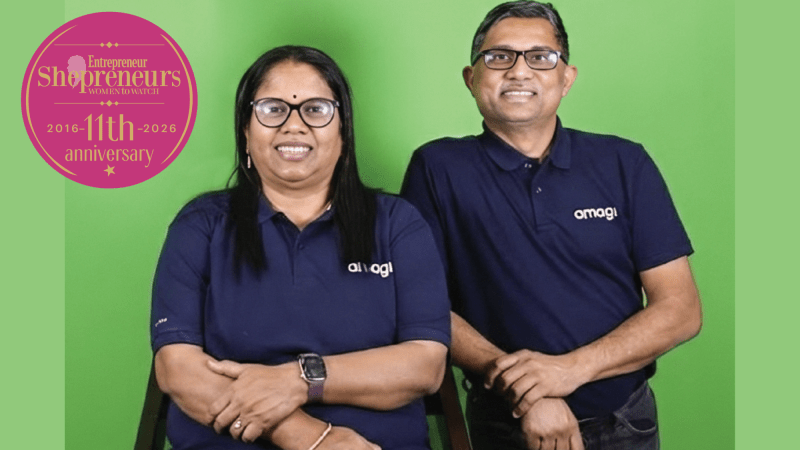
[R-L] Baskar Subramanian (Managing Director & CEO) and Srividhya Srinivasan (CTO), Co-founders of Amagi
Opinions expressed by Entrepreneur contributors are their own.
You're reading Entrepreneur India, an international franchise of Entrepreneur Media.
Building a business is a calculated risk for many founders. It was also a common path for Baskar Subramanian and Srividhya Srinivasan, shaped by their engineering backgrounds, complementing abilities, and a willingness to challenge tradition.
Subramanian traces their beginnings to the Government College of Technology, Coimbatore, and early careers at Texas Instruments India, where exposure to large-scale systems sparked curiosity about broadcast technology. Later, while co-founding ImpulseSoft, he worked closely on product engineering before the company’s acquisition. “Those experiences showed us how rigid and capital-heavy broadcast infrastructure was,” he said. “We believed modernisation was inevitable.”
Srinivasan’s path combined engineering depth with product innovation and technology marketing. She recalled how working across technical and market-facing roles sharpened her understanding of user needs. “We saw an industry ready for change but constrained by legacy thinking,” she noted. That realisation led them to launch Amagi in 2008 with a cloud-first vision for broadcasters navigating a rapidly evolving media landscape.
“The early idea was simple: make television advertising more efficient. National ad slots were expensive and poorly targeted, leaving regional advertisers underserved,” Subramanian mentioned.
Amagi introduced geo-targeted advertising, enabling region-specific messaging. As the ecosystem evolved, the company expanded into cloud-based broadcast and streaming workflows. “Today, we support over 7,000 channel deliveries across 300+ distributors, process more than 500,000 hours of content, and generate over 26 billion monetised ad impressions annually worldwide,” Srinivasan highlighted.
Investors such as NS Raghavan (Infosys) and the Nadathur Group provided crucial backing, while regional broadcasters experimented with localised ads when the model was still unproven. “Those early adopters helped validate everything,” Subramanian added.
Convincing broadcasters to trust cloud workflows required persistence. Over time, the company pivoted toward streaming and connected TV infrastructure and now serves customers in more than 40 countries, including many of the world’s leading media companies. “Amagi reported about INR 1,109 crore in revenue, growing nearly 30% year-on-year, with improved profitability driven by operating efficiency,” Subramanian said.
Srinivasan also navigated biases common in male-dominated technology spaces. “I chose to let execution speak,” she said. “Competence dissolves doubt.”
As partners and spouses, clarity and trust remain central. Subramanian leads business strategy while Srinivasan drives technology innovation. “We debate as co-founders, not as a couple,” he explained. “Shared values and mutual respect keep us aligned, even in difficult decisions,” she added.
Building a business is a calculated risk for many founders. It was also a common path for Baskar Subramanian and Srividhya Srinivasan, shaped by their engineering backgrounds, complementing abilities, and a willingness to challenge tradition.
Subramanian traces their beginnings to the Government College of Technology, Coimbatore, and early careers at Texas Instruments India, where exposure to large-scale systems sparked curiosity about broadcast technology. Later, while co-founding ImpulseSoft, he worked closely on product engineering before the company’s acquisition. “Those experiences showed us how rigid and capital-heavy broadcast infrastructure was,” he said. “We believed modernisation was inevitable.”
Srinivasan’s path combined engineering depth with product innovation and technology marketing. She recalled how working across technical and market-facing roles sharpened her understanding of user needs. “We saw an industry ready for change but constrained by legacy thinking,” she noted. That realisation led them to launch Amagi in 2008 with a cloud-first vision for broadcasters navigating a rapidly evolving media landscape.