When Trust Faces Scrutiny: The Whole Truth’s Clean Labels Put to the Test
The Whole Truth explains that its labeling choices stem from its efforts to build trust in food and stands against deceptive marketing practices.
The Whole Truth
Opinions expressed by Entrepreneur contributors are their own.
You're reading Entrepreneur India, an international franchise of Entrepreneur Media.
“No gimmicks, no fluffs”. “India’s first 100% clean-label food brand…” This is the premise of The Whole Truth Foods.
And it has worked for the seven-year-old startup too – revenue hovering above INR 200 crore in FY 25 and a mammoth USD 51 million series D funding.
With trust being the key proposition, any hint of scrutiny is likely to hit much harder than usual. That is why the recent glare from the Food Safety and Standards Authority of India (FSSAI) and Advertising Standards Council of India (ASCI) spotlighted the need for more transparency within an emerging industry, and of course, putting the brand’s claim to ultimate test.
Heart of the matter is the recent media report which said that the FSSAI had issued a show-cause notice to The Whole Truth over labelling its chocolate products had “no added sugar.” The allegation is that the brand was using dates as sweeteners while saying that no sugar was added to its cocoa items.
The FSSAI says [pdf] non-addition of sugars (a) Claims regarding the non-addition of sugars to a food may be made if the following conditions are met, namely:-
(i) no sugars of any type have been added to the food (Examples: sucrose, glucose, honey, molasses, corn syrup, etc.);
(ii) the food contains no ingredients that contain sugars as an ingredient (Examples: jams, jellies, sweetened chocolate, sweetened fruit pieces, etc.);
(iii) the food contains no ingredients containing sugars that substitute for added sugars (Examples: non-reconstituted concentrated fruit juice, dried fruit paste, etc.); and
(iv) the sugars content of the food itself has not been increased above the amount contributed by the ingredients by some other means (Example: the use of enzymes to hydrolyse starches to release sugars).
(b) Claims regarding the non-addition of sugars to a food may also be made, where sugars are naturally present in the food, and in such case the following indication shall also appear on the label.
A separate report said that the ASCI looked into claims on some of its whey products wherein the startup had mentioned “cleanest, lightest” and “the cleanest most easily digestible protein on mother earth.”
The whole truth
“At The Whole Truth, our mission is to rebuild trust in food. We do this by declaring all ingredients on the front of pack – never hidden at the back in microscopic font. And by communicating only about what we have put inside the product, and what we’ve kept out. Not about what this shall do for you, like make you taller or lighter or better. Because this is how brands misuse the ‘health halo’, and we stand against it,” the company said in a statement to Entrepreneur India.
The company further disclosed that it received a query on one pack two years ago from the ASCI.
“We demonstrated to ASCI that we were in fact cleanest and lightest by comparing our ingredients with those of competitors. As a subtext, we used to write “Cleanest on Mother Earth” – but since our competitive data was for India, we removed this line. Not to mention, within a year of launch, so many competitors copied us, that we couldn’t any more say that we are cleanest (because now others had a similar product). So later we voluntarily changed that line across all packs,” it added.
The company also addressed the “no added sugar in chocolates” debate –
“We use Dehydrated Dates Powder. We take whole dates, chop them, dry them, and grind them into a powder. This is fundamentally different from how most of the industry makes date powder. They make date paste, turn it into a syrup, and then get a powder that is largely sugar. Our date powder is rich in fibre and micronutrients. In fact, we got it tested and it has a Glycemic Index of 43. That’s closer to Boiled Carrots (GI 39) and Apples (GI 42) than Sugar (GI 65). Globally, where chocolates like ours exist, this matter is clear and settled. In the US you will find date sweetened products claiming No Added Sugar. And we’ve been interacting with the Indian regulator to clarify the same. But as you’d imagine, this process takes time. And while it gets done, it was indicated to us to write ‘sweetened with dates’ instead of ‘no added sugar’. We have now made that change. And we continue to co-ordinate with the regulator to update the regulation. Because we still believe we are right.”
The company also highlighted that it explicitly mentions what is in their products. Like in the case of snacks, it says, it has mentioned whole dates.
“We don’t write what this will do for your body. That’s where the health halo lives, and we stay out of it… We don’t hide behind regulations. We proactively interact with the regulator to update them. Engaging with the regulator openly is exactly who we are. We’ve shared our formulation, got independent testing done, and updated our packaging. That’s the whole truth,” it concluded.
Healthy industry
In the last few years, there’s a rising interest in healthy food from consumers. Several influencers across social media platforms are now raising awareness about the ingredients in the packaged products.
A lot of conventional companies have come under scanner for deceptive marketing tactics. Back in 2023, Revant Himatsingka, widely known as FoodPharmer, came under the spotlight for posting a video about Bournvita’s high sugar content and color usage. The influencer was issued a legal notice though Bournvita reportedly reduced its added sugar content.
In the meantime, several food and beverage startups such as Farmley, Open Secret, Happilo, Yogabar and Slurrp Farms have emerged tapping into a growing health-conscious customer base in the country. Recently, FMCG giant Marico acquired True Elements. According to a GrandView Horizon report, India’s healthy snacks market is set to hit a revenue of USD 8,183.3 million by 2033 at a CAGR of 8.1%.
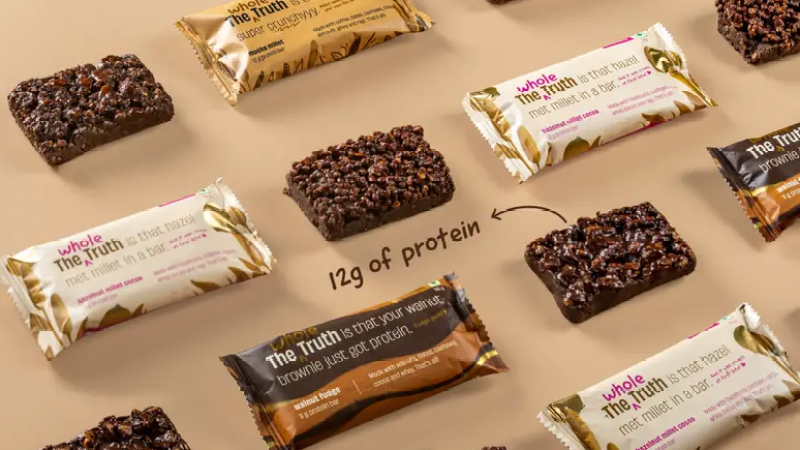
Founded in 2019 by former Unilever executive Shashank Mehta, The Whole Truth is among the top brands to operate in the clean-label space. Its portfolio includes snackbars, cocoa bars, and protein powders, among others.
Earlier this year, the startup raised about $51 million in a Series D funding round led by Sofina and Sauce.vc. Before this round, it had raised $15 million in a Series C funding round led by Sofina and with participation from Z47, Peak XV Partners, and Sauce.vc. Earlier stage investors include names such as Nithin Kamath, Jaydeep Barman, and Sriharsha Majety among others.
According to Entrackr, the company’s revenue from operations grew 232% to INR 216 crore in FY25. The company’s losses, however, increased 17% to INR 28 crore in FY25. Its ROCE and EBITDA margin were at -14.85% and -13.43%, respectively.
That said, India’s health food sector is still at a nascent stage. The rising consumer interest and advent of new-age startups backed by VC money is also compelling the regulators to re-evaluate the industry, especially nudging for more transparency and cracking down on deceptive marketing. Any hyperbole must go through the vetting process. Moreover, updated and standardized labelling will help new-age startups to flourish in the longer-term.
“No gimmicks, no fluffs”. “India’s first 100% clean-label food brand…” This is the premise of The Whole Truth Foods.
And it has worked for the seven-year-old startup too – revenue hovering above INR 200 crore in FY 25 and a mammoth USD 51 million series D funding.
With trust being the key proposition, any hint of scrutiny is likely to hit much harder than usual. That is why the recent glare from the Food Safety and Standards Authority of India (FSSAI) and Advertising Standards Council of India (ASCI) spotlighted the need for more transparency within an emerging industry, and of course, putting the brand’s claim to ultimate test.