TIS 2026: Global VC Outlook: Betting on the Next Big Wave
VCs discuss founders can raise narratives, traction, and metrics, and navigate through the AI challenge.
Entrepreneur India
Opinions expressed by Entrepreneur contributors are their own.
You're reading Entrepreneur India, an international franchise of Entrepreneur Media.
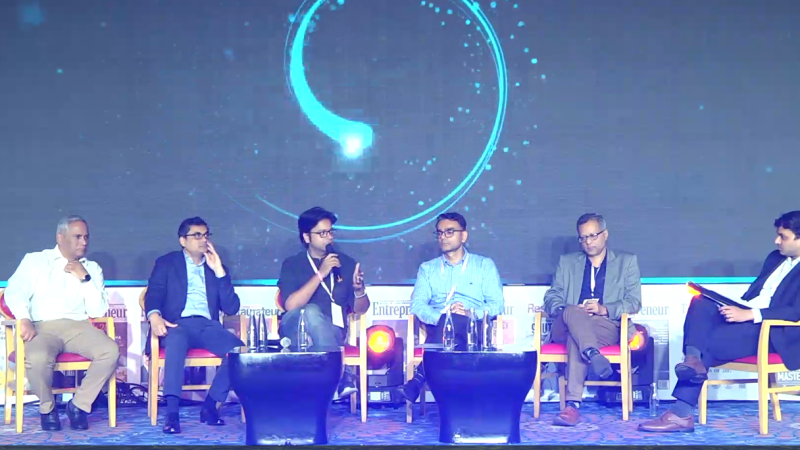
The Entrepreneur Tech & Innovation Summit 2026, held in Bengaluru last month, hosted multiple sessions on the impact of technology across sectors, including what the next wave of Indian Venture Capital ecosystem look like in the near future.
Led by Ashish Kumar, Partner at Bain & Company, the panel featuring Vineet Rai (Aavishkaar Group), Imran Jafar (Gaja Capital), Krishna Ramachandran (TVS Capital), Abhishek (Kae Capital), Ashish Kumar (Fundamentum) and Somshubhro Pal Choudhury (Bharat Innovation Fund) discussed a wide range of topics including the ongoing ‘Deep Tech’ revolution and how has the Indian entrepreneur matured over the years.
The conversation kicked off with an overview of the ecosystem and opportunities. For Rai, things are going to be more challenging in the coming years as the easy wins of the past decade have been exhausted.
“I think we have exhausted the obvious… The whole idea that you can actually create efficiencies at scale with what we have has been used… but now there is a need for us to look beyond the obvious,” he said while stressing the need to focus on new areas such as climate, defense, and spacetech.
“There has been a little bit more move away from carbon towards solutions that will probably keep the world on,” he noted while highlighting the ongoing volatility. “The volatility is so high today that we cannot really believe the truth of today is the truth of tomorrow,” Rai cautioned.
While acknowledging new sectors, especially deeptech, Choudhury highlighted that there should be a framework for investors on measuring these bets. He proposed three categories such as deep science, hardware tech, and advanced software or AI.
“Deep tech is an overused word,” Choudhury explained. “Hardcore technical founder[s], we cannot expect them to immediately transform themselves into a CEO.” He added that his fund is making efforts to ensure that “a chief business officer or somebody business-centric role is either getting hired before our investment or right after.” This pragmatism, according to him, is critical for shrinking the distance between scientific breakthroughs and building products for markets.
As expected, the panelists also addressed the challenge of AI. Abhishek highlighted that AI is new and complicated, and many are yet to truly understand its full potential. “AI is a beast that nobody understands, it’s very new,” he commented.
Ramachandran’s take on AI is that the companies who move from simple applications to “behaving almost like an infrastructure” will last longer. He also highlighted the emergence of “physical AI.”
“India’s private equity and venture capital is roughly 33 billion dollars a year, right? 1/4th of that would be you know mid-market. And if you look at growth investing and buyout investing mid-market companies account for 2/3rds of both. So the market exists, we think we need more specialized investors to focus on that and also I think we need a greater appreciation at the earlier stages of what it takes to you know meet the criteria of that stage so that we can have outsized outcomes in public markets and so on which are then more visible to the world and that will attract scale capital to the country,” he said.
“…we invested in Fractal Analytics which went public, this was our in our view the picks and shovels at the growth stage to participate in the AI wave. The AI wave is very real. It is true that if you are a AI first startup in the valley, the probability of getting funded and getting funded early and at scale is much higher than if you were in India. But you know India always operates with a lag and what used to take, let’s say in the SaaS world a five to six year lag has become a two-year lag…” Jafar said.
Stay tuned to this space to watch the full conversation.
The Entrepreneur Tech & Innovation Summit 2026, held in Bengaluru last month, hosted multiple sessions on the impact of technology across sectors, including what the next wave of Indian Venture Capital ecosystem look like in the near future.
Led by Ashish Kumar, Partner at Bain & Company, the panel featuring Vineet Rai (Aavishkaar Group), Imran Jafar (Gaja Capital), Krishna Ramachandran (TVS Capital), Abhishek (Kae Capital), Ashish Kumar (Fundamentum) and Somshubhro Pal Choudhury (Bharat Innovation Fund) discussed a wide range of topics including the ongoing ‘Deep Tech’ revolution and how has the Indian entrepreneur matured over the years.
The conversation kicked off with an overview of the ecosystem and opportunities. For Rai, things are going to be more challenging in the coming years as the easy wins of the past decade have been exhausted.