Government Grants INR 105 Cr to Dhruva Space for Satellite Project
Project Garud focuses on developing a flat-pack 500 kg-class satellite platform designed for large-scale constellation deployments.
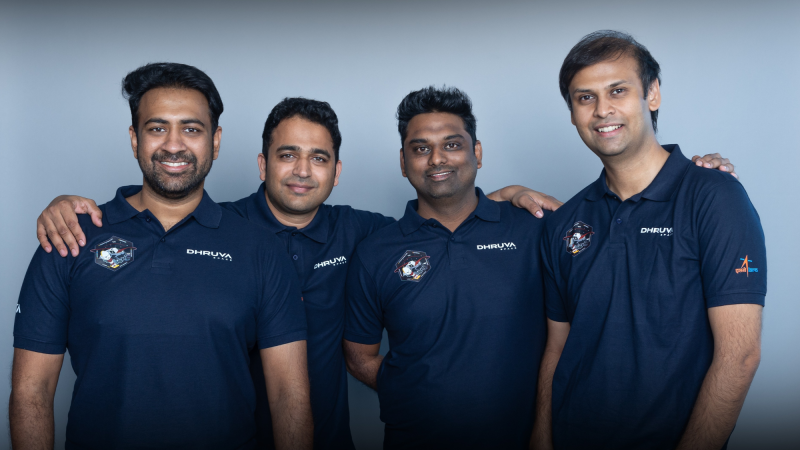
Dhruva Space Founders
You're reading Entrepreneur India, an international franchise of Entrepreneur Media.
The Government of India has extended INR 105 crore to Hyderabad-based Dhruva Space under its Research, Development & Innovation Fund (RDIF) to support Project Garud, a next-generation satellite platform programme. The initiative aims to strengthen India’s indigenous space infrastructure and accelerate its ambitions of becoming a global space power.
Project Garud focuses on developing a flat-pack 500 kg-class satellite platform designed for large-scale constellation deployments. The platform is positioned to bridge the gap between smaller experimental satellites and larger traditional systems, offering a balance between payload capacity, scalability, and launch efficiency. It is expected to support a wide range of applications, including telecommunications, national security, Earth observation, and emerging data-driven services.
According to Dhruva Space, it is among the first companies to receive support under the RDIF initiative, marking a step forward in building a competitive commercial space ecosystem in India. The programme aims to shift satellite development from customised builds to a standardised, production-oriented model, enabling faster deployment and improved manufacturing efficiency.
“Project Garud represents the industrialisation of satellite manufacturing from India,” said Abhay Egoor, CTO and co-founder of Dhruva Space. “The global market is rapidly moving toward constellation-scale deployments, but the supply side for reliable, production-ready spacecraft platforms remains constrained.”
The platform introduces a flat-pack architecture that allows efficient launch stacking and faster system integration, making it suitable for large-scale deployments. It is also expected to serve as a foundational layer for future missions across low Earth orbit (LEO), medium Earth orbit (MEO), and geostationary orbit (GEO).
The project seeks to address a key gap in India’s space ecosystem by developing an indigenous, production-ready satellite platform in the 300–500 kg range. Current systems are often custom-built, resulting in longer development timelines and limited reusability.
As part of the programme, Dhruva Space will also set up infrastructure and processes for high-volume satellite manufacturing. The company is targeting a production capacity of up to two satellites per day, translating to an annual output of around 500 to 600 satellites.
“Through RDIF, Dhruva Space is building an indigenous satellite platform and manufacturing ecosystem capable of supporting high-volume deployment requirements,” Egoor added. “Our objectives are to build satellites for our own missions and position the company as a globally competitive spacecraft OEM.”
The funding was formalised on May 13, 2026, in New Delhi during the first fund disbursement under the government’s broader RDI scheme. The programme builds on Dhruva Space’s existing capabilities across satellite platforms and subsystems, with the aim of advancing multiple technologies toward flight readiness and supporting both domestic and global markets.
The Government of India has extended INR 105 crore to Hyderabad-based Dhruva Space under its Research, Development & Innovation Fund (RDIF) to support Project Garud, a next-generation satellite platform programme. The initiative aims to strengthen India’s indigenous space infrastructure and accelerate its ambitions of becoming a global space power.
Project Garud focuses on developing a flat-pack 500 kg-class satellite platform designed for large-scale constellation deployments. The platform is positioned to bridge the gap between smaller experimental satellites and larger traditional systems, offering a balance between payload capacity, scalability, and launch efficiency. It is expected to support a wide range of applications, including telecommunications, national security, Earth observation, and emerging data-driven services.
According to Dhruva Space, it is among the first companies to receive support under the RDIF initiative, marking a step forward in building a competitive commercial space ecosystem in India. The programme aims to shift satellite development from customised builds to a standardised, production-oriented model, enabling faster deployment and improved manufacturing efficiency.

Entrepreneur Staff • Editor
Entrepreneur Staff
For more than 30 years, Entrepreneur has set the course for success for millions of... Read more