The Era of the Automation: How Embodied AI is Joining the Household
Physical robots are learning to navigate chaotic household environments as developers advance perception, prediction, and motor-control technologies.
.
Opinions expressed by Entrepreneur contributors are their own.
You're reading Entrepreneur India, an international franchise of Entrepreneur Media.
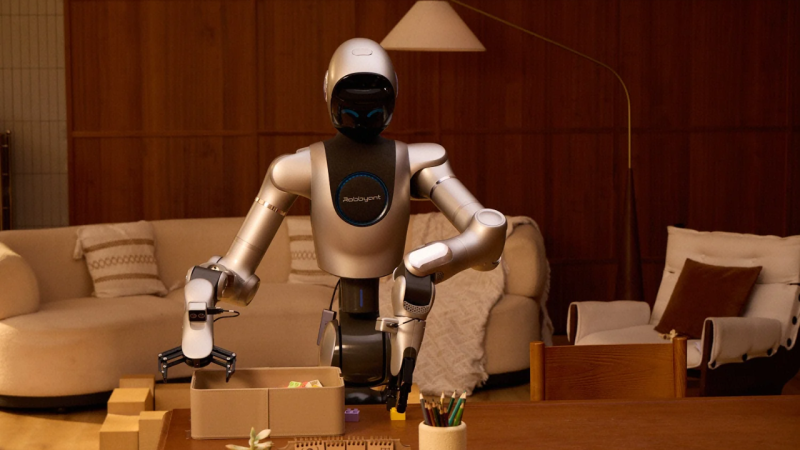
Imagine a home assistant robot identifying objects scattered across a living room, responding to a request to organize them, and adapting as someone moves a chair into its path. These everyday tasks illustrate the challenges developers are working to address as artificial intelligence moves beyond screens and into physical spaces.
Artificial intelligence is moving into real-world living spaces. For years, AI systems were disembodied systems that handled analytical work and digital tasks. But today, physical hardware is learning to move through dynamic, three-dimensional environments, and the idea of the home robotic assistant, once an SF trope, may no longer belong to a far-flung future.
Learning to Navigate Unstructured Spaces
A home robot, unlike its industrial counterpart, faces several challenges as it attempts to complete its duties, including moving around pets, scattered toys, and even shifting furniture. Overcoming these hurdles means building a generalizable intelligence that can transfer across unpredictable real-world conditions. And unlike industrial robots in controlled environments that follow set instructions, any robot that must exist in a normal household needs to be responsive to changing surroundings and highly adaptable.
Some of the areas in which domestic robots would be most useful include completing daily chores, organizing household items, and performing general home management. But such responsibilities would require systems that can perceive surroundings, anticipate cause and effect, and carry out precise physical acts. Then there is the cost barrier. One way to lower production costs is to use reusable intelligence across different robot bodies, which could potentially lead to less duplicated tech development and better scalability. This approach could also simplify aspects of development across hardware designs. Market projections point in the same direction: the global personal and household service robots market is expected to grow from $22.1 billion in 2026 to $90.9 billion by 2033, according to Grand View Research.
Developing Capabilities Across Robot Bodies
To develop AI capabilities that can operate across different physical robot bodies, a growing number of companies in the industry are exploring innovative solutions. Among them, Robbyant, an embodied AI company under Ant Group, has introduced LingBot 2.0, an embodied-native, full-stack technology system spanning 3D spatial perception, environmental prediction, and motor control, working toward the goal of “building one brain for all robots.” The broader development goal is to support different robotic hardware formats. Currently, the firm is sharing its ongoing developments and technical progress across its social media platforms.
Robbyant’s robotic architecture centers on three areas: perception, environmental prediction, and motor control. On the perception side, LingBot-Depth 2.0 & LingBot-Vision models offer 3D spatial awareness capabilities designed to help robots identify items and chart spatial boundaries. For reasoning, the Video and World 2.0 models are designed to model dynamic environments and predict how situations may evolve as objects move or interactions unfold. And, finally, the VLA 2.0 models focus on translating visual information and language instructions into robot actions for physical tasks. These areas of development are relevant to household challenges such as recognizing an object, responding to a changed furniture layout, and manipulating an item in response to a request.
The Road to Adoption
For broader adoption, machines must demonstrate that they can complete useful tasks in the same unstructured, unpredictable environments described earlier, such as cluttered living rooms, shifting furniture, and pets underfoot, rather than only in controlled settings. By open-sourcing the basic models and publishing technical findings, Robbyant is offering outside researchers the chance to review and build on its work across these areas of embodied AI.
Additionally, the company’s open collaboration can give researchers access to models and technical resources that support further experimentation. As embodied AI technologies continue to mature, reusable capabilities could help reduce duplicated development work and broaden the range of tasks robots can perform. For household applications, progress will depend on how well these capabilities translate into practical assistance with everyday chores and home management. Underscoring this momentum, the broader embodied AI market is projected to grow from $4.44 billion in 2025 to $23.06 billion by 2030, according to MarketsandMarkets, providing a wider market context for the development of full-stack technology systems such as LingBot 2.0.
Imagine a home assistant robot identifying objects scattered across a living room, responding to a request to organize them, and adapting as someone moves a chair into its path. These everyday tasks illustrate the challenges developers are working to address as artificial intelligence moves beyond screens and into physical spaces.
Artificial intelligence is moving into real-world living spaces. For years, AI systems were disembodied systems that handled analytical work and digital tasks. But today, physical hardware is learning to move through dynamic, three-dimensional environments, and the idea of the home robotic assistant, once an SF trope, may no longer belong to a far-flung future.
Learning to Navigate Unstructured Spaces
A home robot, unlike its industrial counterpart, faces several challenges as it attempts to complete its duties, including moving around pets, scattered toys, and even shifting furniture. Overcoming these hurdles means building a generalizable intelligence that can transfer across unpredictable real-world conditions. And unlike industrial robots in controlled environments that follow set instructions, any robot that must exist in a normal household needs to be responsive to changing surroundings and highly adaptable.